
Last reviewed: July 2026
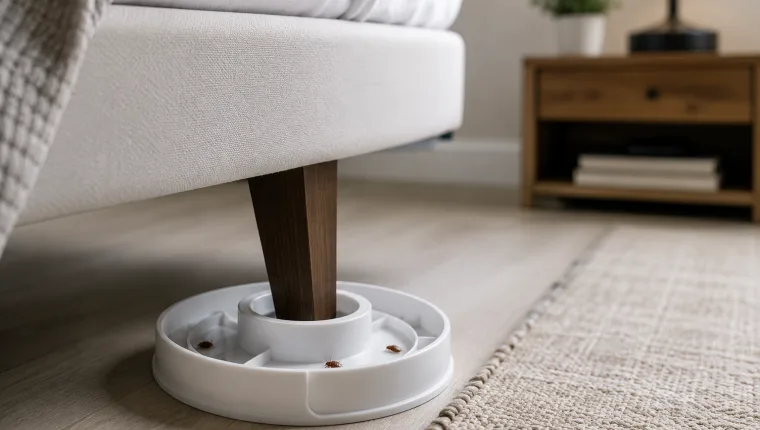
A bed bug interceptor is a passive pitfall monitor placed beneath the legs of a bed, couch, chair, or other furniture. Bed bugs attempting to climb onto or leave the furniture enter the device and become trapped inside its smooth-sided channels.
Interceptors can help:
- Detect low-level bed bug activity
- Confirm that a suspicious insect is present
- Show whether bed bugs are moving between furniture and the floor
- Reduce access to an isolated bed or couch
- Measure changes during treatment
- Monitor for activity after professional control
They do not kill every bed bug, eliminate eggs
, replace an inspection, or prove that a room is free of bed bugs when no insects are captured.
The main factor determining whether an interceptor works is whether the furniture has been correctly isolated. Every bed or sofa leg must sit inside a suitable device, and sheets, blankets, walls, curtains, power cords, headboards, stored belongings, and nearby furniture must not create an alternative bridge.
For a complete examination of the sleeping area, use our bed bug inspection guide. When physical evidence has already been confirmed, see our complete bed bug identification and control guide.
- What Is a Bed Bug Interceptor?
- How Bed Bug Interceptors Work
- Bed Bug Interceptors vs. Sticky Traps
- When Bed Bug Interceptors Are Useful
- How to Choose a Bed Bug Interceptor
- How to Place Bed Bug Interceptors Correctly
- Using Interceptors Under Couches and Chairs
- How Often to Check Bed Bug Interceptors
- How to Inspect and Clean an Interceptor
- How to Interpret Bed Bug Captures
- Why an Empty Interceptor Does Not Rule Out Bed Bugs
- Common Interceptor Mistakes
- Can You Make a DIY Bed Bug Interceptor?
- Interceptors Are Not a Complete Bed Bug Treatment
- When to Call a Bed Bug Professional
- Bed Bug Interceptor Monitoring Log
- Frequently Asked Questions
- What is a bed bug interceptor?
- Do bed bug interceptors work?
- Can interceptors prevent bed bug bites?
- Where should bed bug interceptors be placed?
- How long should interceptors remain in place?
- How often should bed bug interceptors be checked?
- Why is my interceptor empty?
- Can bed bugs escape from interceptors?
- Do I need an interceptor under every bed leg?
- Should the bed be moved away from the wall?
- Can bedding touch the floor?
- Can interceptors be used under a couch?
- Can I use sticky traps instead?
- Do interceptors contain pesticides?
- Can I put diatomaceous earth inside an interceptor?
- Can I make my own interceptor?
- Does one captured bed bug confirm an infestation?
- Are interceptors useful after heat treatment?
- When should I call an exterminator?
What Is a Bed Bug Interceptor?
A bed bug interceptor is usually a round or square plastic device
with a central well for the furniture leg and one or more outer channels.
The basic design uses two types of surfaces:
- A textured exterior that bed bugs can climb
- A smooth or treated interior that makes escape difficult
The furniture leg normally rests inside the center section. Bed bugs moving from the floor toward the furniture fall into the outer channel. In designs with a separate inner channel, bed bugs leaving the furniture may be captured closer to the furniture leg.
Interceptors are considered passive monitors because they generally do not contain carbon dioxide, heat, pheromones, food, or another active attractant. They rely on normal bed bug movement toward or away from a sleeping or resting host.
How Bed Bug Interceptors Work
Bed bugs crawl between hiding places and locations where people rest. They can climb many textured surfaces but have difficulty escaping from sufficiently smooth, clean pitfall walls.
An interceptor takes advantage of this behavior:
- The bed bug approaches the furniture.
- It climbs the textured outer wall.
- It falls into a smooth channel.
- It cannot easily climb back out.
- The trapped insect can be collected and identified.
Interceptors placed under furniture legs may capture bed bugs traveling in either direction.
| Capture location | Possible interpretation | Important limitation |
|---|---|---|
| Outer channel | The bed bug may have approached the furniture from the floor or surrounding room | The insect may also have fallen or been displaced into the device |
| Inner channel | The bed bug may have moved down the furniture leg from the bed, couch, or chair | Device designs differ, and the capture route may not always be certain |
| Several devices around one bed | The location with the greatest captures may indicate a frequently used travel route | Counts are influenced by placement, furniture design, bridges, and cleaning |
| No captures | No bed bug entered that interceptor during the monitoring period | Does not prove that no bed bugs are present elsewhere |
Bed Bug Interceptors vs. Sticky Traps
Bed bug interceptors are different from ordinary adhesive insect traps.
| Feature | Bed bug interceptor | General sticky trap |
|---|---|---|
| Capture method | Bed bugs fall into a smooth pitfall channel | Insects become attached to an adhesive surface |
| Typical placement | Under furniture legs | Along walls or insect travel routes |
| Furniture isolation | Can become part of an isolated-bed setup | Does not prevent insects from climbing furniture legs |
| Bed bug suitability | Designed around bed bug climbing behavior | General sticky traps are not considered reliable primary bed bug monitors |
| Maintenance | Requires cleaning and preservation of smooth internal surfaces | Requires replacement when dusty, full, or no longer sticky |
| Child and pet concerns | Can crack, tip, or become contaminated | Adhesive can contact skin, hair, paws, or fur |
The EPA distinguishes bed bug interceptors from general sticky traps and provides instructions for both commercial and homemade pitfall-style devices.
When Bed Bug Interceptors Are Useful
Confirming a Suspected Infestation
Interceptors can capture a physical specimen when the only initial evidence is
:
- Unexplained stains
- Possible cast skins
- Nighttime crawling sensations
- An uncertain photograph
- Recurring but unconfirmed sightings
A captured specimen is more useful for identification than a photograph of a skin reaction.
Detecting Low-Level Activity
Early infestations may contain few insects and limited physical evidence. Interceptors can remain in place continuously and monitor bed bug movement when no inspector is present.
Low-level infestations may require at least a week or longer to produce a capture. A short overnight test is not enough to rule out bed bugs.
Measuring Treatment Progress
Interceptor counts can be recorded before and after treatment. A general downward trend may support evidence that control is working.
Counts should be interpreted with:
- Visual inspections
- New or old fecal spotting
- Live insects
- Eggs and cast skins
- Furniture and room distribution
- Treatment dates
Post-Treatment Monitoring
The EPA includes interceptors within an Integrated Pest Management program and recommends monitoring devices to help determine whether bed bugs have been eliminated.
Post-treatment monitoring is important because:
- Eggs may hatch after an initial service
- Hidden bed bugs may survive
- Adjoining rooms or units may remain affected
- A new introduction can occur
- Old physical evidence may remain after successful control
How to Choose a Bed Bug Interceptor
Interceptors are not identical. Compare the device dimensions and furniture before purchasing.
| Feature | Why it matters |
|---|---|
| Center-well dimensions | The furniture leg must fit completely without resting on the surrounding channel |
| Weight capacity | The device must support the occupied bed, couch, or chair without cracking or deforming |
| Interior surface | The trapping channel must remain sufficiently smooth for the design to work |
| Exterior texture | Bed bugs must be able to climb the exterior and enter the pitfall |
| Channel visibility | A light interior can make small nymphs and debris easier to inspect |
| Crack resistance | Thin plastic can fail under heavy furniture or uneven flooring |
| Cleaning access | The full channel should be accessible for examination and gentle cleaning |
| Floor protection | A suitable pad may be needed to protect wood, tile, carpet, or other flooring without creating an escape bridge |
Measure Furniture Legs Before Buying
Measure:
- Leg width
- Leg length
- Distance between legs
- Furniture weight
- Available clearance beneath the frame
- Floor surface
Large platform beds, furniture with solid bases, pedestal frames, wheels, wide recliners, and floor-level mattresses may not work with standard interceptors.
How to Place Bed Bug Interceptors Correctly
Step 1: Inspect the Furniture
Before isolating a bed or couch, inspect:
- Mattress seams
- Box-spring fabric
- Bed-frame joints
- Headboards
- Screw and bolt holes
- Upholstery seams
- Underside covers
Interceptors do not remove bed bugs already living in the furniture.
Step 2: Place One Device Beneath Every Leg
Each leg must sit completely inside the center well. A missing interceptor leaves an unmonitored route onto the furniture.
Check that:
- The leg does not touch the outer channel
- The device sits flat
- The furniture remains stable
- The plastic does not bend under weight
- The interceptor is not hidden beneath loose fabric
Step 3: Move the Furniture Away From Walls
The EPA recommends moving the bed at least six inches from the wall as part of making the bed an island.
Also separate the furniture from:
- Nightstands
- Curtains
- Radiators
- Wall decorations
- Power cords
- Other furniture
Step 4: Eliminate Bridges
Sheets, blankets, bed skirts, clothing, charging cables, curtains, headboards, and stored objects can allow bed bugs to bypass the interceptors.
Make sure:
- Bedding does not touch the floor
- The headboard does not touch the wall
- Nothing is stored beneath the bed
- Cords do not connect the bed to the floor or wall
- Nearby furniture does not touch the bed
Step 5: Record the Starting Date
Number each device or identify it by location:
- Front left
- Front right
- Rear left
- Rear right
This helps reveal whether one side repeatedly captures more insects.
Using Interceptors Under Couches and Chairs
Bed bugs are not limited to beds. Sofas, recliners, upholstered chairs, and other furniture where people remain stationary can support infestations.
Place interceptors beneath every compatible leg and inspect:
- Cushion seams
- Zippers
- Furniture frames
- Underside fabric
- Reclining mechanisms
- Wall contact points
Some couches have hidden central supports or broad bases. Every structural contact with the floor must be considered. An interceptor beneath four visible legs will not isolate furniture resting on an unnoticed central support.
How Often to Check Bed Bug Interceptors
Inspection frequency depends on the purpose of monitoring.
| Monitoring situation | Practical inspection frequency |
|---|---|
| New suspected infestation | Check daily at first without repeatedly disturbing the furniture |
| Active treatment program | Check at least weekly or according to the professional plan |
| Low-level detection | Leave continuously in place and evaluate over several weeks |
| Post-treatment monitoring | Check regularly for an extended period after visible activity stops |
| Long-term preventive monitoring | Inspect during routine cleaning and after travel, visitors, or furniture changes |
The EPA recommends checking interceptors daily at the beginning of an isolated-bed setup and continuing to use them for long-term post-control monitoring. Rutgers guidance commonly recommends examinations every seven to ten days during active control.
How to Inspect and Clean an Interceptor
Use:
- A flashlight
- A hand magnifier
- Fine-point tweezers
- A small specimen container
- Clear tape
- A soft cloth or brush
Inspect carefully for:
- Adult bed bugs
- Pale early-stage nymphs
- Cast skins
- Eggs
- Other insects
- Dust, hair, lint, and debris
Young nymphs may be only 1.5 to 2 millimeters long and can resemble pale debris.
Cleaning Steps
- Photograph or record captured insects.
- Preserve suspected bed bugs for identification.
- Remove debris with a soft cloth or brush.
- Clean the device according to the manufacturer’s instructions.
- Allow it to dry completely.
- Restore any permitted talcum or surface treatment.
- Replace the furniture leg in the center.
Do not coat the device with oils, petroleum jelly, pesticide dust, household cleaners, or another substance unless the manufacturer or validated design specifically directs it.
How to Interpret Bed Bug Captures
One Captured Bed Bug
One correctly identified bed bug confirms that the insect is present or recently traveled through the monitored area. It does not reveal:
- The total population
- How long the infestation has existed
- Whether the insect came from another room
- Whether the furniture contains a harborage
Expand the inspection and preserve the specimen.
Several Nymph Stages
Capturing nymphs of different sizes may indicate that bed bugs have been feeding and developing nearby.
Inspect for:
- Eggs
- Cast skins
- Fecal spots
- Adults
- Furniture harborages
Increasing Captures
An increase may result from:
- A growing infestation
- Bed bugs being disturbed by treatment
- Newly hatched nymphs
- A change in where people sleep
- Removal of an alternative route
- Movement from an adjoining room or unit
Counts should be reviewed with treatment dates and inspection findings.
Declining Captures
A declining trend is encouraging but does not independently prove elimination. Continue monitoring for new insects and physical evidence.
Why an Empty Interceptor Does Not Rule Out Bed Bugs
No monitor has perfect detection. An interceptor may remain empty because:
- The infestation contains very few insects
- Bed bugs are already living inside the bed or couch
- The furniture touches a wall or another object
- Bedding creates an alternative route
- The occupant has not slept in the furniture consistently
- The furniture leg does not fit properly
- The channel is dirty or damaged
- Bed bugs are hiding in another room
- The monitoring period was too short
- The suspected pest is not a bed bug
Low-level activity may require a week or longer to detect. Inspection should combine monitors with a physical examination of furniture, walls, and belongings.
Common Interceptor Mistakes
- Using fewer devices than furniture legs
- Allowing bedding to touch the floor
- Keeping the bed against the wall
- Leaving boxes beneath the bed
- Using a device too small for the furniture leg
- Allowing dust and hair to fill the channel
- Cleaning the surface with a product that leaves residue
- Checking for only one night
- Assuming no capture means no infestation
- Failing to inspect couches and chairs
- Discarding a captured specimen before identification
- Using interceptors as the only treatment
Can You Make a DIY Bed Bug Interceptor?
The EPA provides a homemade interceptor design using two sturdy plastic containers, textured tape, and a light application of talcum powder.
A DIY version must meet several conditions:
- The smaller container must support the furniture leg.
- The larger container must create a surrounding pitfall.
- The exterior must be climbable.
- The interior must remain smooth.
- The device must support the weight safely.
- The furniture must remain stable.
Homemade devices may crack, tip, deform, scratch flooring, or fail under heavy furniture. Commercial interceptors may offer more consistent dimensions and load capacity.
Interceptors Are Not a Complete Bed Bug Treatment
Interceptors do not directly eliminate:
- Eggs attached inside furniture joints
- Bed bugs already hiding in the mattress or frame
- Bed bugs inside walls
- Activity on furniture without legs
- Infestations in adjoining rooms or apartments
A complete treatment may combine:
- Vacuuming
- Dryer treatment of appropriate textiles
- Steam
- Encasements
- Interceptors
- Professional heat treatment
- EPA-registered pesticides
- Repeated inspection and follow-up
Compare professional options in our bed bug treatment cost guide and bed bug heat treatment cost guide.
When to Call a Bed Bug Professional
Arrange professional inspection when:
- An interceptor captures a confirmed bed bug
- Several life stages are captured
- More than one room shows activity
- A couch or chair may be infested
- The property is an apartment or multifamily building
- DIY inspection cannot locate the harborages
- Captures continue after treatment
- Identification remains uncertain
Ask the provider:
- How will interceptor counts be incorporated into the inspection?
- Which furniture should be monitored?
- How frequently should devices be checked?
- How long should they remain installed?
- What result will be used to declare control?
- Will adjoining rooms or units be inspected?
- Are interceptors included in the treatment price?
Bed Bug Interceptor Monitoring Log
| Date | Device location | Inner-channel captures | Outer-channel captures | Life stage | Cleaned |
|---|---|---|---|---|---|
Frequently Asked Questions
What is a bed bug interceptor?
It is a passive pitfall monitor placed beneath a furniture leg to capture bed bugs moving between the furniture and the floor.
Do bed bug interceptors work?
They can effectively detect and trap bed bugs when the furniture is correctly isolated and every leg is placed in a suitable device.
Can interceptors prevent bed bug bites?
They may reduce access from the floor to an isolated bed, but they cannot prevent bites from bed bugs already living in the bed, frame, headboard, or bedding.
Where should bed bug interceptors be placed?
Place one beneath every leg of the bed, couch, chair, or other compatible furniture being monitored.
How long should interceptors remain in place?
Keep them installed throughout detection, treatment, and post-treatment monitoring. EPA guidance recommends long-term use after control.
How often should bed bug interceptors be checked?
Check daily when monitoring begins and at least weekly during an active treatment program, unless the manufacturer or pest professional directs otherwise.
Why is my interceptor empty?
Bed bugs may be absent, present at very low levels, hiding within the furniture, using another route, or located in another room. An empty device does not prove absence.
Can bed bugs escape from interceptors?
A clean, intact interceptor is designed to make escape difficult. Dust, hair, scratches, residue, cracks, and incorrect setup can reduce performance.
Do I need an interceptor under every bed leg?
Yes. Leaving one leg unprotected creates an alternative route and reduces the value of the setup.
Should the bed be moved away from the wall?
Yes. The bed should be separated from walls, nightstands, curtains, and other objects that can create a bridge.
Can bedding touch the floor?
No. Sheets, blankets, bed skirts, and clothing touching the floor allow bed bugs to bypass the interceptors.
Can interceptors be used under a couch?
Yes, when every leg and floor contact point fits safely inside a suitable device.
Can I use sticky traps instead?
General sticky traps are not equivalent to bed bug interceptors and are not considered reliable primary bed bug monitors.
Do interceptors contain pesticides?
Most commercial pitfall interceptors are passive and pesticide-free. Product designs vary, so review the packaging and instructions.
Can I put diatomaceous earth inside an interceptor?
Do not add pesticide dust unless the product labels and interceptor instructions specifically permit that use. Loose dust can create exposure and identification problems.
Can I make my own interceptor?
Yes. The EPA describes a homemade two-container design, but it must safely support the furniture and maintain appropriate climbing and trapping surfaces.
Does one captured bed bug confirm an infestation?
One correctly identified capture confirms bed bug presence or recent movement but does not reveal the infestation size or exact source.
Are interceptors useful after heat treatment?
Yes. They can help monitor for surviving insects, activity outside the treated area, or a later reintroduction.
When should I call an exterminator?
Contact a qualified professional when a bed bug is captured, several rooms may be affected, repeated captures continue, or the source cannot be located.
Bed bug interceptors are monitoring and supporting control devices, not stand-alone treatments. An empty interceptor does not confirm that a room is free of bed bugs. Treatment decisions should be based on specimens, physical evidence, inspection, and continued monitoring.


