
Last reviewed: July 2026
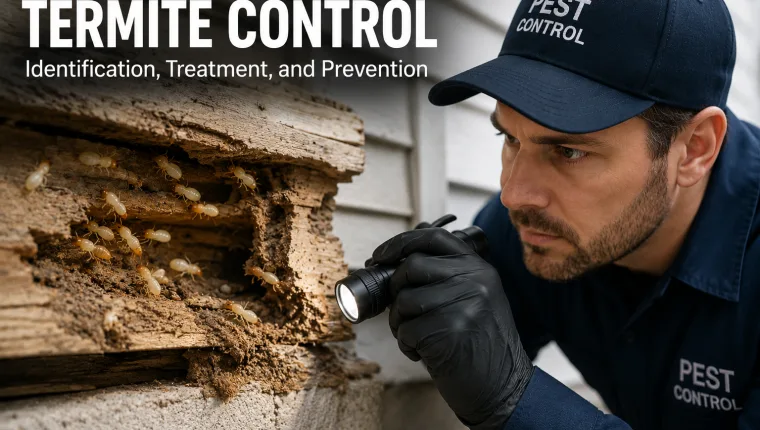
Effective termite control begins by identifying the termite type, locating the activity, evaluating the structure, and selecting a treatment designed for that specific infestation. Subterranean termites are commonly managed with liquid soil treatments, bait systems, or a combination of methods. Drywood termites may require localized wood treatment or whole-structure fumigation. Dampwood termite control often depends heavily on correcting moisture and damaged wood.
There is no single termite treatment that is best for every property. The correct method depends on:
- Termite species
- Location and extent of the infestation
- Building construction
- Foundation type
- Soil conditions
- Accessibility
- Previous treatments
- Moisture and drainage problems
- Local regulations
- Warranty and monitoring requirements
Most active structural termite infestations should be evaluated and treated by a properly licensed termite-control professional. Professional treatments may require specialized equipment, drilling, trenching, soil injection, structural fumigation, restricted-use products, or continuing inspections.
Before approving treatment, request a written report identifying the evidence, suspected termite type, affected areas, proposed methods, preparation requirements, limitations, follow-up schedule, price, and warranty.
If you are comparing the inspection fee before choosing a treatment plan, see our termite inspection cost guide.
Begin with our termite inspection guide when activity has not been confirmed. For pricing by treatment type, see our termite treatment cost guide.
- How Termite Control Works
- Confirm the Pest Before Treatment
- Why Termite Species Changes the Treatment
- Liquid Soil-Applied Termite Treatment
- Termite Bait Systems
- Liquid Treatment vs. Termite Bait Stations
- Direct Wood and Void Treatments
- Drywood Termite Spot Treatment
- Whole-Structure Fumigation
- Preconstruction Termite Treatment
- Postconstruction Termite Treatment
- Termite Treatment Process
- How Long Does Termite Treatment Take to Work?
- How Do You Know Whether Termite Treatment Worked?
- Common Reasons Termite Treatment Fails
- DIY Termite Control vs. Professional Treatment
- Termite Treatment Safety
- How to Prevent Termites
- Termite Warranties and Service Agreements
- How to Compare Termite Control Companies
- Termite Control Decision Checklist
- Frequently Asked Questions
- What is the best termite-control method?
- How do I know which termite treatment I need?
- Can I treat termites myself?
- Do store-bought termite sprays eliminate a colony?
- Are termite bait stations effective?
- How long do termite bait stations take to work?
- How long does liquid termite treatment last?
- Does liquid treatment kill the entire colony?
- Is termite tenting always necessary?
- Does fumigation prevent termites from returning?
- Can termites return after treatment?
- Should termite-damaged wood be replaced immediately?
- Does termite treatment repair damage?
- How often should a home be inspected for termites?
- Are termite warranties worth it?
- What can void a termite warranty?
- How much does termite control cost?
- Should I get more than one termite quote?
- How do I verify a termite-control company?
How Termite Control Works
Termite control is not simply the visible treatment of damaged wood. A useful program should address the termite population, its access to the structure, the conditions supporting the infestation, and the risk of future activity.
A complete termite-control process generally includes:
- Inspecting the structure and accessible surrounding areas
- Confirming termite evidence and identifying the likely termite group
- Determining whether activity appears current or historical
- Evaluating foundation, soil, moisture, wood, and access conditions
- Selecting an appropriate treatment method
- Preparing the property
- Completing treatment according to the product label
- Documenting treated areas and limitations
- Monitoring for continuing or new activity
- Correcting moisture, drainage, wood-contact, and structural conditions
The U.S. Environmental Protection Agency identifies several major termite-control categories, including liquid soil-applied termiticides, termite bait systems, building-material treatments, and wood treatments.
A pesticide used to prevent or treat termite infestations is called a termiticide. EPA-registered termiticide products must meet product-performance and labeling requirements for their registered uses.
Confirm the Pest Before Treatment
Winged ants, carpenter ants, wood-boring beetles, moisture damage, fungal decay, and old termite evidence may be mistaken for an active termite infestation.
Possible termite evidence includes:
- Live workers, soldiers, or swarmers
- Discarded wings
- Mud tubes
- Drywood termite fecal pellets
- Damaged wood
- Blistered or hollow-sounding surfaces
- Termite galleries
- Moisture or soil conditions favorable to termites
No single sign should be interpreted without context.
Damaged wood may remain after an old infestation has been controlled, while active termites may exist inside concealed areas without obvious surface damage.
A general home inspection may identify suspicious evidence, but a dedicated termite or wood-destroying insect inspection is more appropriate when treatment, a real-estate transaction, or a formal report is involved.
See our guides to signs of termites in a house and flying termites and discarded wings.
Why Termite Species Changes the Treatment
| Termite group | Common behavior | Treatment approaches that may be considered |
|---|---|---|
| Subterranean termites | Colonies are generally associated with soil and may enter through foundation gaps, utility routes, mud tubes, or hidden structural connections | Liquid soil treatment, bait systems, direct treatment of accessible activity, moisture correction, and structural prevention |
| Formosan subterranean termites | A highly destructive subterranean termite capable of forming large colonies and, under some conditions, aboveground carton nests | Professional inspection, liquid treatment, bait systems, direct treatment, and evaluation for aerial colonies |
| Drywood termites | Colonies live inside relatively dry wood without maintaining a direct soil connection | Localized wood treatment, removal of infested wood, or whole-structure fumigation depending on distribution |
| Dampwood termites | Usually associated with damp or decaying wood and excessive moisture | Moisture correction, removal or replacement of damaged wood, and localized treatment when needed |
Subterranean Termite Control
Subterranean termites normally travel between a colony associated with soil and a food source containing cellulose. They may enter a building through:
- Foundation cracks
- Expansion joints
- Plumbing and utility penetrations
- Wood-to-soil contact
- Porches and additions
- Crawl spaces
- Hollow masonry
- Hidden construction gaps
Common control options include liquid soil-applied termiticides, bait systems, and selected direct treatments.
Read our subterranean termite identification and control guide.
Drywood Termite Control
Drywood termites live within wood and do not require the same continuing soil connection as subterranean termites. Their colonies may occur inside:
- Framing
- Roof components
- Attic wood
- Window and door frames
- Furniture
- Exterior trim
- Other structural or decorative wood
Localized treatment may be considered when the colony locations are known and accessible. Whole-structure fumigation may be recommended when activity is widespread,
concealed, or distributed through several inaccessible areas.
Subterranean termite soil treatments do not automatically control drywood termites located inside structural wood.
Read our drywood termite guide.
Dampwood Termite Control
Dampwood termites are strongly associated with high-moisture wood. Long-term control frequently depends on correcting:
- Roof leaks
- Plumbing leaks
- Drainage problems
- Wood-to-soil contact
- Damaged siding
- Poor ventilation
- Decaying stumps or structural wood
Pesticide treatment without correcting the moisture source may provide incomplete control.
Liquid Soil-Applied Termite Treatment
Liquid soil treatment is a common method for subterranean termite control. A professional applies an EPA-registered termiticide to selected soil areas beneath or around the structure according to the product label and construction conditions.
The treatment may involve:
- Trenching soil beside the foundation
- Treating soil beneath slabs through drilled access points
- Treating crawl-space foundation areas
- Injecting labeled areas around plumbing penetrations
- Treating hollow masonry or construction voids when permitted
- Correcting gaps in an existing treatment zone
The objective is to establish treated zones where subterranean termites are likely to travel between the soil and structure.
Repellent and Nonrepellent Termiticides
Liquid products may differ in how termites respond to treated soil.
Some products create a treated zone that termites may detect and avoid. Other products are designed so termites travel through treated areas and contact the active ingredient without immediately detecting it.
The product, application volume, soil conditions, construction, termite pressure, and completeness of treatment all influence performance.
Advantages of Liquid Treatment
- May provide relatively rapid control of subterranean termite access
- Can protect treated entry routes around a structure
- May provide residual protection for multiple years
- Can be combined with direct treatment or monitoring
Limitations of Liquid Treatment
- May require drilling, trenching, or access beneath slabs
- Untreated gaps can reduce protection
- Construction features may limit application
- Soil disturbance can affect treated zones
- Landscaping, additions, repairs, or utility work may compromise treatment
- It is not the standard treatment for drywood colonies located inside wood
Ask the company to identify:
- The proposed product
- EPA registration number
- Areas to be treated
- Drilling and trenching locations
- Areas that cannot be treated
- Repair responsibility after drilling
- Warranty and inspection requirements
Termite Bait Systems
Termite bait systems are primarily used for subterranean termites. Stations containing monitoring material are installed in the ground around a structure or, in selected systems, directly over active termite areas.
When termites are detected, a bait containing a slow-acting active ingredient may be introduced according to the registered system instructions.
Workers feed on the bait and can distribute it among colony members. The process depends on termites locating and feeding from the stations.
Advantages of Bait Systems
- Use relatively small quantities of active ingredient
- Require less soil treatment than a full liquid application
- Can provide ongoing monitoring
- May be useful where liquid treatment access is limited
- Can be incorporated into an Integrated Pest Management program
Limitations of Bait Systems
- Termites must find and feed from the stations
- Control may take longer than some liquid treatments
- Stations require continuing inspection and maintenance
- Landscaping or construction may damage or cover stations
- Service agreements may require annual or continuing fees
- Missing scheduled inspections can reduce the value of the system
A bait system is not a set-it-and-forget-it product. The contract should state:
- Number and general placement of stations
- Inspection frequency
- Who owns the stations
- What happens when activity is detected
- Replacement fees
- Annual renewal cost
- Conditions that end the warranty
See our termite bait station guide.
Liquid Treatment vs. Termite Bait Stations
| Factor | Liquid soil treatment | Bait system |
|---|---|---|
| Main approach | Treats soil zones where termites may travel | Uses monitoring stations and slow-acting bait |
| Initial activity | May begin affecting termites soon after contact with treated areas | Depends on termites locating and feeding from stations |
| Installation | May require trenching, drilling, or soil injection | Requires station installation around the structure |
| Monitoring | Periodic inspections remain important | Continuing station inspection is essential |
| Active ingredient quantity | Generally uses a larger treatment volume | Uses small quantities of bait in stations |
| Construction limitations | Access and complete soil treatment may be difficult | Station placement and termite discovery can be limiting factors |
| Continuing cost | May include annual inspection or warranty renewal | Usually includes continuing monitoring and renewal fees |
Some companies recommend a combination of liquid treatment and bait monitoring. The proposal should explain why the combined approach is appropriate and which parts of the structure each method addresses.
Direct Wood and Void Treatments
Direct treatment may be applied to accessible termite galleries, structural wood, wall voids, or other confirmed activity areas.
Possible formulations include:
- Liquids
- Foams
- Dusts
- Injected products
- Borate wood treatments
Direct treatment may be useful when:
- Activity is localized and accessible
- The exact infested wood is known
- Construction prevents complete soil treatment
- A supplemental treatment is needed
- Wood is exposed during construction or renovation
Its main limitation is reach. Treating one visible gallery does not prove that other colonies, galleries, or entry points have been addressed.
Borate Wood Treatments
Borate products may be applied to exposed, unfinished wood when permitted by the label. They are commonly used during new construction, renovation, or treatment of accessible structural wood.
Performance depends on:
- Wood accessibility
- Surface coatings
- Moisture
- Product concentration
- Application coverage
- Termite species and infestation location
A surface application to one accessible piece of wood does not create complete protection for an entire finished structure.
Drywood Termite Spot Treatment
Localized treatment may be considered when a drywood termite infestation appears limited and the colonies can be accurately located.
Possible methods include:
- Drilling and injecting galleries
- Foam or liquid treatment
- Dust treatment
- Heat or cold applied by a qualified provider
- Removing and replacing infested wood
Advantages of Localized Treatment
- May avoid whole-structure fumigation
- Can reduce preparation and displacement
- Targets known activity areas
- May cost less for a genuinely limited infestation
Limitations of Localized Treatment
- Hidden colonies may remain untreated
- Visual inspections cannot access every structural area
- Termite galleries may extend beyond visible evidence
- Several separate colonies may be present
- Continuing monitoring is necessary
A company recommending spot treatment should explain how the affected areas were located and how the property will be monitored afterward.
Whole-Structure Fumigation
Whole-structure fumigation is primarily associated with widespread or inaccessible drywood termite infestations.
The building is enclosed, usually with tarpaulins, and a registered fumigant is introduced by a licensed fumigation company. The process requires strict preparation, occupancy restrictions, monitoring, aeration, and clearance procedures.
See our termite tenting and fumigation guide.
When Fumigation May Be Considered
- Drywood termite activity occurs in several areas
- Colonies are hidden inside inaccessible structural wood
- Localized treatments cannot reliably reach the infestation
- The property has repeated drywood termite activity
- A comprehensive whole-structure treatment is preferred
What Fumigation Does Not Provide
Structural fumigation can control termites present within the enclosed treatment space, but it generally does not leave continuing residual protection against future drywood termite introductions.
Fumigation also does not:
- Repair termite damage
- Correct roof leaks or moisture problems
- Seal future entry routes
- Protect untreated soil from subterranean termites
- Prevent termites from being introduced again
A post-fumigation prevention and inspection plan remains important.
Preconstruction Termite Treatment
Termite protection can be incorporated during construction before concrete slabs, walls, insulation, and finished surfaces limit access.
Preconstruction methods may include:
- Soil treatment before slab placement
- Treatment around foundations and utility penetrations
- Borate treatment of accessible wood
- Physical termite barriers
- Stainless-steel mesh systems
- Termite-resistant construction details
- Installation of monitoring systems
Requirements vary by building code, jurisdiction, construction type, and registered product.
Construction changes after treatment should be documented. Additions, plumbing work, grading, landscaping, and soil removal can compromise previously treated areas.
Postconstruction Termite Treatment
Postconstruction treatment occurs after a building has been completed. It may be preventive or used to control an active infestation.
The technician must work around existing:
- Concrete slabs
- Floor coverings
- Walls
- Landscaping
- Utilities
- Porches and patios
- Crawl spaces
- Occupied areas
This may require drilling, trenching, station installation, direct wood treatment, or access modifications.
The written proposal should state which areas cannot be treated and whether those limitations affect the warranty.
Termite Treatment Process
1. Inspection and Identification
The company documents termite evidence, construction features, moisture conditions, wood contact, previous treatment, and inaccessible areas.
2. Treatment Proposal
The proposal should identify:
- Termite type
- Evidence locations
- Treatment method
- Products
- Application areas
- Preparation requirements
- Limitations
- Price
- Follow-up
- Warranty
3. Property Preparation
Preparation depends on the method. It may involve:
- Providing access to walls and foundation areas
- Moving stored items
- Removing selected floor coverings
- Clearing exterior soil or landscaping
- Managing pets and occupants
- Preparing food, medicine, plants, and sensitive items for fumigation
- Coordinating with utility or construction contractors
4. Treatment
The licensed provider applies the treatment according to the registered label, state requirements, property construction, and written plan.
5. Documentation
Request records showing:
- Date
- Treated locations
- Product name
- EPA registration number
- Application method
- Areas not treated
- Technician or applicator
- Follow-up requirements
6. Monitoring and Reinspection
Termite activity should be evaluated after treatment according to the method, label, contract, and biological expectations.
Do not disturb mud tubes, bait stations, treated soil, or monitoring devices unless instructed.
How Long Does Termite Treatment Take to Work?
The timeline depends on the termite type, treatment method, infestation, property, and how success is measured.
| Treatment method | Possible treatment timeline | Monitoring consideration |
|---|---|---|
| Liquid soil treatment | Termites contacting treated zones may be affected relatively quickly | Continuing inspection is needed because hidden areas and untreated gaps may remain |
| Termite bait system | Control may require weeks or months after termites locate and feed from bait | Stations require scheduled inspection and maintenance |
| Localized wood treatment | Directly contacted termites may be controlled quickly | Hidden or separate colonies may remain |
| Structural fumigation | The fumigation process is completed over a defined preparation, exposure, and aeration period | Future infestations remain possible because fumigation does not normally leave residual protection |
| Moisture correction | Conditions improve after leaks and damp wood are corrected | Damaged wood and remaining termite activity still require evaluation |
Seeing swarmers soon after treatment does not automatically prove that the treatment failed. The company should inspect the source, treatment history, termite type, and timing before drawing a conclusion.
How Do You Know Whether Termite Treatment Worked?
Treatment success should be evaluated using several forms of evidence:
- No live termites found in previously active areas
- No reconstruction of disturbed mud tubes
- No new tubes or galleries
- No continuing bait-station activity after the expected control period
- No new pellets from confirmed drywood termite locations
- No new swarmers originating inside the structure
- Follow-up inspection findings
Old damage, old mud tubes, discarded wings, or pellets may remain after control. The inspector should distinguish historical evidence from signs of current activity.
Common Reasons Termite Treatment Fails
- The termite type was incorrectly identified
- The inspection missed additional colonies or entry points
- Liquid treatment contained untreated gaps
- Soil was disturbed after treatment
- Stations were not inspected or maintained
- Termites did not locate bait stations
- Spot treatment failed to reach hidden drywood colonies
- Moisture and wood-to-soil conditions remained
- Additions or repairs were not incorporated into the treatment plan
- Previous treatment locations were unknown
- Follow-up inspections were not completed
- A new infestation developed after treatment
Recurring activity should be inspected rather than automatically retreated with the same method.
DIY Termite Control vs. Professional Treatment
Homeowners can reduce termite risk and monitor visible conditions, but most active structural infestations are not appropriate for complete DIY treatment.
Reasonable Homeowner Actions
- Correct plumbing and roof leaks
- Improve drainage
- Reduce wood-to-soil contact
- Keep firewood away from the structure
- Remove cellulose debris from crawl spaces
- Maintain access for inspection
- Preserve termite specimens
- Document mud tubes, pellets, and swarmers
- Arrange a professional inspection
Limits of DIY Termite Products
Consumer products may fail because:
- The termite type has not been confirmed
- The colony is hidden underground or inside structural wood
- Application cannot reach the infestation
- Incomplete soil treatment leaves gaps
- Products are not labeled for structural protection
- Equipment cannot deliver the required application
- Treatment interferes with a professional bait or monitoring system
Spraying visible swarmers or mud tubes may kill exposed insects without controlling the colony or protecting the structure.
Do not drill structural elements, inject wall voids, treat electrical areas, apply agricultural products indoors, or use a pesticide in any manner not permitted by its label.
Termite Treatment Safety
Pesticide safety depends on the product, application method, exposure, property, and compliance with the label.
Before treatment, tell the company about:
- Children
- Pregnant occupants
- Pets
- Aquariums and terrariums
- Wells and water sources
- Vegetable gardens
- People with asthma or chemical sensitivities
- HVAC systems
- Food-storage areas
Ask for:
- Product names
- EPA registration numbers
- Labels
- Safety Data Sheets when applicable
- Application locations
- Occupancy restrictions
- Re-entry instructions
- Pet precautions
- Well and drainage precautions
The EPA recommends recording the product name and EPA registration number for pesticides used by a pest-control company.
How to Prevent Termites
No prevention step can guarantee that termites will never reach a property. Risk can be reduced by removing conditions that provide hidden access, moisture, and food.
Reduce Wood-to-Soil Contact
Inspect:
- Wood siding
- Door frames
- Porch posts
- Deck supports
- Fences
- Landscape timbers
- Form boards
- Crawl-space debris
Correct Moisture Problems
- Repair roof and plumbing leaks
- Direct gutters and downspouts away from the foundation
- Correct standing water
- Improve crawl-space ventilation or moisture management
- Repair damaged exterior wood
- Address irrigation that repeatedly wets the foundation
Store Firewood Properly
Keep firewood and scrap lumber away from the building and raised from soil where practical. Do not stack wood against siding or foundation walls.
Maintain Inspection Access
Avoid covering foundation edges, crawl-space walls, and other inspection zones with dense storage, permanent finishes, soil, mulch, or vegetation.
Review Renovations and Additions
New patios, additions, plumbing work, landscaping, and grading may disturb treated soil or create new termite access routes.
Schedule Appropriate Inspections
Inspection frequency depends on:
- Local termite pressure
- Construction type
- Treatment method
- Warranty requirements
- Previous activity
- Property conditions
Termite Warranties and Service Agreements
A termite warranty may provide inspections, retreatment, repairs, or a combination of coverage. The word “warranty” does not describe one standard benefit.
| Warranty feature | Questions to ask |
|---|---|
| Retreatment coverage | Will the company treat new activity without a separate treatment fee? |
| Damage-repair coverage | Does the agreement pay for termite damage, and what limits or exclusions apply? |
| Annual inspection | Is an inspection required to keep the warranty active? |
| Renewal fee | What is the current annual cost, and can it increase? |
| Transferability | Can the warranty transfer to a future property owner? |
| Construction changes | Must additions, repairs, or soil disturbance be reported? |
| Moisture and maintenance | Can leaks, wood contact, or owner maintenance void coverage? |
| Covered termite types | Does the agreement cover subterranean, Formosan, drywood, or only one group? |
Do not assume that “repair warranty” covers all structural damage. Review deductibles, maximum limits, excluded areas, inspection requirements, and documentation standards.
How to Compare Termite Control Companies
The EPA recommends verifying credentials, comparing companies, and understanding the treatment and guarantee before hiring a pest-control service.
Request at least two or three inspections when:
- The treatment is expensive
- Companies disagree about the termite type
- Fumigation is recommended
- Extensive drilling or repairs are proposed
- The evidence is uncertain
- A long-term contract is required
Ask each company:
- What termite type did you identify?
- What evidence confirms the infestation?
- Does the activity appear current?
- Which areas could not be inspected?
- Why is this treatment appropriate?
- What alternatives were considered?
- Which product will be used?
- What is the EPA registration number?
- Where will drilling, trenching, injection, or station installation occur?
- How will the property be monitored?
- What is included in the warranty?
- What can void the warranty?
- What is the initial and annual cost?
- How can I verify the company and applicator licenses?
See our pest-control company comparison guide and guide to finding a qualified provider.
Termite Control Decision Checklist
| Decision item | Company A | Company B | Company C |
|---|---|---|---|
| Termite type identified | |||
| Active evidence documented | |||
| Interior and exterior inspected | |||
| Inaccessible areas documented | |||
| Treatment method | |||
| Product and EPA registration number | |||
| Drilling or trenching locations | |||
| Bait station count and ownership | |||
| Preparation requirements | |||
| Monitoring schedule | |||
| Initial treatment price | |||
| Annual renewal price | |||
| Retreatment warranty | |||
| Damage-repair warranty | |||
| Cancellation terms |
Frequently Asked Questions
What is the best termite-control method?
There is no universal best method. Subterranean termites may be treated with liquid soil termiticides, bait systems, or a combination. Drywood termites may require localized treatment or whole-structure fumigation.
How do I know which termite treatment I need?
The termite type, infestation location, building construction, previous treatment, accessibility, and property conditions should be evaluated through a professional inspection.
Can I treat termites myself?
Homeowners can correct moisture, reduce wood contact, and monitor evidence. Complete control of an active structural infestation usually requires professional equipment, products, application, and follow-up.
Do store-bought termite sprays eliminate a colony?
Sprays may kill exposed termites but may not reach a subterranean colony, concealed drywood colony, untreated soil route, or hidden structural area.
Are termite bait stations effective?
EPA-registered bait systems can be effective when correctly installed, inspected, and maintained. Termites must locate and feed from the stations.
How long do termite bait stations take to work?
Control may require weeks or months after termites find and begin feeding from bait. Timing varies by colony activity, season, station placement, and system.
How long does liquid termite treatment last?
Residual performance varies by product, label, soil, application, construction, termite pressure, and soil disturbance. Follow the company’s inspection and warranty schedule.
Does liquid treatment kill the entire colony?
Some nonrepellent treatments may affect termites beyond the individuals that contact treated soil, but results depend on the product, application, infestation, and colony behavior.
Is termite tenting always necessary?
No. Tenting is mainly considered for widespread or inaccessible drywood termite infestations. It is not the standard treatment for subterranean termites.
Does fumigation prevent termites from returning?
Structural fumigation generally does not leave long-term residual protection against future drywood termite introductions. Continued inspection and prevention remain necessary.
Can termites return after treatment?
Yes. Activity may continue because treatment missed an area, soil was disturbed, bait stations were not maintained, hidden colonies remained, or a new infestation developed.
Should termite-damaged wood be replaced immediately?
Structural safety should be evaluated by an appropriate contractor or engineer. Pest treatment and structural repair are separate decisions, although they must be coordinated.
Does termite treatment repair damage?
No. Termite treatment controls or helps prevent pest activity. Carpentry, structural repair, electrical work, and cosmetic restoration are separate services unless included in writing.
How often should a home be inspected for termites?
Inspection frequency depends on local termite pressure, construction, previous activity, treatment method, and warranty requirements. Many agreements require annual inspection.
Are termite warranties worth it?
A warranty may provide useful inspection and retreatment coverage. Its value depends on the renewal price, covered termite types, repair coverage, exclusions, and maintenance requirements.
What can void a termite warranty?
Possible conditions include missed inspections, unpaid renewal fees, unreported additions, soil disturbance, moisture problems, wood contact, inaccessible areas, or unauthorized treatment. Review the agreement.
How much does termite control cost?
Prices vary by property size, termite type, treatment method, construction, infestation extent, preparation, and warranty. See our termite treatment cost guide.
Should I get more than one termite quote?
Yes, particularly for expensive treatment, fumigation, extensive drilling, uncertain evidence, or long-term contracts. Compare the evidence and scope, not only the price.
How do I verify a termite-control company?
Request the company and applicator credentials and verify them through the state pesticide or structural pest-control authority responsible for the property location.
Termite inspections are generally visual and non-destructive and cannot guarantee that every concealed area has been evaluated. Termiticides must be used according to their EPA-registered labels and applicable state requirements. Structural damage should be evaluated by an appropriately qualified professional.


