
Last reviewed: July 2026
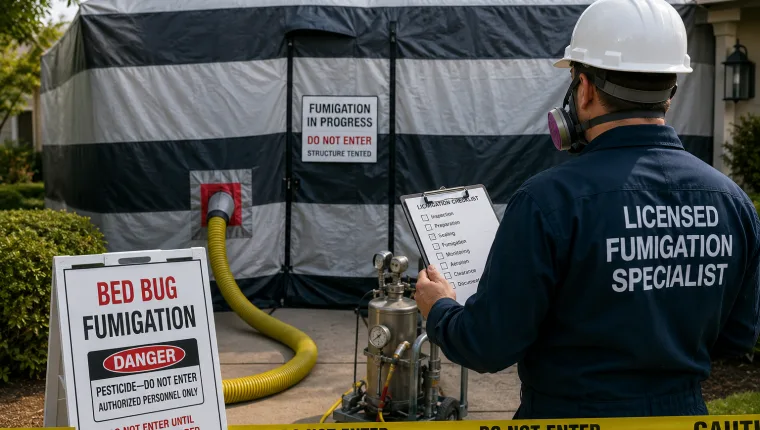
Bed bug fumigation is a specialized professional treatment in which a sealed structure, chamber, container, or other approved enclosure is exposed to a registered fumigant gas. It is not the same as spraying insecticide, using a fogger, steaming furniture, or performing whole-room heat treatment.
When correctly performed under label-required conditions, fumigation can reach bed bugs hidden inside furniture, cracks, wall voids, belongings, and other spaces that are difficult to treat with surface applications. It may kill eggs, nymphs, and adults exposed to the required concentration for the required period.
Fumigation also has major limitations:
- It requires licensed specialists.
- Occupants, pets, plants, food, medications, and sensitive items may require extensive preparation or removal.
- The treated space must remain unoccupied until it has been professionally aerated and cleared for reentry.
- It provides no continuing residual protection after the fumigant has dissipated.
- Bed bugs can be reintroduced after treatment.
- Residential structural fumigation is not available or routinely used in every region.
- It is often more disruptive than conventional bed bug treatment.
The main decision factor is whether the infestation and property justify a treatment capable of penetrating a large enclosed space. A single confirmed bed bug in one accessible room does not automatically justify structural fumigation.
For general identification and treatment planning, begin with our complete bed bug guide and bed bug inspection checklist.
- What Is Bed Bug Fumigation?
- How Bed Bug Fumigation Works
- Structural Fumigation for Bed Bugs
- Container and Chamber Fumigation
- Bed Bug Fumigation vs. Heat Treatment
- Fumigation vs. Conventional Bed Bug Treatment
- Fumigation vs. Steam
- Is Bed Bug Fumigation Common?
- Legal and Licensing Requirements
- Preparing for Bed Bug Fumigation
- What Happens During Fumigation?
- How Long Does Bed Bug Fumigation Take?
- Does Fumigation Leave a Residue?
- What to Expect After Fumigation
- Why Bed Bugs May Appear After Fumigation
- Bed Bug Fumigation Cost Factors
- Questions to Ask Bed Bug Fumigation Specialists
- When Fumigation May Not Be the Best Choice
- When to Stop DIY Treatment
- Frequently Asked Questions
- What is bed bug fumigation?
- Is fumigation the same as using a bug bomb?
- Does fumigation kill bed bug eggs?
- Does fumigation kill every bed bug?
- Does fumigation leave residual protection?
- Is bed bug fumigation safe?
- Can I remain in the house during fumigation?
- Can I fumigate one room?
- Is fumigation better than heat treatment?
- Is fumigation better than conventional treatment?
- How much does bed bug fumigation cost?
- How long must a home remain vacant?
- Can furniture be fumigated separately?
- Why did bed bugs return after fumigation?
- Can I use a commercial fumigant myself?
- When should I consider fumigation?
What Is Bed Bug Fumigation?
Fumigation uses a gaseous pesticide inside a sealed and controlled treatment space.
Unlike a liquid spray or dust, a fumigant moves through available air spaces and may penetrate materials and voids that are difficult to reach manually.
The treatment may involve:
- An entire structure
- A section of a building specifically designed or approved for fumigation
- A sealed container
- A specialized chamber or vault
- Selected vehicles, furnishings, or belongings in an approved enclosure
The term “fumigation” is frequently misused. Many homeowners call any aerosol, fog, smoke, mist, or odor-producing treatment a fumigation. These methods are not equivalent.
| Method | What it actually does | Is it fumigation? |
|---|---|---|
| Total-release fogger | Releases pesticide droplets or aerosol into a room | No |
| Residual spray | Applies liquid pesticide to labeled surfaces and harborages | No |
| Insecticidal dust | Places a pesticide dust in cracks, voids, or other labeled areas | No |
| Steam treatment | Uses direct heat and moisture on accessible surfaces | No |
| Structural heat treatment | Raises temperatures throughout a room or building | No |
| Structural or chamber fumigation | Exposes a sealed treatment space to a registered fumigant gas | Yes |
How Bed Bug Fumigation Works
A licensed fumigation company evaluates the structure or treatment enclosure,
develops a legally compliant treatment plan, prepares the site, introduces the registered fumigant, monitors the treatment, aerates the space, and verifies that it meets the product-label requirements for reentry.
At a high level, the process includes:
- Confirming that bed bugs are present
- Evaluating infestation distribution and property conditions
- Determining whether fumigation is legally available and appropriate
- Providing written preparation instructions
- Removing occupants and addressing protected or prohibited items
- Securing and controlling the treatment enclosure
- Conducting the licensed fumigation
- Aerating the treated space
- Testing and clearing the space for reentry
- Implementing prevention and post-treatment monitoring
This process must never be improvised by a homeowner, landlord, maintenance worker, or unlicensed pest-control operator.
The U.S. Environmental Protection Agency recommends treating bed bugs through an Integrated Pest Management approach based on confirmed identification, inspection, preparation, monitoring, and appropriate control methods.
Structural Fumigation for Bed Bugs
Structural fumigation treats an entire approved structure or enclosed section as one controlled treatment space.
Depending on the structure and jurisdiction, the building may be enclosed using a specialized covering or another approved sealing system. The exact process is determined by the fumigant label, structure, local requirements, and licensed provider.
Structural fumigation may be considered when:
- Bed bugs are widespread through multiple rooms.
- Several units or connected spaces are affected.
- Furniture and belongings contain extensive hidden harborages.
- Previous properly conducted treatments have failed.
- The property can be vacated and prepared safely.
- The method is legally available in the jurisdiction.
- The cost and disruption are justified by the infestation.
It is generally not the default first treatment for one lightly infested bedroom.
Why Structural Fumigation Can Be Effective
A fumigant gas can move through many spaces that are difficult to treat with:
- Surface sprays
- Steam
- Vacuuming
- Dust applications
- Localized heat
Potentially exposed harborages include:
- Furniture interiors
- Wall voids
- Floor and ceiling spaces
- Mattress and box-spring interiors
- Stored belongings
- Cracks and construction joints
Penetration is not the same as residual protection. Once the fumigant has been removed and the structure has been cleared, it does not continue killing bed bugs introduced later.
Container and Chamber Fumigation
Container or chamber fumigation treats selected belongings inside an approved enclosure rather than fumigating the entire home.
Possible items may include:
- Furniture
- Mattresses
- Box springs
- Luggage
- Books
- Household belongings
- Commercial inventory
- Selected contents from an infested room
Whether an item can be fumigated depends on:
- The product label
- The treatment facility
- Item composition
- Packaging
- Food or medication restrictions
- Material compatibility
- Local law
Container fumigation may be useful when belongings must be treated but the structure will receive another form of bed bug control.
Treating belongings alone will fail if live bed bugs remain inside the home, apartment, vehicle, or workplace.
Bed Bug Fumigation vs. Heat Treatment
| Factor | Fumigation | Heat treatment |
|---|---|---|
| Primary treatment agent | Registered fumigant gas | Elevated temperature |
| Penetration | Moves through available air spaces and many belongings | Heat must penetrate materials and reach lethal temperatures in every target area |
| Residual protection | None after aeration | None after cooling |
| Egg control | Can kill eggs when label-required exposure is achieved | Can kill eggs when lethal temperature and exposure are achieved |
| Main technical challenge | Maintaining and verifying required fumigant conditions | Avoiding cold spots and maintaining lethal temperatures |
| Occupancy | Building must remain vacant until professionally cleared | Building remains vacant during treatment and until provider clearance |
| Belongings | Many belongings may remain, but preparation rules are strict | Heat-sensitive belongings may require removal or protection |
| Availability | Limited by regional licensing, regulation, equipment, and provider availability | More commonly offered by bed bug specialists in many markets |
| Typical use | Complex, widespread, or specialty situations | Room, apartment, or whole-structure treatment |
Neither method automatically prevents reinfestation. Both require post-treatment monitoring, inspection, and prevention.
See our bed bug heat treatment guide and heat treatment cost guide for a closer comparison.
Fumigation vs. Conventional Bed Bug Treatment
Conventional treatment normally combines several targeted methods over multiple visits.
These may include:
- Vacuuming
- Steam
- Dryer treatment of textiles
- Mattress encasements
- Bed bug interceptors
- Residual liquid pesticides
- Insecticidal dusts
- Follow-up inspection
| Factor | Fumigation | Conventional treatment |
|---|---|---|
| Treatment scope | Entire approved enclosure or selected contents | Targeted rooms, furniture, cracks, and harborages |
| Number of visits | One fumigation event plus planning and clearance | Often several treatment and follow-up visits |
| Residual activity | None after aeration | Some labeled products may provide continuing residual control |
| Disruption | High | Usually lower, although preparation can still be extensive |
| Hidden harborages | Potentially broad penetration | Dependent on inspection and treatment access |
| Best fit | Widespread or difficult infestations where available | Most typical residential bed bug infestations |
Fumigation vs. Steam
Steam is a localized contact treatment. It kills bed bugs and eggs only where adequate heat reaches them directly.
Steam may help on:
- Mattress seams
- Box-spring edges
- Bed-frame joints
- Upholstery seams
- Carpet edges
- Accessible baseboard cracks
Fumigation treats the enclosed volume rather than one visible surface at a time.
Steam can be incorporated into a conventional treatment plan but should not be confused with structural fumigation. See our steam for bed bugs guide.
Is Bed Bug Fumigation Common?
Residential structural fumigation for bed bugs is less common than conventional insecticide treatment or professional heat treatment in many parts of the United States.
Reasons include:
- Limited provider availability
- Special licensing requirements
- Extensive preparation
- Temporary building evacuation
- Higher logistical cost
- Local restrictions
- Availability of less disruptive alternatives
It may be more practical in regions where structural fumigation infrastructure already exists for other pests or where specialized companies offer bed bug fumigation.
Legal and Licensing Requirements
Fumigants are highly regulated pesticides. Their use is controlled by:
- Federal pesticide law
- The registered product label
- State pesticide regulations
- Professional licensing requirements
- Local building, fire, safety, and notification rules
A legitimate provider should be able to explain:
- Its fumigation license or certification
- The registered fumigant proposed
- The EPA registration number
- The treatment enclosure
- Occupant preparation requirements
- Aeration and clearance procedures
- Responsibility for security and access
- Documentation provided after treatment
Do not hire a company that proposes unregistered gases, improvised chambers, household chemicals, propane devices, carbon monoxide, ozone, or another unapproved method.
Preparing for Bed Bug Fumigation
Preparation instructions vary by product, treatment enclosure, property, and jurisdiction. The licensed fumigator must provide a written checklist.
Preparation may address:
- Occupants
- Children
- Pets
- Plants
- Food
- Medications
- Animal feed
- Open beverages
- Mattresses and furnishings
- Locked rooms and safes
- Vehicles
- Utilities
- Security systems
- Neighbor notifications
Follow only the company’s written, label-compliant instructions. Do not create your own sealing, aeration, or reentry procedure.
The EPA recommends keeping potentially infested belongings within the treatment area unless they are sealed and handled according to the treatment plan. Moving loose belongings can spread bed bugs into untreated spaces.
What Happens During Fumigation?
Only the licensed provider should manage the fumigation process.
At a high level, the provider:
- Confirms preparation
- Controls access to the treatment space
- Secures the enclosure
- Applies the registered fumigant
- Monitors treatment conditions
- Aerates the enclosure
- Tests the space
- Authorizes reentry when legal requirements are met
Occupants should never enter the treatment area to retrieve belongings, check equipment, feed pets, or investigate an alarm.
How Long Does Bed Bug Fumigation Take?
The total timeline includes more than the period when the fumigant is present.
Time may be required for:
- Inspection
- Quoting
- Permits or notifications
- Preparation
- Enclosure setup
- Treatment exposure
- Aeration
- Testing
- Clearance
- Reoccupation
The provider should state the estimated vacancy period in writing but must not guarantee reentry at an exact clock time before clearance testing is complete.
Does Fumigation Leave a Residue?
Fumigation is commonly misunderstood as leaving a protective pesticide coating throughout the structure.
A fumigant is intended to disperse through the treatment enclosure and then be removed through controlled aeration. After proper clearance, it does not provide a lasting bed bug barrier.
This means:
- Bed bugs introduced later can survive.
- Untreated belongings can reintroduce the pest.
- Adjacent infested units can remain a source.
- Prevention and monitoring remain necessary.
“No residual protection” does not mean occupants can ignore clearance procedures. Reentry is allowed only after the licensed fumigator completes the required aeration and testing.
What to Expect After Fumigation
After professional clearance:
- Follow the company’s reentry instructions.
- Do not bring untreated belongings back immediately.
- Inspect luggage, vehicles, storage units, and removed items.
- Install or continue bed bug interceptors.
- Inspect mattresses, frames, couches, and resting areas periodically.
- Document any new specimen.
Old fecal spots, dead insects, cast skins, and eggshells may remain after treatment. They do not necessarily indicate continuing live activity.
New live bed bugs or repeated monitor captures require investigation.
Why Bed Bugs May Appear After Fumigation
Possible reasons include:
- An untreated item was returned to the property.
- The infestation involved an adjoining untreated unit.
- A bed bug was introduced again after clearance.
- A vehicle, office, storage space, or frequent destination remains infested.
- The original insect was misidentified.
- The treatment enclosure or exposure did not meet the required plan.
Contact the fumigation provider immediately and preserve the specimen. Do not apply another pesticide before the company investigates.
Bed Bug Fumigation Cost Factors
Bed bug fumigation cost varies substantially and should be based on a written inspection and scope.
Pricing may depend on:
- Structure size and volume
- Property type
- Structural complexity
- Treatment enclosure
- Regional licensing and labor costs
- Preparation assistance
- Security requirements
- Container or chamber transportation
- Number and type of belongings
- Permits and notifications
- Monitoring and follow-up
Ask whether the quote includes:
- Inspection
- Preparation guidance
- Enclosure setup
- Fumigation
- Aeration and clearance
- Documentation
- Post-treatment monitoring
- Warranty or callback terms
Compare the proposal with heat and conventional treatment in our bed bug treatment cost guide.
Questions to Ask Bed Bug Fumigation Specialists
| Question | Why it matters |
|---|---|
| What evidence confirms bed bugs? | Fumigation should not be sold without reliable identification |
| Why is fumigation preferable to heat or conventional treatment? | The company should explain the decision, not simply sell the most expensive method |
| Are you licensed for this fumigant and treatment type? | General pest-control licensing may not authorize structural fumigation |
| What registered product will be used? | The proposal should identify the fumigant and EPA registration information |
| What exactly will be fumigated? | Clarifies whether the treatment includes the structure, a container, or selected belongings |
| How long must the property remain vacant? | Occupants need realistic lodging and access plans |
| Who authorizes reentry? | Only the responsible licensed fumigator should clear the space |
| What belongings require removal or special handling? | Preparation affects safety, cost, and treatment completeness |
| What monitoring follows treatment? | Fumigation provides no residual protection |
| What does the warranty cover? | Reintroduction and untreated adjacent areas may be excluded |
When Fumigation May Not Be the Best Choice
Another treatment may be more appropriate when:
- The infestation is limited to one accessible room.
- Bed bugs are concentrated in identifiable furniture.
- The property cannot be vacated safely.
- Local providers do not offer licensed fumigation.
- Connected units remain untreated.
- The source of reinfestation has not been corrected.
- The preparation and disruption exceed the likely benefit.
- A conventional multi-visit program can provide reliable control.
When to Stop DIY Treatment
Stop DIY control and contact a qualified bed bug professional when:
- Several rooms are affected.
- Bed bugs are present in couches or wall voids.
- The property is an apartment or multifamily building.
- Repeated treatments have failed.
- Belongings cannot be managed safely.
- Heat, fumigation, or another specialized method is being considered.
- The insect has not been identified confidently.
Never attempt to create a homemade fumigation enclosure or use gases, combustion devices, agricultural fumigants, household chemicals, foggers, or industrial products outside their registered labels.
Frequently Asked Questions
What is bed bug fumigation?
Bed bug fumigation is a licensed treatment that exposes a sealed structure, container, chamber, or approved enclosure to a registered fumigant gas.
Is fumigation the same as using a bug bomb?
No. A total-release fogger disperses aerosol droplets. It is not structural or chamber fumigation and may fail to reach hidden bed bugs.
Does fumigation kill bed bug eggs?
Fumigation can kill eggs when the registered product is applied under the label-required concentration, exposure, and treatment conditions.
Does fumigation kill every bed bug?
A correctly conducted fumigation is designed to control all exposed life stages within the approved enclosure, but no company should guarantee protection against later reinfestation.
Does fumigation leave residual protection?
No. After the fumigant has been removed and the property cleared, it does not continue killing bed bugs introduced later.
Is bed bug fumigation safe?
It can be performed safely only by properly licensed professionals following the registered label, evacuation, security, aeration, testing, and reentry requirements.
Can I remain in the house during fumigation?
No. Occupants and pets must leave and cannot return until the licensed fumigator has completed clearance procedures.
Can I fumigate one room?
Room-only fumigation may not be legally or technically appropriate in an ordinary home. The licensed specialist must determine whether an approved treatment enclosure is possible.
Is fumigation better than heat treatment?
Neither method is universally better. Fumigation offers gas penetration, while heat avoids a fumigant but must eliminate cold spots. Availability, cost, structure, belongings, and infestation spread determine the better fit.
Is fumigation better than conventional treatment?
Fumigation may be useful for widespread or difficult infestations. Conventional treatment is more commonly used and may be less disruptive for localized activity.
How much does bed bug fumigation cost?
Cost depends on structure volume, region, preparation, enclosure type, licensing, transportation, permits, and monitoring. A written inspection and quote are necessary.
How long must a home remain vacant?
The vacancy period depends on the registered product, treatment plan, aeration, testing, and legal requirements. Reentry cannot occur until the fumigator authorizes it.
Can furniture be fumigated separately?
Some licensed providers treat furniture and belongings in approved containers or chambers. The home must still be inspected and treated separately when bed bugs remain there.
Why did bed bugs return after fumigation?
Common causes include untreated belongings, an infested adjoining unit, a vehicle or storage source, or a new introduction after treatment.
Can I use a commercial fumigant myself?
No. Structural and container fumigation require registered products, specialized equipment, professional licensing, monitoring, aeration, and legal clearance procedures.
When should I consider fumigation?
Consider an evaluation when the infestation is widespread, hidden in numerous belongings, resistant to properly conducted treatments, or located in a property suited to licensed fumigation.
Bed bug fumigation is a specialized licensed treatment and must never be attempted as a DIY project. Preparation, fumigant application, aeration, testing, and reentry are controlled by the registered product label and applicable law. Fumigation provides no residual protection against future introductions.


