
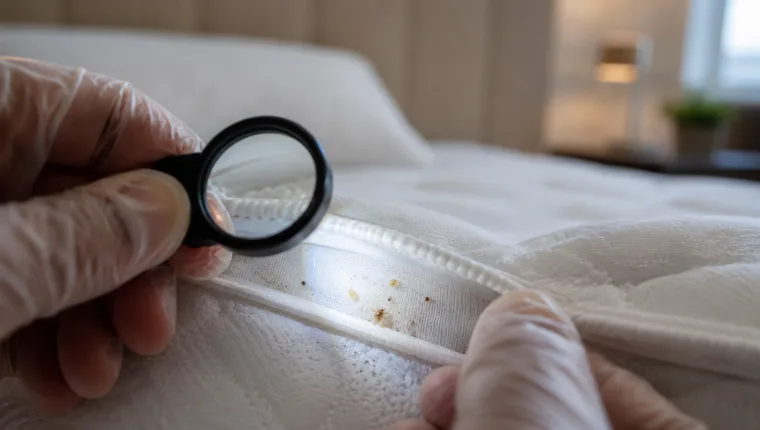
Last reviewed: July 2026
There is no true bed bug larval stage. Bed bugs develop through incomplete metamorphosis: an egg hatches into a first-stage nymph, and that nymph passes through five immature stages before becoming an adult. Baby bed bugs resemble smaller, paler adults rather than worms, maggots, caterpillars, or hairy larvae.
Bed bug eggs are approximately 1 millimeter long. According to the U.S. Environmental Protection Agency’s bed bug life-stage scale, the five nymph stages are approximately 1.5, 2, 2.5, 3, and 4.5 millimeters long. Unfed adults are generally about 5 to 7 millimeters long.
Young nymphs can be difficult to see because they are small and nearly colorless when unfed. After taking a blood meal, their abdomen may appear bright red, dark red, or reddish brown. Each nymph must feed and molt before progressing to the next stage.
Finding an egg, nymph, cast skin, or adult near a sleeping area can indicate bed bug activity, but lint, booklice, carpet beetle larvae, fleas, cockroach nymphs, and bat bugs are frequently misidentified.
Preserve the specimen and confirm the pest before beginning treatment.
For the complete identification and control hub, see our bed bug guide. To search a room systematically, use our bed bug inspection checklist.
- Do Bed Bugs Have Larvae?
- Bed Bug Life Stages and Actual Sizes
- What Do Bed Bug Eggs Look Like?
- What Do Baby Bed Bugs Look Like?
- Bed Bug Nymphs Before and After Feeding
- How Bed Bug Nymphs Develop
- How Long Does Bed Bug Development Take?
- Where Bed Bug Eggs and Nymphs Hide
- Bed Bug Eggs and Nymphs vs. Common Lookalikes
- Do Bed Bug Nymphs Bite?
- Do Bed Bug Nymphs Jump or Fly?
- What Cast Skins Look Like
- What Finding Eggs or Nymphs Means
- What to Photograph and Preserve
- Bed Bug Treatment and Immature Stages
- Common Identification and Treatment Mistakes
- When to Call a Bed Bug Professional
- Printable Millimeter Scale for Evidence Photos
- Frequently Asked Questions
- What do bed bug larvae look like?
- How many nymph stages do bed bugs have?
- How big is a newly hatched bed bug?
- How big are bed bug eggs?
- What color are baby bed bugs?
- Can bed bug nymphs be seen with the naked eye?
- Do bed bug nymphs jump?
- Do baby bed bugs bite?
- Do bed bug eggs move?
- What kills bed bug eggs?
- How long do bed bug eggs take to hatch?
- Does finding a nymph mean there is an infestation?
- Are bed bug eggs always found in clusters?
- Can bed bug eggs be vacuumed?
- Are pale cast skins live bed bugs?
- What bugs are mistaken for bed bug nymphs?
- Can bed bug nymphs survive without feeding?
- When should I call an exterminator?
Do Bed Bugs Have Larvae?
No. The phrase “bed bug larvae” is commonly used online, but it is not entomologically correct.
Insects can develop through different types of metamorphosis:
| Development type | Life stages | Examples |
|---|---|---|
| Complete metamorphosis | Egg, larva, pupa, adult | Fleas, flies, moths, beetles, and butterflies |
| Incomplete metamorphosis | Egg, nymph, adult | Bed bugs, cockroaches, and many true bugs |
A flea larva looks wormlike and differs substantially from an adult flea. A carpet beetle larva is elongated and hairy. A bed bug nymph already has the flattened body, six legs, antennae, and general form of an adult bed bug.
The correct terms are:
- Bed bug egg
- First-stage nymph
- Second-stage nymph
- Third-stage nymph
- Fourth-stage nymph
- Fifth-stage nymph
- Adult bed bug
Bed Bug Life Stages and Actual Sizes
| Life stage | Approximate length | Typical unfed appearance | Identification notes |
|---|---|---|---|
| Egg | 1 mm | Pearl-white, oval, and slightly curved | Usually glued to a protected surface rather than lying loose like dust |
| First-stage nymph | 1.5 mm | Nearly colorless or whitish yellow | Very difficult to see on pale bedding before feeding |
| Second-stage nymph | 2 mm | Pale yellow to light tan | Still translucent, with a visible blood meal after feeding |
| Third-stage nymph | 2.5 mm | Light tan or yellowish brown | Body becomes easier to recognize as bed bug-shaped |
| Fourth-stage nymph | 3 mm | Tan to light brown | Broader and more visible than early stages |
| Fifth-stage nymph | 4.5 mm | Light brown to reddish brown | Close to adult size but sexually immature |
| Adult | 5–7 mm | Brown, flat, oval, and apple-seed shaped | Becomes swollen, darker, and more elongated after feeding |
These measurements are approximate. Individual size can vary with sex, feeding status, preservation, body position, and natural variation.
A clear millimeter scale is more reliable than comparisons such as a speck of pepper, sesame seed, or apple seed because household objects vary in size.
What Do Bed Bug Eggs Look Like?
Bed bug eggs are generally:
- Approximately 1 millimeter long
- Pearl-white or creamy white
- Oval and slightly curved
- Comparable in size to a pinhead
- Glued to a surface
- Marked by a darker eye spot as development progresses
Female bed bugs commonly place eggs inside protected cracks, seams, joints, fabric folds, screw holes, and other harborages near a host.
Possible egg locations include:
- Mattress seams and labels
- Box-spring fabric and wooden framing
- Bed-frame joints
- Headboards
- Nightstand drawer joints
- Upholstery seams
- Baseboard cracks
- Loose wallpaper
- Furniture screw holes
An egg may stand upright, lie on its side, or be partly concealed inside a crack. Newly hatched eggs leave behind empty shells that may remain attached to the surface.
Are Bed Bug Eggs Hard or Soft?
Bed bug eggs have an outer shell but can be crushed. Their small size makes texture difficult to evaluate without magnification.
Do not squeeze a suspected egg with bare fingers. Lift it with clear tape or preserve the entire object and surrounding material for identification.
Are Bed Bug Eggs Sticky?
Female bed bugs deposit eggs with a substance that helps attach them to surfaces. This is why they may remain fixed to wood, fabric, paper, or another sheltered material.
A pile of loose white particles is not automatically a group of bed bug eggs. Dust, dandruff, fabric fibers, foam fragments, seeds, insect debris, and carpet beetle material may appear similar in a low-quality photograph.
What Do Baby Bed Bugs Look Like?
Baby bed bugs are nymphs. They have:
- Six legs
- Two antennae
- A flattened oval body
- No functional wings
- A visible segmented abdomen
- The same general body plan as an adult
Early nymphs can be almost transparent when unfed. Their pale color may make them difficult to see against:
- White sheets
- Light-colored mattresses
- Clear plastic
- Pale wood
- Dusty surfaces
Dark fecal spotting, eggs, cast skins, or larger bed bugs nearby may be easier to locate than an unfed first-stage nymph.
Bed Bug Nymphs Before and After Feeding
Feeding changes the color, width, and length of a nymph.
| Feature | Unfed nymph | Recently fed nymph |
|---|---|---|
| Color | Nearly colorless, pale yellow, tan, or light brown | Bright red, dark red, or reddish brown through the abdomen |
| Body shape | Flat and broadly oval | Swollen and more elongated |
| Visibility | Can blend into pale surfaces | Blood meal makes the abdomen easier to see |
| Behavior | May remain hidden while waiting for a host | Generally moves toward a protected harborage after feeding |
A recently fed nymph can look like a tiny red insect or a moving drop of blood. It should still have six legs, antennae, and a recognizable bed bug body.
Crushing a recently fed bed bug may leave a reddish stain, but stains alone cannot confirm an infestation.
How Bed Bug Nymphs Develop
A bed bug nymph must take at least one blood meal before it can molt into the next stage. It may feed more than once when a host is available.
The development sequence is:
- An egg hatches into a first-stage nymph.
- The first-stage nymph feeds and molts.
- The process repeats through five nymph stages.
- The fifth-stage nymph feeds and molts into an adult.
Each molt leaves behind a pale cast skin, also called an exuvia. Finding cast skins of several sizes can indicate that nymphs have been feeding and developing in the area.
The University of Minnesota Extension explains that immature bed bugs molt five times before reaching adulthood and must feed before each molt.
How Long Does Bed Bug Development Take?
Development speed depends on temperature, access to a host, feeding frequency, humidity, and other environmental conditions.
Under favorable conditions, the EPA states that the egg-to-egg life cycle may occur in approximately four to five weeks. Cooler temperatures or limited access to a host can slow development.
A fixed timeline should not be used to determine:
- When the infestation began
- How many bed bugs are present
- Whether treatment has succeeded
- Whether one insect was recently introduced
Finding several nymph stages, eggs, and adults is stronger evidence of an established reproducing population than finding one isolated specimen.
Where Bed Bug Eggs and Nymphs Hide
Bed bug nymphs and adults generally hide in similar places. Early-stage nymphs can enter particularly narrow spaces.
Inspect:
- Mattress piping, seams, folds, and labels
- Box-spring corners and underside fabric
- Bed-frame joints and bolt holes
- Headboards
- Nightstands
- Upholstered chairs and couches
- Baseboard gaps
- Loose wallpaper
- Drawer joints
- Curtain folds
- Wall decorations near beds
The EPA advises searching for eggs, eggshells, shed nymphal skins, fecal spots, stains, and live insects rather than relying on bites.
Bed Bug Eggs and Nymphs vs. Common Lookalikes
| Lookalike | How it differs | Typical clue |
|---|---|---|
| Carpet beetle larva | Elongated and covered with hairs or bristles | Hairy cast skins and natural-fiber damage |
| Booklouse | Very small, pale, soft-bodied, and relatively narrow | Moisture, mold, damp paper, or humid windows |
| Flea | Narrow from side to side with enlarged jumping legs | Jumps and is commonly associated with pets |
| Cockroach nymph | More elongated with very long antennae | Runs quickly and may occur near kitchens or electronics |
| Bat bug | Extremely similar to a bed bug | May require magnification and evaluation of bat activity |
| Mite | Adult and nymphal mites generally have eight legs and no antennae | May be associated with birds, rodents, pets, or stored products |
| Lint or debris | No complete insect anatomy | No organized legs, antennae, segmentation, or movement |
See our visual guide to tiny bugs in bed that are not bed bugs for a broader comparison.
Do Bed Bug Nymphs Bite?
Bed bug nymphs feed on blood and can bite people. They must feed to progress through their developmental stages.
A skin reaction cannot reveal:
- Whether an adult or nymph fed
- Which nymph stage was involved
- How many bed bugs are present
- Whether the reaction was caused by bed bugs
Some people develop itching or visible marks, while others show little or no reaction. Do not identify bed bugs from photographs of skin.
Seek medical advice for breathing difficulty, extensive swelling, signs of infection, fever, or another concerning reaction.
Do Bed Bug Nymphs Jump or Fly?
No. Bed bug nymphs and adults crawl. They do not jump and do not have functional wings.
A tiny insect that repeatedly jumps is more consistent with a flea or another jumping arthropod. A small insect that flies is not a bed bug.
What Cast Skins Look Like
A cast skin is the empty outer covering left after a bed bug nymph molts.
Cast skins are generally:
- Pale yellow, tan, or translucent
- Hollow
- Bed bug-shaped
- Equipped with visible legs and antennae
- Found near active or historical harborages
They may be mistaken for dead insects, eggshells, carpet beetle skins, or debris.
A cast skin confirms that a bed bug developed in or near the area at some point. It does not prove that live bed bugs remain present. Look for new fecal spots, live insects, eggs, or monitor captures.
What Finding Eggs or Nymphs Means
| Evidence | Possible interpretation | Next step |
|---|---|---|
| One possible egg | Identification remains uncertain | Preserve it and inspect the surrounding crack or seam |
| One confirmed nymph | A bed bug reached or developed in the area | Inspect the full sleeping area and begin monitoring |
| Eggs and nymphs together | Reproduction is likely occurring nearby | Locate harborages and arrange treatment planning |
| Several nymph sizes | Bed bugs have been feeding and developing over time | Expand inspection to nearby furniture and rooms |
| Cast skins without live activity | Evidence may be historical | Clean after documentation and monitor for new signs |
| Eggs, nymphs, adults, and dense fecal spots | An established infestation is likely | Seek professional inspection and coordinated treatment |
What to Photograph and Preserve
Useful identification photographs should include:
- A sharp image from above
- A side view
- A millimeter ruler
- The full body, including legs and antennae
- The exact crack, seam, or furniture joint
- Nearby eggs, cast skins, or fecal spots
Preserve specimens with:
- Clear tape attached to a white card
- A small sealed transparent container
- A labeled plastic bag containing the affected material
Record the date, room, furniture item, exact location, and whether the specimen was moving, fed, or attached to a surface.
Bed Bug Treatment and Immature Stages
A treatment plan must address eggs, nymphs, adults, and hidden harborages.
Depending on the property and infestation, control may combine:
- Vacuuming and physical removal
- Dryer treatment of suitable textiles
- Steam applied correctly to accessible surfaces
- Bed bug-rated mattress and box-spring encasements
- Interceptors and monitors
- Whole-room or whole-structure heat performed by qualified providers
- Targeted EPA-registered pesticides
- Repeated inspection and follow-up
One pesticide may not affect every life stage equally. Eggs can be difficult to reach, and newly hatched nymphs may appear after the first service. This is one reason follow-up inspection and treatment timing matter.
Never apply a pesticide more frequently than its label permits. See our bed bug treatment cost guide and bed bug heat treatment cost guide when comparing professional options.
Common Identification and Treatment Mistakes
- Calling every small pale insect a bed bug larva
- Assuming every white particle is an egg
- Using bite patterns to identify the life stage
- Treating before preserving a specimen
- Using bug bombs or foggers
- Applying pesticides to skin, pets, or unlabeled surfaces
- Discarding a mattress without inspecting the frame and room
- Moving belongings into another bedroom
- Stopping treatment after adults disappear
- Using AI-generated insect illustrations as proof of identification
When to Call a Bed Bug Professional
Professional inspection is appropriate when:
- An egg or nymph has been confirmed
- Several life stages are present
- Evidence occurs in more than one furniture item or room
- The property is an apartment, hotel, shelter, dormitory, or healthcare facility
- DIY inspection cannot locate the harborage
- Treatment has failed
- The specimen may be a bat bug or another close relative
Ask the provider:
- Which features confirm bed bugs?
- Which life stages were found?
- Where are the eggs and harborages located?
- Which rooms and adjoining units require inspection?
- How will the proposed treatment address eggs and newly hatched nymphs?
- How many follow-up visits are included?
- How will clearance be evaluated?
Printable Millimeter Scale for Evidence Photos
Place the scale on the same flat surface as the specimen. Keep both the insect and scale in focus and photograph them from directly above.
| Measurement | Reference use |
|---|---|
| 1 mm | Approximate bed bug egg length |
| 1.5 mm | Approximate first-stage nymph length |
| 2 mm | Approximate second-stage nymph length |
| 2.5 mm | Approximate third-stage nymph length |
| 3 mm | Approximate fourth-stage nymph length |
| 4.5 mm | Approximate fifth-stage nymph length |
| 5–7 mm | General adult bed bug length |
Frequently Asked Questions
What do bed bug larvae look like?
Bed bugs do not have larvae. Their eggs hatch into nymphs that resemble smaller, paler adult bed bugs.
How many nymph stages do bed bugs have?
Bed bugs pass through five nymph stages before reaching adulthood.
How big is a newly hatched bed bug?
A first-stage nymph is approximately 1.5 millimeters long.
How big are bed bug eggs?
Bed bug eggs are approximately 1 millimeter long.
What color are baby bed bugs?
Unfed early nymphs are nearly colorless, whitish yellow, or pale tan. After feeding, their abdomen can appear red or reddish brown.
Can bed bug nymphs be seen with the naked eye?
Yes, but early unfed nymphs can be difficult to see because of their small size and pale color.
Do bed bug nymphs jump?
No. Bed bug nymphs crawl and cannot jump or fly.
Do baby bed bugs bite?
Yes. Nymphs feed on blood and require a blood meal before progressing to the next developmental stage.
Do bed bug eggs move?
No. Eggs are attached to surfaces and do not crawl or jump.
What kills bed bug eggs?
Egg control depends on the method, temperature, exposure, product label, and whether the eggs are reached. Professional programs often combine physical and chemical methods with follow-up.
How long do bed bug eggs take to hatch?
Hatching time varies with environmental conditions. University extension guidance commonly describes hatching in approximately 6 to 10 days under favorable conditions.
Does finding a nymph mean there is an infestation?
A confirmed nymph proves that a bed bug is present or was recently present. A full inspection is needed to determine whether additional life stages and harborages exist.
Are bed bug eggs always found in clusters?
No. Eggs may be placed individually or near other eggs inside protected cracks and harborages.
Can bed bug eggs be vacuumed?
Accessible eggs may be removed with a vacuum, although their attachment and hidden placement can make complete removal difficult. Vacuuming should be part of a broader treatment plan.
Are pale cast skins live bed bugs?
No. Cast skins are empty exoskeletons left after a nymph molts. They indicate development but do not prove that live activity remains.
What bugs are mistaken for bed bug nymphs?
Common lookalikes include booklice, fleas, cockroach nymphs, carpet beetle larvae, mites, bat bugs, and small household beetles.
Can bed bug nymphs survive without feeding?
They can survive for a period without feeding, but survival varies with stage, temperature, humidity, and other conditions.
When should I call an exterminator?
Call a qualified professional when eggs or nymphs are confirmed, several stages are present, multiple rooms may be affected, or inspection and DIY control have failed.
Bed bugs have an egg, five nymph stages, and an adult stage; they do not have a larval stage. Identification should be based on a preserved specimen and physical evidence rather than bites or skin photographs. Pesticides must be used according to their EPA-registered labels.


