
Last reviewed: July 2026
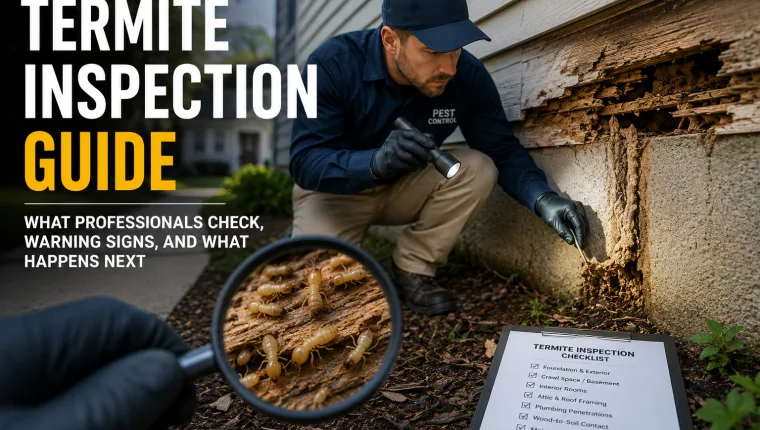
A professional termite inspection is a visual examination of the accessible interior and exterior areas of a property for evidence of termites, termite damage, and conditions that may make an infestation more likely. The inspector typically checks the foundation, crawl space or basement, accessible structural wood, plumbing penetrations, exterior walls, attic areas when relevant, and places where wood contacts soil.
A thorough inspection of an average-size home may take an hour or more, depending on its construction, accessibility, and the evidence discovered. The result should be a written report that identifies the areas inspected, visible findings, inaccessible areas, conditions that need correction, and any recommended next steps.
A termite inspection is important, but it has limits. Most residential inspections are visual and non-destructive. An inspector cannot see through every wall, floor, ceiling, or finished surface, so a report stating that no visible evidence was found is not a guarantee that no termites exist anywhere in the structure.
- What Does a Termite Inspection Include?
- Signs That Justify Booking a Termite Inspection
- How a Professional Termite Inspection Works
- What a Termite Inspection Cannot Guarantee
- How Long Does a Termite Inspection Take?
- How to Prepare for a Termite Inspection
- What Should Be Included in the Written Report?
- Termite Inspection vs. WDI or WDO Inspection Report
- What Happens After the Inspection?
- How to Choose a Termite Inspection Company
- Can You Perform Your Own Termite Inspection?
- How Often Should a Home Be Inspected for Termites?
- Termite Inspection Cost
- Frequently Asked Questions
- How long does a termite inspection take?
- Do I need to leave the house during a termite inspection?
- Can a termite inspection find termites inside walls?
- Does no visible evidence mean the house has no termites?
- Should I get a termite inspection before buying a house?
- Is a termite inspection the same as a termite treatment estimate?
- Will the inspector drill holes or open walls?
- What if I find termite swarmers inside?
- Can an inspection tell whether termite damage is structural?
- Should I hire the same company for inspection and treatment?
- What should I do if two inspectors disagree?
What Does a Termite Inspection Include?
A termite inspection should do more than confirm whether the inspector saw live termites.
It should evaluate three separate issues:
- Evidence of current termite activity: live termites, recently constructed shelter tubes, swarmers, or other signs suggesting an active infestation.
- Evidence of previous activity or damage: damaged wood, abandoned tubes, old pellets, repaired areas, or records of earlier treatment.
- Conditions conducive to infestation: moisture, plumbing leaks, wood-to-soil contact, inaccessible foundation areas, stored lumber, poor drainage, or vegetation obstructing the structure.
The North Carolina Department of Agriculture and Consumer Services describes the initial inspection as the first major step in termite protection. Its guidance says a qualified technician should visually inspect accessible areas inside and outside, probe or sound vulnerable wood, identify inaccessible locations, document visible evidence, and note conditions that encourage termite activity.
| Area | What the inspector may examine | Possible findings |
|---|---|---|
| Foundation and exterior perimeter | Foundation walls, slab edges, expansion joints, utility penetrations, siding, porches, decks, and wood near soil | Mud tubes, damaged wood, cracks, wood-to-soil contact, moisture, obstructed inspection zones |
| Basement or crawl space | Joists, beams, sill plates, subflooring, support posts, plumbing areas, and accessible foundation surfaces | Shelter tubes, hollow or weakened wood, moisture, fungal decay, plumbing leaks, inaccessible sections |
| Interior rooms | Baseboards, window frames, door frames, flooring edges, walls near plumbing, and visible structural wood | Swarmers, shed wings, blistered surfaces, pellets, damaged trim, unexplained openings |
| Attic and roof-adjacent areas | Accessible rafters, roof framing, eaves, vents, stored wood, and areas affected by leaks | Drywood termite pellets, damaged wood, moisture intrusion, evidence of other wood-destroying organisms |
| Garage and attached structures | Slab joints, wall framing, stored cardboard, expansion joints, and door frames | Mud tubes, exposed entry points, moisture, hidden wood-to-soil contact |
| Detached structures | Sheds, fences, wooden steps, decks, and other structures included in the agreed inspection scope | Termite activity, deteriorated wood, conducive conditions, or areas excluded from the main report |
| Surrounding property | Drainage, mulch, firewood, tree stumps, landscape timbers, irrigation, and vegetation near the building | Conditions that increase risk without necessarily proving the house is infested |
Signs That Justify Booking a Termite Inspection
Termites often remain concealed inside soil, shelter tubes, or wood.
According to the U.S. Environmental Protection Agency, many homeowners do not realize termites are present until they encounter a swarm or discover damage during construction or renovation.
Schedule a professional inspection when you notice any of the following:
- Winged insects emerging indoors or near the foundation
- Discarded wings near windows, doors, lights, or baseboards
- Mud or shelter tubes running across foundations, walls, piers, or wood
- Wood that sounds hollow when lightly tapped
- Soft, weakened, blistered, or visibly tunneled wood
- Small piles of dry, pellet-like material beneath wood
- Tiny openings or “kickout holes” in wood surfaces
- Unexplained damage discovered during remodeling
- Recurring moisture near structural wood
- Plumbing leaks, roof leaks, or drainage problems near the foundation
- Wood siding, lattice, steps, posts, mulch, or stored lumber touching soil
- A previous termite treatment with no current inspection or warranty record
- A neighboring property with confirmed termite activity
Not every one of these signs proves that termites are active. Water damage, fungal decay, carpenter ants, wood-boring beetles, and other conditions may produce similar symptoms. The purpose of the inspection is to identify the evidence correctly before a treatment decision is made.
Flying Termites vs. Flying Ants
Termite swarmers are frequently confused with winged ants. The EPA notes that termite swarmers generally have wings of roughly equal length and relatively straight antennae. Winged ants usually have front wings that are longer than the rear wings, bent antennae, and a more visibly narrowed waist.
Finding a few winged insects outdoors does not automatically mean the house is infested. Finding termite swarmers emerging inside a building, however, is a strong reason to request an inspection promptly.
When possible, collect several insects in a sealed container or take clear close-up photographs.
Do not rely exclusively on an image-based identification when the property may have structural activity.
Mud Tubes
Subterranean termites commonly construct shelter tubes that help protect them while traveling between soil and wood. Tubes may appear on foundation walls, piers, plumbing penetrations, crawl-space supports, or other surfaces.
A dry or damaged tube does not necessarily establish that termites are currently active. It may be abandoned, part of a previously treated infestation, or temporarily unused. The inspector should evaluate the tube together with other evidence rather than diagnosing the property from one sign alone.
Drywood Termite Pellets
Drywood termites live within wood rather than maintaining the same soil connection as subterranean termites.
Inspectors may look for feeding damage, discarded wings, small kickout holes, and accumulations of fecal pellets.
The University of California Statewide Integrated Pest Management Program explains that drywood termite inspections commonly focus on these signs and on differentiating them from evidence caused by carpenter ants or wood-boring beetles.
How a Professional Termite Inspection Works
1. The Inspector Reviews the Property History
The inspector may begin by asking about:
- Previous termite inspections or treatments
- Existing termite contracts, bonds, or warranties
- Locations where swarmers, wings, tubes, pellets, or damage were observed
- Recent leaks, plumbing problems, or roof repairs
- Renovations that exposed damaged wood
- Additions, decks, porches, or slab extensions
- Areas that are difficult to access
- Real estate, lender, or insurance documentation requirements
Provide any previous treatment diagrams, invoices, inspection reports, and warranty documents you have. Old records can help distinguish previously documented damage from new evidence and may reveal which parts of the property were treated.
2. The Exterior Is Examined
The exterior inspection normally includes the visible foundation, lower walls, slab edges, utility penetrations, expansion joints, porches, decks, stairs, posts, attached fences, and other accessible components.
The inspector may also note:
- Soil or mulch covering the foundation edge
- Wood siding or structural wood contacting the ground
- Firewood, lumber, cardboard, or debris stored beside the house
- Dense vegetation blocking access to the foundation
- Downspouts releasing water beside the structure
- Poor grading or standing water
- Cracks or openings around utilities
- Damaged or leaking gutters
These are risk conditions, not automatic proof of infestation. Their importance is that they can provide termites with moisture, food, concealed entry, or an area the inspector cannot examine properly.
3. Accessible Structural Wood Is Inspected
In basements and crawl spaces, inspectors commonly examine sill plates, joists, beams, support posts, subflooring, plumbing areas, and visible foundation surfaces.
The technician may use a flashlight, inspection mirror, probing tool, sounding tool, moisture meter, or other detection equipment. Probing or sounding helps determine whether accessible wood appears solid or has concealed galleries immediately below the surface.
The amount of probing should be reasonable and consistent with the inspection agreement. A standard visual inspection is not permission to dismantle walls or cause unnecessary damage.
4. Interior Evidence Is Evaluated
Inside the home, the inspector may focus on rooms with plumbing, moisture, exterior walls, slab penetrations, attached garages, windows, doors, baseboards, and visible structural wood.
Bathrooms, kitchens, laundry areas, utility rooms, and rooms adjacent to porches or additions may receive closer attention because water and construction joints can create favorable conditions or concealed entry points.
5. The Attic May Be Inspected When Relevant and Accessible
Attic inspection is particularly important when the regional termite species, construction type, visible evidence, or moisture history makes roof framing and upper wood components relevant.
An attic may be excluded when access is unsafe, blocked, too small, or outside the agreed scope. Any uninspected attic or roof area should be identified as a limitation in the report.
6. Evidence Is Interpreted
The inspector should distinguish among:
- Live termites or active evidence
- Old or inactive evidence
- Damage with undetermined activity
- Conditions conducive to infestation
- Evidence of another wood-destroying organism
- Areas that could not be inspected
Visible damage alone does not always prove that termites are currently active. Conversely, the absence of visible live termites does not prove that the entire structure is termite-free.
What a Termite Inspection Cannot Guarantee
A standard termite inspection is generally visual and limited to accessible areas. The inspector cannot lift the house, see through every finished wall, remove all flooring, open every ceiling, or inspect areas concealed by permanent construction.
The Arizona Department of Agriculture explains this limitation directly in its consumer guidance on wood-destroying insect inspections: an inspector cannot take a house apart to look beneath or inside every component.
An inspection may be limited by:
- Finished walls, ceilings, and flooring
- Stored belongings
- Built-in cabinets
- Carpet or floor coverings
- Insulation
- Low or unsafe crawl spaces
- Locked rooms or detached structures
- Heavy vegetation
- Soil or mulch covering the foundation
- Decks, porches, or additions blocking access
- Standing water, exposed wiring, sharp objects, or other hazards
A good report should identify material limitations instead of silently treating obstructed areas as inspected.
If visible evidence points toward activity inside a concealed location, the inspector may recommend additional access, removal of a limited finish, specialized detection, evaluation by another contractor, or an inspection with a more invasive scope. Obtain permission and a written description before allowing destructive inspection.
How Long Does a Termite Inspection Take?
A careful inspection of an average-size home can take an hour or more. The actual time depends on:
- Property size
- Foundation and construction type
- Number of buildings included
- Presence of a basement or crawl space
- Accessibility
- Amount of stored material
- Regional termite species
- Whether evidence is found
- Real estate or lender reporting requirements
A small, open, easily accessible property may take less time. A large building with a crawl space, attic, additions, detached structures, previous damage, or multiple suspect areas may take considerably longer.
Inspection speed should not be the primary criterion for choosing a company. A very short appointment that omits major accessible areas may not provide the information needed to make a treatment or purchase decision.
How to Prepare for a Termite Inspection
Preparation helps the inspector access the areas most likely to contain evidence. You do not need to dismantle your home, but you should remove avoidable obstructions.
Termite Inspection Preparation Checklist
- Clear access to the basement, crawl-space entrance, attic access, garage, and utility rooms.
- Move stored items away from foundation walls where practical.
- Remove objects blocking plumbing penetrations beneath sinks.
- Provide access to water heaters, laundry connections, and utility closets.
- Unlock detached garages, sheds, gates, and other structures included in the inspection.
- Trim or move vegetation that completely blocks visible foundation areas.
- Identify where you saw insects, wings, tubes, pellets, or damage.
- Save insect specimens or photographs when possible.
- Gather previous treatment records, inspection reports, diagrams, contracts, and warranties.
- Tell the inspector about leaks, moisture problems, renovations, and inaccessible areas.
- Secure pets if the inspector needs access to crawl spaces, yards, or utility areas.
- Confirm in advance whether the attic, crawl space, detached structures, fences, decks, and other improvements are included.
What Should Be Included in the Written Report?
Do not rely solely on a verbal statement such as “you have termites” or “everything looks fine.” Request a written report.
The report should state:
- Property address
- Inspection date
- Name and license information of the company or inspector, where applicable
- Structures and areas included in the inspection
- Areas that were inaccessible, obstructed, unsafe, or excluded
- Type of visible evidence found
- Location of each material finding
- Whether evidence appears active, inactive, previous, or undetermined
- Visible termite damage
- Conditions conducive to infestation
- Evidence of other wood-destroying organisms, when included in the inspection scope
- Recommended corrective actions
- Recommended treatment or additional inspection
- Any diagrams, photographs, or annotations used to locate findings
- Important limitations and disclaimers
| Report term | What it generally means | What to ask |
|---|---|---|
| Active infestation | The inspector found live termites or evidence interpreted as current activity | Where was activity found, what species is suspected, and what treatment scope is recommended? |
| Previous evidence | Damage, tubes, pellets, or repairs may relate to an earlier infestation | Is there documentation showing when and how the property was treated? |
| Damage observed | Visible wood or building materials show termite-related deterioration | Is a structural contractor or engineer needed to determine repair scope? |
| Conducive condition | A moisture, access, or construction condition may increase risk | Who should correct it, and does it affect a treatment warranty? |
| Inaccessible area | The inspector could not examine a relevant location | Can access be created, or is another inspection method recommended? |
| No visible evidence | No termite evidence was seen in the accessible areas inspected | Which areas were excluded, and does the report provide any guarantee? |
| Further evaluation recommended | The visible evidence cannot be fully resolved within the current scope | What specialist or additional access is required? |
Termite Inspection vs. WDI or WDO Inspection Report
Consumers often use “termite inspection” as a general term, but real estate transactions may require a formal report covering more than termites.
Depending on the state and transaction, the report may be called:
- Wood-Destroying Insect Inspection Report
- Wood-Destroying Organism Inspection Report
- WDI report
- WDO report
- Wood infestation inspection report
- Termite letter
The exact form, inspection scope, licensing requirements, expiration period, and organisms covered vary by jurisdiction. For example, the Florida Department of Agriculture and Consumer Services provides a state Wood-Destroying Organisms Inspection Report and regulates businesses performing these inspections.
A treatment estimate is not automatically the same as a real estate WDI or WDO report. If the inspection is connected to a home purchase, sale, refinance, or government-backed loan, ask the lender, closing professional, or relevant state agency which form and credentials are required.
Does a General Home Inspection Include Termites?
A home inspector may observe visible signs that suggest wood-destroying insects, but a general home inspection or appraisal should not automatically be treated as a complete termite inspection.
The U.S. Department of Housing and Urban Development states that an FHA appraiser’s observation is limited to readily observable conditions and is not as comprehensive as an inspection performed by a licensed home inspector. A specialized wood-destroying organism report may still be required when evidence, local rules, lender requirements, or transaction conditions call for one.
What Happens After the Inspection?
If No Visible Evidence Is Found
Review the report for inaccessible areas and conducive conditions. “No visible evidence” means no evidence was observed in the accessible locations included in the inspection; it does not create an unlimited guarantee.
Correct moisture, drainage, wood-to-soil contact, stored wood, and access problems identified in the report. Keep the inspection document with the property records.
If Active Termites Are Found
Request a written treatment proposal describing:
- Termite type or evidence identified
- Areas to be treated
- Proposed treatment method
- Product names and EPA registration numbers, when pesticides are proposed
- Preparation and re-entry instructions
- Monitoring and follow-up schedule
- Warranty or service agreement
- Renewal inspection fees
- Retreatment terms
- Damage-repair coverage, if any
- Total price and payment schedule
The EPA explains that termite treatments may include soil-applied termiticides, bait systems, treated building materials, or wood treatments. The correct option depends on the termite, structure, infestation, product label, and local conditions.
See our termite control guide for an explanation of the available methods and our termite treatment cost guide for pricing variables.
If Damage Is Found but Activity Is Unclear
Do not assume the damage is either active or harmless. Ask the inspector:
- What evidence suggests termites caused the damage?
- Is the evidence consistent with subterranean, drywood, or another termite type?
- Was live activity found?
- Could the damage relate to a previous treatment?
- Is additional access needed?
- Should a carpenter, contractor, or structural engineer evaluate the affected material?
A pest inspector identifies pest evidence and treatment needs. The inspector may not be qualified to determine whether damaged structural components remain capable of supporting their intended loads.
If Important Areas Were Inaccessible
Ask what prevented access and whether the limitation can be corrected. Moving stored items, trimming vegetation, opening a locked area, or creating a safe crawl-space entry may allow the inspector to return.
Do not accept a broad “clear” interpretation when the report identifies significant uninspected areas directly related to the suspected activity.
How to Choose a Termite Inspection Company
Termite inspection and treatment licensing is generally handled at the state level. Verify the company and individual credentials required where the property is located.
Before hiring, ask:
- Are you licensed to perform termite or wood-destroying organism inspections in this state?
- Does the quoted service include a written report?
- Which buildings and areas are included?
- Will the crawl space and attic be inspected when accessible?
- Is this a general termite inspection or a transaction-specific WDI/WDO report?
- Will photographs or a diagram be included?
- What happens if an area cannot be inspected?
- Is the inspector also selling the treatment?
- Can I receive the inspection findings before deciding on treatment?
- Does the inspection fee apply toward treatment?
- Are follow-up inspections included?
- What does the warranty cover, and what can void it?
The EPA’s consumer guidance for selecting a pest control service recommends comparing companies, verifying licenses, understanding the proposed program, and reviewing guarantees carefully. The EPA also warns against high-pressure claims that a house is immediately unsafe or that a government agency endorses a particular company or pesticide product.
When treatment is recommended, obtain more than one written proposal when practical. Compare scope, method, follow-up, warranty, exclusions, and first-year cost—not only the initial price.
Can You Perform Your Own Termite Inspection?
A homeowner can monitor visible areas for warning signs, but a do-it-yourself check is not equivalent to a licensed inspection.
You can periodically look for:
- Mud tubes
- Swarmers or discarded wings
- Drywood termite pellets
- Wood-to-soil contact
- Plumbing and roof leaks
- Poor drainage
- Firewood or lumber stored beside the house
- Visible wood damage
Do not enter unsafe crawl spaces, disturb electrical systems, cut into structural components, or apply pesticides based solely on an uncertain identification.
Consumer tools such as flashlights, mirrors, and moisture meters may help document a suspicious location, but they do not establish that termites are present or absent. A moisture reading identifies moisture; it does not identify the insect responsible for damage.
The UC Statewide IPM Program recommends professional inspection when infestation is suspected, particularly because termite evidence may occur in dark, confined, or hazardous areas.
How Often Should a Home Be Inspected for Termites?
There is no single inspection interval that fits every U.S. property. Appropriate frequency depends on regional termite pressure, construction, moisture, prior activity, treatment history, and warranty requirements.
An annual inspection may be appropriate when:
- The property is under a termite contract or bond requiring annual renewal
- The home is in a region with significant termite pressure
- Termites have been found or treated previously
- The structure has a crawl space or recurring moisture problems
- Wood-to-soil contact or other risk conditions remain
- A bait or monitoring system requires scheduled checks
For lower-risk properties without known activity, some university extension guidance recommends periodic professional inspections every three to five years. However, that interval should not override a treatment warranty, state requirement, lender condition, or recommendation based on the property’s individual risk.
Termite Inspection Cost
Some termite companies provide a no-cost inspection when the purpose is to prepare a treatment estimate. Other inspections carry a fee, especially when the customer needs an independent written report, a real estate WDI/WDO form, a lender-specific document, or an inspection without purchasing treatment.
The price may depend on:
- Property size
- Number of structures
- Crawl-space or attic access
- Location
- Type of report
- Real estate requirements
- Urgency
- Whether the fee is credited toward treatment
For detailed pricing and a comparison of free estimates, standalone inspections, and transaction reports, see our termite inspection cost guide. If you are comparing the inspection fee with broader service pricing, our pest control cost guide explains how inspection, one-time treatment, recurring service, and specialty work can affect the final quote.
Frequently Asked Questions
How long does a termite inspection take?
A thorough inspection of an average-size house may take an hour or more. Larger properties, crawl spaces, attics, multiple structures, obstructed areas, and visible evidence can extend the appointment.
Do I need to leave the house during a termite inspection?
Usually not. A standard inspection is visual and does not involve pesticide application. You may need to provide access to rooms, the attic, crawl-space entry, garage, yard, and detached structures. Treatment preparation and re-entry rules are separate and depend on the method and product label.
Can a termite inspection find termites inside walls?
An inspector may find external evidence suggesting concealed activity, but a standard visual inspection cannot guarantee detection inside every finished wall. Additional access or specialized detection may be recommended when visible evidence points to a concealed area.
Does no visible evidence mean the house has no termites?
No. It means the inspector did not observe visible evidence in the accessible areas included in the inspection. Read the limitations and inaccessible-area sections of the report before interpreting the result.
Should I get a termite inspection before buying a house?
A termite or WDI/WDO inspection is a prudent step when purchasing in a termite-prone area, when visible evidence exists, or when required by the lender, state, local jurisdiction, or purchase agreement. A general home inspection is not automatically a substitute for a specialized termite report.
Is a termite inspection the same as a termite treatment estimate?
No. A treatment estimate explains the proposed work and price. A formal inspection report documents the property areas examined, findings, limitations, and recommendations. A real estate transaction may require a specific state or lender form.
Will the inspector drill holes or open walls?
Not during a standard visual inspection unless a separate invasive scope has been authorized. The inspector may probe accessible wood. Any destructive testing or opening of finished surfaces should be discussed and approved in writing.
What if I find termite swarmers inside?
Save several specimens or photographs and schedule a professional inspection. Indoor termite swarmers can indicate activity within or immediately connected to the structure, although the species and source still need to be confirmed.
Can an inspection tell whether termite damage is structural?
The inspector can document visible termite damage and recommend additional evaluation. A qualified contractor or structural engineer may be needed to determine whether load-bearing components require repair.
Should I hire the same company for inspection and treatment?
You may, but request written findings before committing to treatment and compare proposals when practical. An inspection should identify the evidence, locations, limitations, proposed method, follow-up, warranty, and total scope clearly enough for you to evaluate the recommendation.
What should I do if two inspectors disagree?
Ask each inspector to identify the evidence physically or in photographs and explain how it supports the diagnosis. Compare the areas inspected, inaccessible locations, termite type, treatment history, and report definitions. When the disagreement would lead to a major treatment or real estate decision, obtain an additional independent opinion.
A termite inspection provides information for a treatment, maintenance, or property decision. It does not replace a structural evaluation, pesticide label, real estate requirement, or advice from a properly licensed local professional.


