
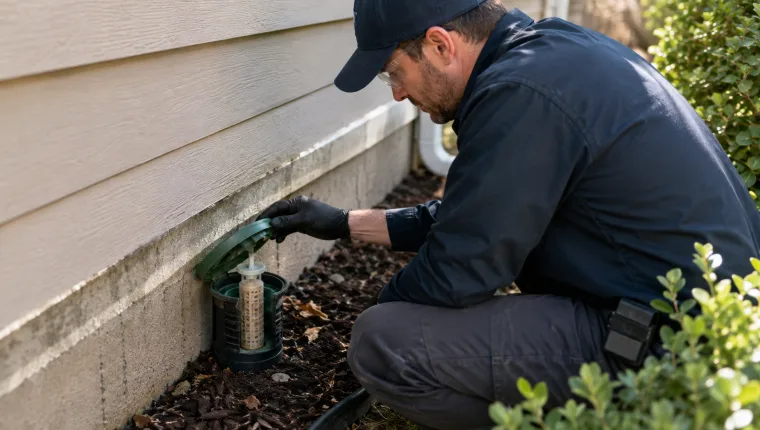
Termite bait stations are monitored treatment devices that use cellulose bait and a slow-acting termiticide to reach foraging subterranean termites and affect the colony over time. They are not instant traps, perimeter repellents, or set-and-forget plastic containers. Their performance depends on termites finding the stations, continuing to feed, carrying or sharing the bait within the colony, and the system being inspected and maintained according to its label and service plan.
The main decision factor is whether the property owner is prepared to maintain a continuing monitoring contract. A professionally installed bait system can be an effective long-term termite-control strategy, but protection depends on scheduled service, station replacement, bait replenishment, structural inspection, and follow-up when activity is found.
Termite bait stations are most often used against subterranean termites. They do not provide a general solution for drywood termite colonies living entirely inside wood.
Before choosing a system, confirm the termite type and building conditions through a professional termite inspection. Our termite control guide compares baiting, liquid soil treatment, wood treatment, structural methods, and prevention.
- How Termite Baits Work
- What Is Inside a Termite Bait Station?
- In-Ground vs. Aboveground Bait Stations
- Where Termite Bait Stations Are Installed
- How Long Do Termite Bait Stations Take to Work?
- How Often Are Termite Bait Stations Checked?
- Do Bait Stations Eliminate the Entire Colony?
- Termite Bait Stations vs. Liquid Barriers
- When Combined Treatment Is Used
- Termite Bait Station Cost
- What an Annual Bait Contract Should Include
- What Happens If the Contract Lapses?
- Can Homeowners Install DIY Termite Bait Stations?
- How to Evaluate Whether a Bait System Is Working
- Common Termite Bait Station Mistakes
- When to Call a Termite Professional
- Termite Treatment Quote Comparison Checklist
- Frequently Asked Questions
- What are termite bait stations?
- Do termite bait stations attract termites from far away?
- How long do termite bait stations take to work?
- How often should termite bait stations be checked?
- Do termite bait stations kill the queen?
- Are bait stations better than liquid termite treatment?
- Can bait stations and liquid treatment be used together?
- How much do termite bait stations cost?
- What happens if I stop paying the annual renewal?
- Do termite bait stations work without maintenance?
- Can I install termite bait stations myself?
- Do termite bait stations work on drywood termites?
- How do I know a bait system is working?
- When should I call a termite professional?
How Termite Baits Work
Subterranean termite workers forage through soil in search of cellulose.
A bait system places suitable cellulose material in stations around or at the structure. When workers encounter the station, they feed on the bait and interact with other termites through food sharing, grooming, and colony contact.
The active ingredients used in professional bait systems are intentionally slow acting. A product that kills the first worker immediately would reduce the chance that feeding termites remain active long enough to transfer the effect through the colony.
The U.S. Environmental Protection Agency describes termite baits as cellulose materials containing slow-acting insecticides. Depending on the registered product, the active ingredient may interfere with growth, molting, development, energy production, or another essential process.
A typical professional process is:
- Inspect the structure and confirm termite evidence.
- Map foundation design, soil access, moisture, hardscape, utilities, additions, and inaccessible areas.
- Install in-ground stations around the structure according to the product label and site plan.
- Install aboveground stations at selected active termite locations when the system permits it.
- Inspect stations at the required intervals.
- Replace consumed, damaged, contaminated, missing, or deteriorated components.
- Document termite feeding and structural evidence.
- Continue monitoring after activity declines.
What Is Inside a Termite Bait Station?
A station may contain untreated monitoring material, active bait, or a product design that includes active ingredient from installation. The exact configuration differs by registered system.
Common components include:
- A durable station housing
- A cellulose matrix, wood insert, or compressed bait material
- A removable inspection cap
- An active ingredient permitted by the EPA-registered label
- Identification or service records used by the pest-control company
EPA lists several active ingredients that have been used in termite bait products, including insect growth regulators and other slow-acting compounds. Product availability, registrations, and labels change, so the current label—not an old online list—determines how a system may be installed and serviced.
In-Ground vs. Aboveground Bait Stations
| Feature | In-ground station | Aboveground station |
|---|---|---|
| Placement | Installed in soil around the structure according to the product label | Attached at a known active termite location when the label permits |
| Main purpose | Intercepts natural subterranean termite foraging and supports long-term monitoring | Places bait directly where termites are already feeding above ground |
| Discovery requirement | Termites must encounter the station during normal foraging | Installed at confirmed activity, reducing the need to wait for random discovery |
| Common role | Primary perimeter system | Supplemental treatment for active tubes, wall locations, or unusual aboveground activity |
| Main limitation | Discovery and feeding can be delayed or uneven | Only treats termites connected to the known feeding site and does not replace perimeter monitoring |
Aboveground stations should not be attached to a random wall merely because damage is suspected. They are intended for sites with confirmed termite activity and must be installed without disrupting the feeding connection the system depends on.
Where Termite Bait Stations Are Installed
Professional in-ground stations are generally placed around the building perimeter in soil where they remain accessible for inspection. The number, spacing, and exact locations depend on the product label, structure, hardscape, landscaping, soil, property boundaries, utilities, additions, and known termite evidence.
Installation may be complicated by:
- Concrete patios, driveways, and walkways
- Decks and porches
- Buried utilities and irrigation
- Rocky, saturated, compacted, or frequently disturbed soil
- Property lines and attached buildings
- Planters and dense landscaping
- Wells, drainage systems, or high water tables
- Missing access along part of the foundation
The station map should become part of the property’s termite records. Landscaping crews, construction work, pets, vehicles, erosion, and lawn equipment can damage or remove stations without the owner noticing.
How Long Do Termite Bait Stations Take to Work?
There is no reliable fixed number of days for every property. Baits are designed to act slowly, and the system cannot begin affecting a colony until termites find and feed from an active station.
Timing depends on:
- Termite species and colony size
- Season and soil temperature
- Moisture and rainfall
- Distance between foraging routes and stations
- Station condition and bait palatability
- Active ingredient and product design
- Availability of competing wood and cellulose
- Whether termites continue feeding after disturbance
- Whether supplemental treatment is used at the structure
Mississippi State University Extension explains that bait-only control of an active infestation can take several months and, in some situations, a year or longer. This does not mean the system is automatically failing; it means results must be evaluated through station activity, structural inspections, and the product’s performance plan.
EPA efficacy guidance for registered termite baits evaluates structural control over much longer periods than consumer “fast kill” advertising. A company should not promise colony elimination by a universal short deadline.
How Often Are Termite Bait Stations Checked?
Inspection frequency is product-specific. Institutional guidance describes schedules ranging from quarterly to annually, depending on the registered system, whether termites are active, the type of station, and the service contract.
| Monitoring phase | What the technician evaluates | Why it matters |
|---|---|---|
| Initial installation | Station placement, foundation coverage, known activity, and inaccessible areas | Creates the baseline service map |
| Early follow-up | Termite discovery, station damage, moisture, disturbance, and bait condition | Confirms whether the system is functioning as designed |
| Active feeding | Consumption, termite presence, bait replacement, and structural evidence | Maintains feeding and tracks response |
| Post-control monitoring | New activity, repaired tubes, swarmers, station discoveries, and building changes | Detects continuing or new pressure after visible activity declines |
| Annual contract inspection | Whole-building evidence, conducive conditions, inaccessible areas, and station status | Links station service to structural inspection and warranty obligations |
The contract should state the minimum inspection schedule, whether visits become more frequent after feeding is detected, and how missed or weather-delayed visits are handled.
Do Bait Stations Eliminate the Entire Colony?
Some registered bait systems are designed and supported by data for colony suppression or elimination. However, homeowners should avoid interpreting “colony elimination” as a permanent guarantee that no termites remain anywhere near the property.
A structure may be exposed to:
- More than one colony
- Different termite species
- New colonies entering later
- Foraging routes that have not yet reached a station
- Drywood termites unaffected by soil stations
- Formosan aerial activity supported by structural moisture
Visible activity can decline while termites remain at another location. The system should be judged through continued structural inspection and station monitoring—not through one empty station or one month without swarmers.
Termite Bait Stations vs. Liquid Barriers
| Factor | Bait stations | Liquid soil treatment |
|---|---|---|
| Primary mechanism | Termites find, consume, and share slow-acting bait | Creates a treated soil zone at likely entry routes |
| Speed | Usually slower because discovery and colony transfer take time | Can reduce structural entry more quickly when applied continuously and correctly |
| Insecticide volume | Uses relatively small quantities in contained placements | Uses a larger volume distributed through labeled soil-treatment zones |
| Ongoing maintenance | Essential for continued protection | Periodic inspection remains important, but the treated soil may retain residual activity |
| Construction disruption | Usually less trenching and drilling, although hardscape access may still be needed | May require trenching, rodding, drilling, or treatment beneath slabs and attachments |
| Environmentally sensitive sites | Can be useful near some wells, drains, ducts, or high-water conditions, subject to the label | Application can be complicated or restricted by wells, drains, ducts, and water conditions |
| Contract dependence | High: service lapse generally ends maintained protection | Lower for the pesticide residue itself, although inspection and warranty benefits may end |
| Main failure risk | Stations are not discovered, inspected, maintained, or replaced | Untreated gaps, disturbed soil, incorrect application, or bypass routes |
Neither method is universally better. Penn State Extension notes that bait systems can be valuable around wells, springs, drainage tiles, embedded ducts, or high water tables where conventional soil treatment may be difficult. A liquid treatment may be preferred when rapid entry control and long residual performance are priorities.
When Combined Treatment Is Used
A company may install a perimeter bait system while also applying a localized liquid, foam, dust, or aboveground bait at confirmed structural activity. The purpose is usually to reduce active feeding more quickly while the in-ground system develops long-term monitoring coverage.
Combined treatment should not be a vague collection of products. The proposal should identify:
- Which evidence each treatment addresses
- Whether the localized product could interfere with bait feeding
- Which areas receive liquid, foam, dust, or aboveground bait
- How station activity will be monitored afterward
- Which treatment controls the contract and warranty
Do not spray household insecticide around an active aboveground bait station. Repellent or disruptive applications may cause termites to abandon the feeding site before the professional system has completed its intended work.
Termite Bait Station Cost
Termite bait pricing usually has two parts:
- An initial inspection, installation, and treatment charge
- An annual or recurring renewal charge for inspection, maintenance, bait replacement, and contract coverage
Cost varies by:
- Building size and perimeter
- Foundation type
- Number of stations and hardscape access points
- Active infestation and supplemental treatment
- Termite species and regional pressure
- Inspection frequency
- Product system
- Retreatment-only or damage-repair warranty
- Annual renewal structure
- Access to crawl spaces, attached buildings, additions, and rental units
There is no reliable national price that applies to every bait contract. As a regional institutional reference, Mississippi State Extension reports an approximate initial termite-treatment range of $1,000 to $2,000 for many single-family homes and annual renewals around $200 to $300. Another MSU guide describes renewals from about $125 to several hundred dollars depending on the home and contract.
Those figures are not universal bait-station prices. Local labor, property size, product, infestation, and warranty can move a quote substantially above or below them.
Our termite treatment cost guide explains how method, structure, inspection, renewal, warranty, and repair exclusions affect total ownership cost.
What an Annual Bait Contract Should Include
| Contract item | Question to ask |
|---|---|
| Inspection frequency | How often are stations and the structure inspected? |
| Active feeding response | Does the visit schedule change after termites are found? |
| Station ownership | Does the company remove the stations if the contract ends? |
| Replacement | Are missing, damaged, flooded, or disturbed stations replaced without extra charge? |
| Supplemental treatment | Are active structural infestations treated separately, and is that included? |
| Warranty | Is coverage retreatment-only, damage repair, or limited by a maximum amount? |
| Exclusions | Are detached structures, wells, additions, inaccessible areas, Formosan aerial colonies, or drywood termites excluded? |
| Renewal price | Can the annual fee increase, and how is the increase calculated? |
| Transfer | Can the contract transfer to a buyer, landlord, tenant, or new owner? |
| Cancellation | What protection, inspection, and equipment remain after cancellation? |
What Happens If the Contract Lapses?
A lapsed bait contract is not equivalent to a maintained termite-control system. The company may stop inspecting stations, stop replacing consumed bait, remove proprietary components, end warranty coverage, and discontinue structural inspections.
The plastic housing left in the soil does not guarantee that usable bait remains inside or that termites will be detected. Mississippi State Extension specifically warns that bait-system protection depends on keeping the annual service contract active.
Before canceling, ask:
- Who owns the stations?
- Will the company remove them?
- Is active bait currently present?
- When was each station last inspected?
- Has termite activity ever been recorded?
- What inspection and warranty rights end?
- What alternative protection will replace the system?
Can Homeowners Install DIY Termite Bait Stations?
Some consumer termite stations are sold for homeowner installation. They are not automatically equivalent to a professional structural-protection program.
DIY limitations include:
- Misidentifying the termite species
- Missing active structural evidence
- Incorrect or incomplete perimeter coverage
- Failure to account for slabs, attached garages, wells, drains, additions, and hardscape
- Inconsistent monitoring
- Damaged or missing stations
- No professional warranty or repair coverage
- Assuming an untouched station proves no termites are present
- Using a contact-kill product that has not demonstrated structural protection
A consumer monitoring stake may provide information at the location where it is installed. It cannot prove that the entire structure is protected, that another colony is absent, or that a professional treatment is unnecessary.
How to Evaluate Whether a Bait System Is Working
Performance should be evaluated using several evidence types:
- Termite feeding in stations
- Bait consumption and replacement records
- Changes in live termite activity inside the structure
- New or repaired mud tubes
- Indoor swarmers
- Live workers or soldiers
- New damage
- Aboveground station activity
- Professional inspection findings
An empty station can mean termites have not found it, are foraging elsewhere, are seasonally less active, have consumed the bait and left, or are absent from that immediate point. One station cannot represent the entire property.
Old damage and abandoned tubes can remain after control. New live termites, fresh repaired tubes, repeated indoor swarms, or continuing damage require investigation.
Common Termite Bait Station Mistakes
- Expecting instant control
- Calling stations “traps” that attract every termite from a distance
- Assuming installation eliminates the need for structural inspection
- Letting the contract lapse while leaving housings in the ground
- Covering stations with soil, mulch, paving, planters, or landscaping fabric
- Allowing lawn equipment or construction crews to destroy stations
- Spraying insecticide around an active bait location
- Comparing initial prices without comparing renewal fees
- Assuming every contract includes damage repair
- Using subterranean termite baits for drywood termite colonies
- Believing one empty station proves the property is termite-free
When to Call a Termite Professional
Arrange professional inspection when:
- Live termites or mud tubes are found
- Swarmers emerge indoors
- A station contains feeding termites
- Activity continues after bait installation
- The service company misses required visits
- Stations are damaged, removed, buried, or inaccessible
- The property has wells, drains, embedded ducts, additions, or difficult foundation access
- Formosan termites or aerial activity may be present
- The contract is expiring or being transferred
- A liquid barrier, bait system, or combined treatment must be compared
Ask the company to provide its license, inspection diagram, station map, registered product information, monitoring schedule, treatment response, annual renewal cost, warranty terms, exclusions, and cancellation consequences in writing.
Termite Treatment Quote Comparison Checklist
| Quote field | What to record |
|---|---|
| Termite identification | Species or group, specimens, mud tubes, swarm evidence, and damaged locations |
| Treatment method | Bait, liquid, combined treatment, aboveground station, foam, dust, or wood treatment |
| Property coverage | House, attached garage, additions, crawl space, detached structures, and inaccessible areas |
| Station plan | System name, station map, hardscape access, and aboveground placements |
| Monitoring schedule | Routine interval and schedule after feeding is detected |
| Initial price | Inspection, installation, active-infestation treatment, taxes, and other fees |
| Annual renewal | Current fee, potential increases, included visits, and replacement charges |
| Warranty | Retreatment-only, repair coverage, maximum payment, exclusions, and transfer terms |
| Contract lapse | Equipment removal, loss of monitoring, loss of warranty, and alternative protection |
| Licensed provider | Company license, technician credentials, registered product, and label availability |
Frequently Asked Questions
What are termite bait stations?
They are monitored devices containing cellulose material and, depending on the system, a slow-acting termiticide designed for foraging subterranean termites.
Do termite bait stations attract termites from far away?
They generally depend on termites encountering them during natural foraging. They should not be described as lures that pull every colony toward the house.
How long do termite bait stations take to work?
Timing varies from months to longer periods because termites must discover the station, feed, and transfer the bait effect through the colony. Active infestations may receive supplemental treatment.
How often should termite bait stations be checked?
The registered label and service contract determine the schedule. Institutional guidance describes intervals ranging from quarterly to annually, with additional attention when feeding is active.
Do termite bait stations kill the queen?
Some systems are designed to suppress or eliminate colony activity through shared slow-acting bait. A homeowner cannot verify the queen’s death directly, so performance is evaluated through feeding records and structural inspections.
Are bait stations better than liquid termite treatment?
Neither method is universally better. Baits use less insecticide and can suit difficult treatment sites, while liquid barriers may provide faster and longer residual entry control.
Can bait stations and liquid treatment be used together?
Yes. A company may combine a perimeter bait system with localized treatment at confirmed structural activity, provided the products and placements are compatible with their labels.
How much do termite bait stations cost?
Cost depends on property size, number of stations, active infestation, product, service frequency, and warranty. Quotes commonly include an initial charge plus annual renewal.
What happens if I stop paying the annual renewal?
The company may stop monitoring, remove proprietary components, end warranty coverage, and discontinue bait replacement. Remaining housings do not provide assured protection.
Do termite bait stations work without maintenance?
No professional system should be treated as maintenance-free. Stations can be consumed, damaged, contaminated, buried, flooded, or removed and require scheduled inspection.
Can I install termite bait stations myself?
Consumer stations exist, but they do not replace termite identification, structural inspection, professional system design, label-compliant service, or a treatment warranty.
Do termite bait stations work on drywood termites?
In-ground systems target subterranean termites foraging through soil. They do not control drywood termite colonies that remain entirely inside wood.
How do I know a bait system is working?
Use station feeding and replacement records, structural inspections, mud-tube activity, live termite findings, swarm evidence, and follow-up documentation rather than one empty station.
When should I call a termite professional?
Call after finding termites, mud tubes, indoor swarmers, station feeding, continued activity, damaged stations, a lapsed contract, or a property condition that complicates treatment.
