

If you find termiteous wood damage inside your house, preserve the evidence and arrange a professional termite inspection. Do not spray the insects, tear open walls, destroy every mud tube, or move damaged wood before the problem has been documented.
Termites in a house can indicate anything from a few outdoor swarmers that entered through an open window to an established colony feeding inside or beneath the structure. The most important clue is where the evidence originated.
Termites visibly emerging from an interior wall, floor, ceiling, baseboard, or structural component are much more concerning than a few winged insects found beside an open window during an outdoor swarm.
Take these first steps:
- Photograph the insects, wings, mud tubes, pellets, holes, and damaged wood before cleaning.
- Save several intact insects, wings, or pellets in a sealed container, small plastic bag, or on clear tape.
- Record the exact room, surface, date, and approximate time.
- Check for obvious leaks, standing water, wood-to-soil contact, and hidden foundation edges without dismantling the building.
- Contact your existing termite warranty provider or arrange an inspection with a licensed termite professional.
- Do not agree to treatment until the company identifies the termite type, evidence, affected area, proposed method, total cost, and warranty terms.
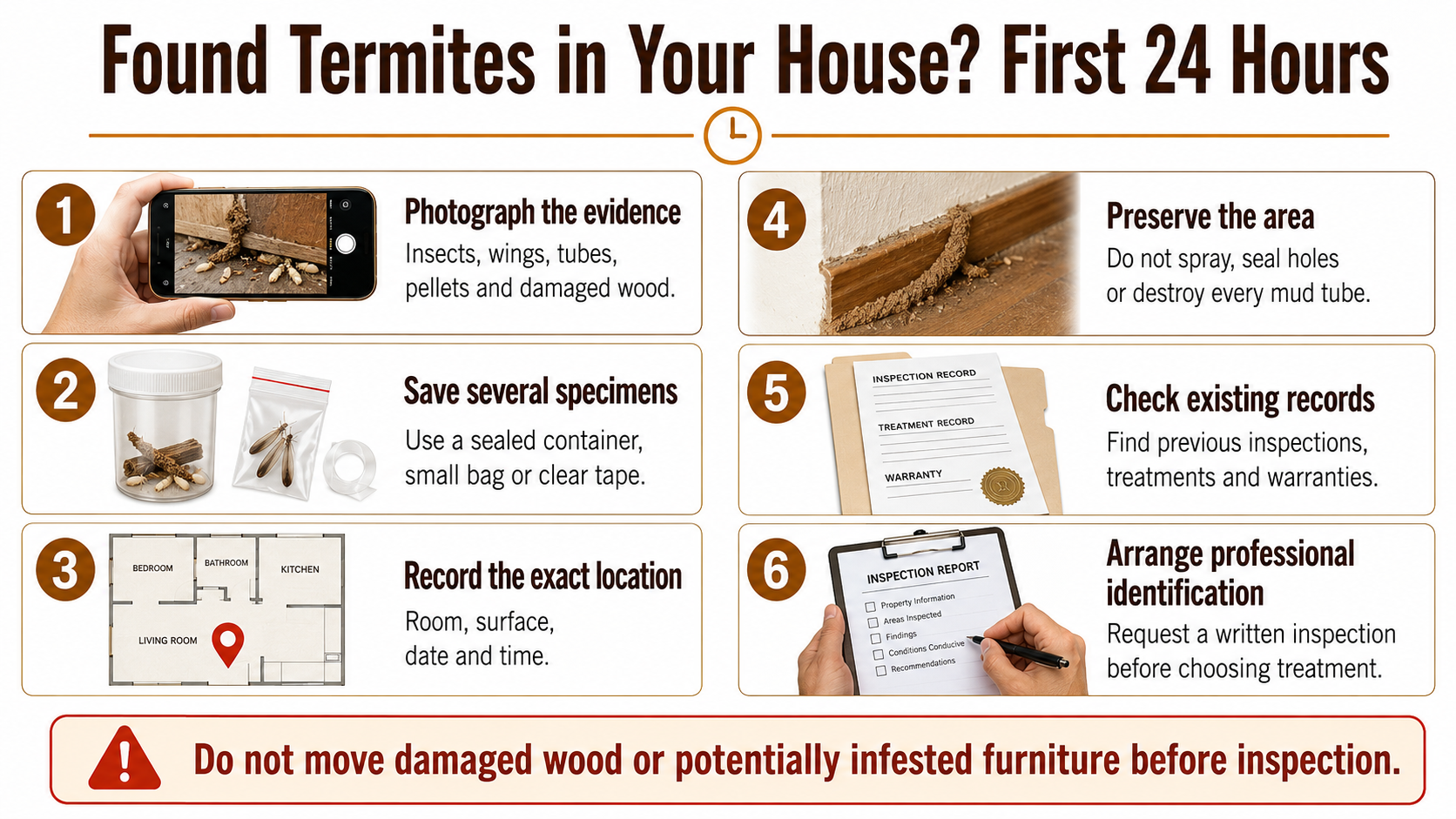
Our termite inspection guide explains what a complete professional examination should include. For a broader overview of available methods, see our termite control guide.
- What Different Termite Signs May Mean
- Flying Termites in the House
- Flying Termites vs. Flying Ants
- Discarded Termite Wings
- Mud Tubes on Foundations and Walls
- Termite Damage in Wood
- Drywood Termite Pellets and Kickout Holes
- What “Black Termites” and “White Termites” Usually Mean
- Where a Termite Nest May Be Located
- How Serious Are Termites in a House?
- What to Do During the First 24 Hours
- Moisture and Access Checks You Can Make Safely
- What Not to Do After Finding Termites
- What a Professional Termite Inspection Should Determine
- Termite Treatment Options
- DIY Termite Treatment Limits
- How to Compare Termite Companies
- Termite Evidence Photo Checklist
- Frequently Asked Questions
- What should I do immediately after finding termites in my house?
- Do flying termites inside mean the house is infested?
- How can I tell flying ants from termites?
- Do discarded wings mean termites are still active?
- Does breaking a mud tube kill termites?
- What do drywood termite droppings look like?
- Do termite pellets prove that an infestation is active?
- Should I remove termite-damaged wood immediately?
- Can I spray termites myself?
- Will fixing a leak get rid of termites?
- Do I need to leave the house after finding termites?
- How much does termite treatment cost?
- Who pays for termite treatment in a rental property?
- When should I call a termite professional?
What Different Termite Signs May Mean
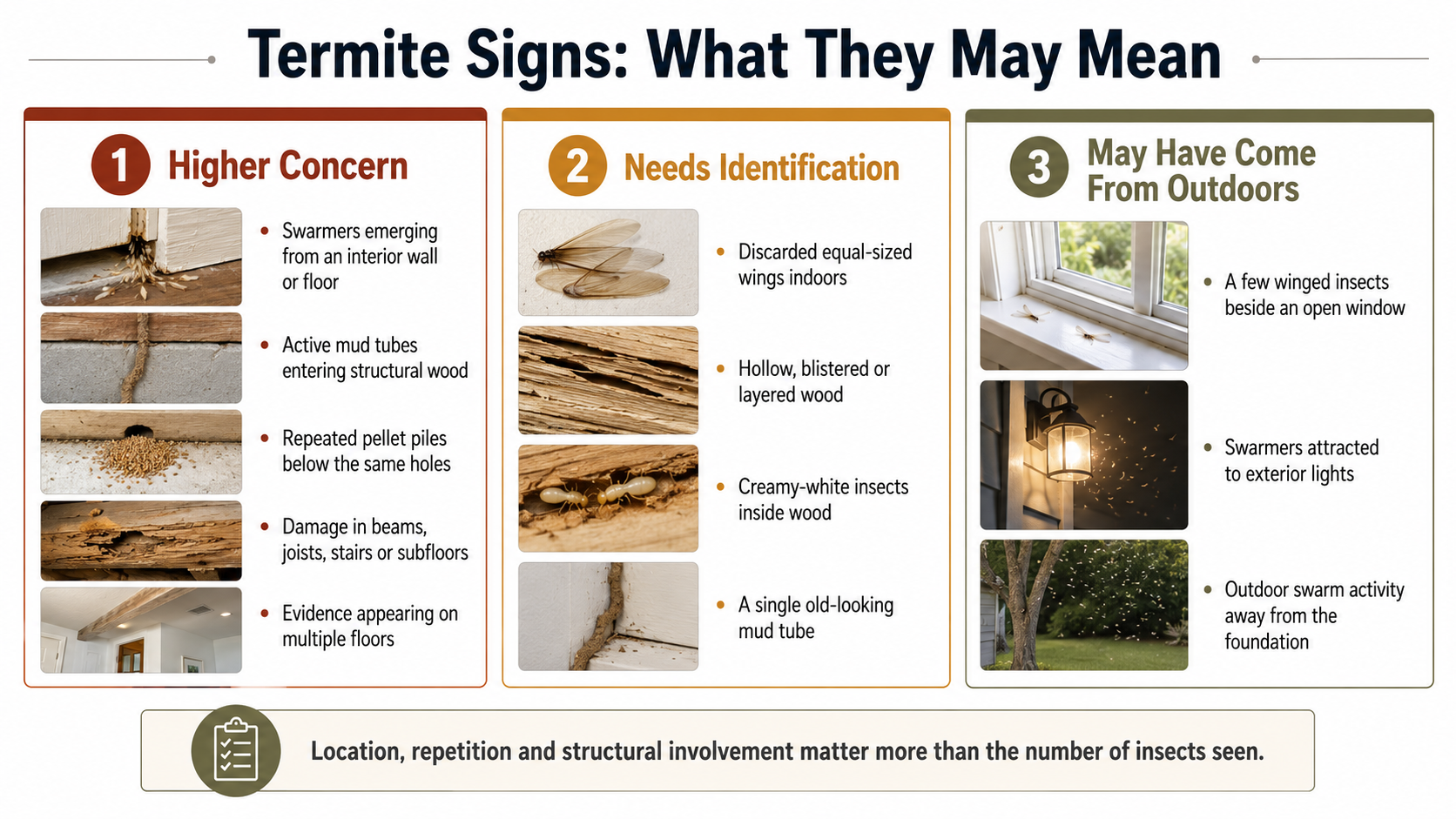
Not every termite-related sign carries the same level of concern. The location, repetition, termite type, and involvement of structural wood matter more than the number of insects seen during a single moment.
| Observed sign | What it may mean | Best next action |
|---|---|---|
| Winged termites emerging from an interior wall, floor, ceiling, or wood | A mature colony is likely active in or directly beneath the structure | Preserve specimens and request a prompt professional inspection |
| Large numbers of discarded equal-sized wings indoors | Termite swarmers may have emerged from a nearby concealed location | Document the location and inspect the surrounding wall, trim, floor, ceiling, and window area |
| A few winged insects beside an open window | They may have entered during an outdoor swarm, particularly when attracted to lights | Preserve and identify the insects before assuming the house is infested |
| Mud tubes on a foundation, pier, plumbing penetration, or wall | Subterranean termites may be traveling between soil and structural wood | Leave representative evidence intact and arrange an inspection |
| Small piles of hard, uniform pellets below tiny holes | Drywood termites may be pushing fecal pellets from galleries inside the wood | Save pellets, photograph the holes, and request a species-specific inspection |
| Soft, hollow, blistered, layered, or honeycombed wood | Termites or another wood-destroying organism may have damaged the material | Avoid aggressive probing in structural components and obtain a professional evaluation |
| Creamy-white insects exposed inside wood or a tube | They may be termite workers, nymphs, or pale-bodied colony members | Capture several specimens without dismantling the surrounding area |
| Flying insects with narrow waists and unequal wings | They are more consistent with winged ants | Preserve specimens for identification; termite treatment may not be appropriate |
Flying Termites in the House
Flying termites are reproductive adults known as swarmers or alates. They leave a mature colony to mate and attempt to start new colonies. The workers that feed on wood normally remain concealed in soil, shelter tubes, galleries, or structural materials.
Finding swarmers indoors is one of the most visible termite warnings. However, the location, species, and number of insects still matter:
- Swarmers visibly emerging from the structure: strong evidence that a mature colony is active in or beneath the building.
- Large numbers of dead swarmers or discarded wings indoors: often indicate emergence from a nearby concealed location.
- A few insects entering near an open window or exterior light: they may have arrived from an outdoor colony, depending on the species, season, and local conditions.
- Swarmers outdoors away from the building: show that termites are present in the environment but do not prove that the structure is infested.
Mississippi State University Extension explains that subterranean termite colonies generally require several years to become large enough to produce swarmers. Killing the visible flying termites does not eliminate the established colony that produced them.
Flying Termites vs. Flying Ants
Winged ants are frequently mistaken for termite swarmers. Color alone is unreliable because termites and ants can both appear dark brown, black, reddish, yellow, or tan depending on the species and caste.
| Feature | Winged termite | Winged ant |
|---|---|---|
| Waist | Broad and relatively straight, without a narrow constriction | Narrow and visibly pinched |
| Antennae | Straight, beadlike, or gently drooping | Elbowed |
| Wings | Four wings approximately equal in length | Front wings noticeably longer than rear wings |
| Body | More uniform or rectangular through the middle | Distinct body sections separated by a narrow waist |
| Wing loss | Wings detach easily and may accumulate near emergence points | Wings generally remain attached longer |
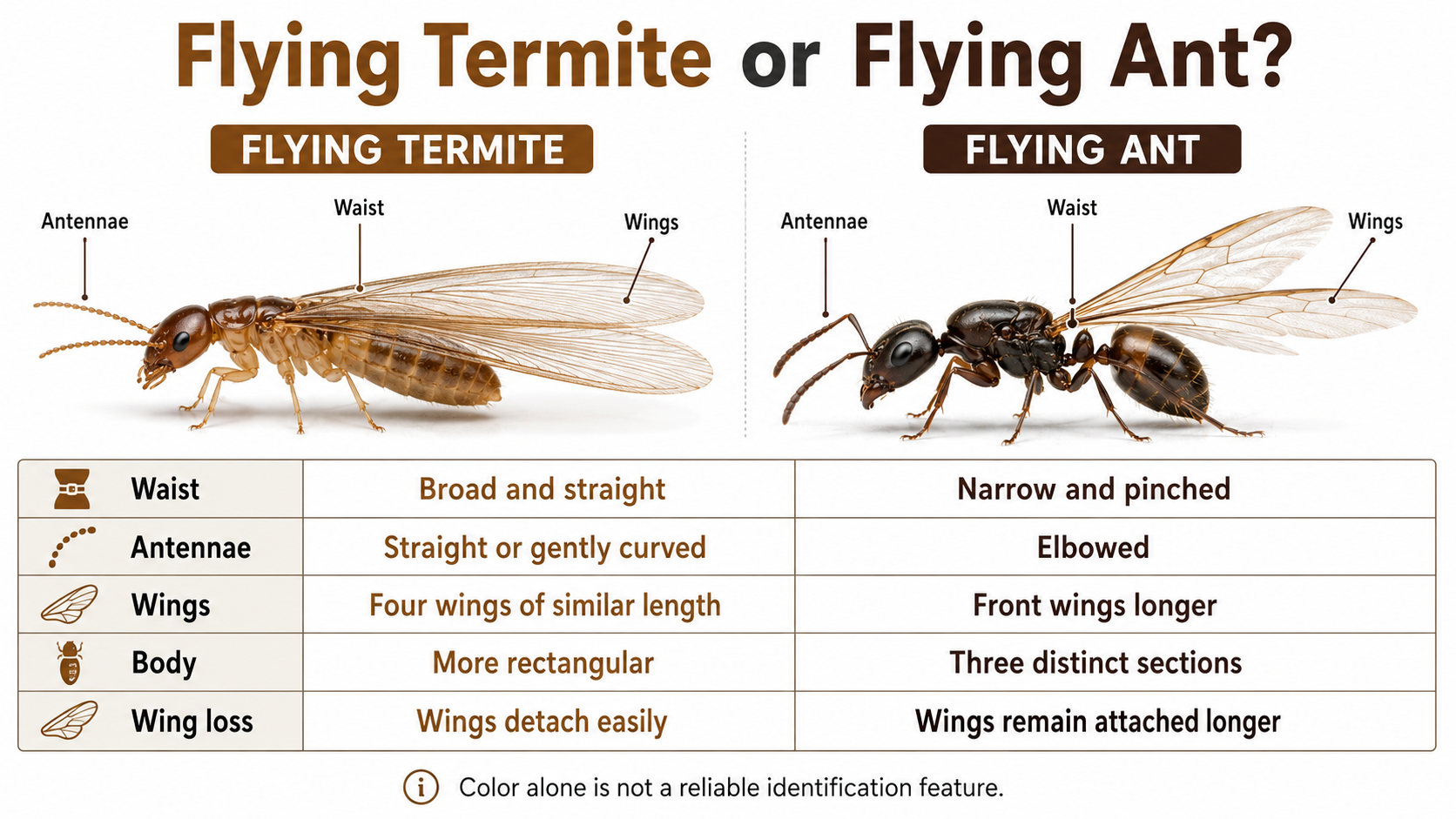
The U.S. Environmental Protection Agency identifies roughly equal-length wings and straighter antennae as important termite characteristics. When a specimen is damaged, very small, or incomplete, identification may require an extension diagnostic service or pest professional.
Discarded Termite Wings
After a short flight, termite swarmers land and shed their wings. Piles of translucent wings may collect:
- On windowsills
- Near doors
- Around floor vents
- Beneath light fixtures
- Beside baseboards
- Near cracks in walls or ceilings
Wings without bodies can still be useful evidence. Photograph the pile before cleaning and place several wings in a small container or plastic bag.
Look closely at the surrounding area for:
- A small emergence crack or hole
- Loose trim or molding
- Mud or soil deposits
- Soft or blistered wood
- Additional insects behind curtains or furniture
Do not immediately seal an apparent emergence point. Sealing a hole may hide useful evidence without affecting the colony behind it.
Mud Tubes on Foundations and Walls
Subterranean termites usually live in soil and build shelter tubes when they must travel across exposed concrete, masonry, metal, wood, or another open surface. The tubes help conserve moisture and protect the termites from dry air and predators.
Common mud-tube locations include:
- Exterior foundation walls
- Crawl-space piers
- Basement walls
- Slab edges
- Plumbing and utility penetrations
- Support posts
- Behind siding, stucco, foam insulation, or wall finishes
A visible tube is significant, but it may be active, inactive, abandoned, or left from a previous infestation. An inspector should evaluate it together with the treatment history, structural conditions, moisture, and evidence elsewhere in the building.
Do not assume that scraping away one tube controls the problem. The colony and other hidden travel routes can remain. Never pour bleach, fuel, oil, household cleaner, or an unlabeled pesticide into a tube, wall, or foundation opening.
Termite Damage in Wood
Termite damage can remain concealed behind paint, drywall, flooring, trim, insulation, cabinets, and finished surfaces.
Possible signs include:
- Wood that sounds hollow when gently tapped
- Thin surface layers covering internal galleries
- Blistered, sunken, or rippled paint
- Flooring that develops unexplained soft areas
- Door or window frames that become distorted
- Earth-like material lining wood galleries
- Wood that breaks into layered or honeycombed channels
These symptoms are not exclusive to termites. Water damage, fungal decay, carpenter ants, powderpost beetles, and construction defects can create similar conditions.
Do not aggressively probe a beam, joist, stair, support post, subfloor, or other load-bearing component. When material appears severely weakened, sagging, cracked, or unstable, restrict access to the immediate area and consult a qualified building professional or structural engineer in addition to a termite specialist.
Drywood Termite Pellets and Kickout Holes
Drywood termites live within wood and do not require a continuous connection to soil. They push fecal pellets from small openings commonly called kickout holes.
Drywood termite pellets are typically:
- Hard and dry
- Small and relatively uniform
- Elongated with rounded ends
- Ridged or flattened along the sides
- Variable in color depending on the wood
Pellets may accumulate beneath furniture, trim, rafters, window frames, beams, flooring, or other infested wood.
The University of California Statewide Integrated Pest Management Program explains that pellets can support a drywood termite identification, but pellets alone cannot determine how extensive an infestation is or conclusively establish that it is currently active. Old pellets may fall after vibration or movement.
After documenting and collecting a sample, an inspector may clean a small area and monitor it for new pellets. Do not inject an aerosol or household chemical into a suspected kickout hole before identification.
What “Black Termites” and “White Termites” Usually Mean
Homeowners often describe termites by color, but color frequently reflects the termite’s caste or developmental stage rather than the species.
Black or dark termites
Dark brown or black termites are commonly winged reproductive swarmers. Their pigmentation, developed eyes, and wings allow them to leave the protected colony environment during a reproductive flight.
White or pale termites
Creamy-white, pale, wingless termites are commonly workers or developing colony members. Workers feed on cellulose and account for most structural feeding damage. Soldiers can also have pale bodies, although their heads are often darker and more heavily developed.
Pale termites avoid open light and dry air. Seeing them usually means a piece of wood, shelter tube, or another protected area has been disturbed.
Identification should not be based on color alone. Save workers, soldiers, and swarmers when possible because different castes provide different identification features.
Where a Termite Nest May Be Located
A termite “nest” does not always mean one visible mound or a single removable object. Colony structure differs among termite groups.
| Termite group | Typical colony relationship | Common structural clue |
|---|---|---|
| Subterranean termites | Primarily nest in soil and forage into structures | Mud tubes, soil-lined galleries, or activity near foundations |
| Formosan subterranean termites | Usually originate from soil but can establish aboveground colonies when sufficient moisture is available | Extensive tubes, carton-like material, upper-level activity, or moisture-associated aerial colonies |
| Drywood termites | Colonies live entirely inside dry wood | Pellets, kickout holes, localized galleries, and seasonal swarmers |
| Dampwood termites | Colonies develop in very moist, decaying, or water-damaged wood | Activity associated with leaks, rot, persistent moisture, or exterior wood |
How Serious Are Termites in a House?
Termites should be addressed promptly, but finding termite evidence does not automatically mean the house is about to collapse.
Severity depends on:
- Termite type
- Colony size and maturity
- Duration of activity
- Number and location of affected structural components
- Moisture and construction conditions
- Previous treatments
- Whether activity is localized or widespread
- Whether the damage has reduced the strength of structural material
Evidence suggesting a higher-priority inspection includes:
- Swarmers emerging from multiple interior locations
- Active mud tubes entering structural wood
- Damage in beams, joists, subfloors, stairs, columns, or supports
- New drywood pellets repeatedly appearing in several areas
- Evidence on multiple floors
- Visible sagging, movement, cracking, or loss of material strength
Evidence that still requires identification but may be less urgent includes one damaged winged insect beside an open window or an outdoor swarm well away from the foundation.
See our termite infestation signs guide for a deeper evidence-by-evidence assessment.
What to Do During the First 24 Hours
- Preserve evidence. Save insects, wings, pellets, and photographs.
- Mark locations. Use removable tape near tubes, holes, pellet piles, or damaged areas without covering the evidence.
- Check property records. Find previous inspections, treatment diagrams, contracts, warranties, and repair invoices.
- Contact the warranty provider. Do not disturb the area before the company evaluates it.
- Check obvious moisture sources. Note plumbing leaks, roof leaks, drainage problems, wet crawl spaces, and damp wood.
- Arrange identification and inspection. Obtain a written report before selecting a treatment.
You generally do not need to leave the home simply because swarmers, wings, pellets, or a mud tube were found. Restrict access or leave the affected area when structural material appears unstable, or when a pesticide label and professional treatment instructions require occupants to vacate.
Moisture and Access Checks You Can Make Safely
Without dismantling the building, note:
- Leaking faucets, drains, supply lines, water heaters, or appliances
- Roof, flashing, siding, or window leaks
- Clogged gutters and downspouts
- Soil sloping toward the foundation
- Standing water beside the house
- Wood siding, lattice, stairs, or posts touching soil
- Firewood, stumps, cardboard, mulch, or lumber beside the foundation
- Blocked crawl-space vents
- Dense vegetation hiding the foundation edge
- Foam insulation, stucco, or exterior finishes extending below grade
The EPA recommends keeping soil around foundations dry, repairing leaks, maintaining drainage and ventilation, reducing foundation openings, keeping wood debris away from the structure, and inspecting periodically.
Correcting moisture and access conditions supports termite management but does not eliminate an established colony by itself.
What Not to Do After Finding Termites
- Do not spray visible swarmers and assume the colony is gone.
- Do not destroy every mud tube before inspection.
- Do not cover tubes, holes, or damage with paint or caulk immediately.
- Do not remove infested wood before documenting the evidence and treatment scope.
- Do not move potentially infested furniture, lumber, or firewood into another building.
- Do not drill walls, floors, or slabs without understanding utilities and construction.
- Do not use agricultural, outdoor-only, or unlabeled pesticides inside the house.
- Do not pour fuel, oil, bleach, or household chemicals into soil, walls, holes, or tubes.
- Do not choose a treatment solely from a phone price without an inspection.
- Do not assume that repairing damaged wood will eliminate termites elsewhere.
What a Professional Termite Inspection Should Determine
A professional inspection should answer:
- Are the specimens actually termites?
- Which termite group or species is most likely involved?
- Is the evidence active, historical, or uncertain?
- Where are the entry points, tubes, pellets, galleries, or damaged components?
- Which areas could not be accessed or inspected?
- Are moisture or construction conditions contributing to the problem?
- Is treatment localized, perimeter-based, soil-applied, bait-based, or whole-structure?
- Are repairs or an additional structural evaluation needed?
Ask for photographs, a treatment diagram, inaccessible-area notes, proposed products or systems, preparation requirements, warranty language, follow-up schedule, and total price.
Our termite inspection cost guide explains paid inspections, free sales inspections, real-estate reports, and possible additional diagnostic charges.
Termite Treatment Options
The appropriate treatment depends on termite type, construction, infestation distribution, access, moisture, local regulations, and the directions on the pesticide or system label.
| Treatment approach | Where it may fit | Important limitation |
|---|---|---|
| Liquid soil-applied termiticide | Subterranean termites entering from soil | Application requires correct trenching, drilling, treatment volume, and protection of wells, drains, utilities, and occupied areas |
| Termite bait system | Subterranean termite colony management and ongoing monitoring | Requires correct placement, periodic inspection, maintenance, and time for colony-level effects |
| Localized wood or void treatment | Accessible and clearly defined activity in specific structural components | May miss concealed galleries, separate colonies, or activity outside the treated area |
| Whole-structure drywood treatment | Multiple, widespread, or inaccessible drywood termite colonies | Requires specialized professional methods and does not prevent future reinfestation |
| Wood repair or replacement | Components that are severely damaged, weakened, or removable | Repairing wood alone does not control termites in soil or untreated structural materials |
The EPA recognizes soil-applied barrier treatments, termite baits, treated building materials, and wood treatments as major termite-control categories. Structural termiticide applications should generally be performed by trained and appropriately licensed professionals.
DIY Termite Treatment Limits
Homeowners can reduce moisture, remove wood debris, improve inspection access, correct drainage, and monitor visible conditions. These actions are useful but should not be confused with eliminating a structural infestation.
DIY products may fail because:
- The termite type was misidentified.
- The colony or galleries extend beyond the visible location.
- The product is not labeled to protect a structure.
- Required soil volumes and treatment zones are not achieved.
- Concrete slabs, drains, ducts, wells, utilities, and hidden voids complicate application.
- Drywood termite colonies remain concealed in separate pieces of wood.
- Visible insects represent only a small portion of the colony.
Improper liquid termiticide application can leave untreated gaps or contaminate occupied areas and nearby water sources. Follow every pesticide label and applicable state and local requirement.
How to Compare Termite Companies
Obtain more than one written proposal when structural conditions and timing permit.
Compare:
- Evidence used to confirm termites
- Termite identification
- Treatment area and method
- Product or bait system
- Preparation and access requirements
- Repair exclusions
- Number and frequency of follow-up visits
- Annual inspection or renewal charges
- Retreatment warranty
- Damage-repair warranty, when offered
- Transferability if the home is sold
- Conditions that void coverage
A low initial price can become expensive when monitoring, renewals, drilling, preparation, detached structures, additional treatments, or repairs are excluded. Review typical pricing factors in our termite treatment cost guide.
Termite Evidence Photo Checklist
| Evidence | What to capture |
|---|---|
| Winged insects | Top view, side view, antennae, waist, all four wings, and a ruler or coin for scale |
| Discarded wings | Full pile, close-up, window or wall location, and any nearby crack or hole |
| Mud tubes | Full route, foundation context, close-up texture, and the point where the tube reaches wood |
| Pellets | Full pile, close-up with scale, suspected kickout hole, and the wood surface above |
| Wood damage | Wide structural context, close-up galleries, moisture staining, and approximate affected dimensions |
| Property conditions | Leaks, drainage, wood-to-soil contact, crawl spaces, siding clearance, vegetation, and stored wood |
Frequently Asked Questions
What should I do immediately after finding termites in my house?
Photograph the evidence, preserve several specimens, record the exact location, avoid spraying or dismantling the area, check any existing termite warranty, and arrange a professional inspection.
Do flying termites inside mean the house is infested?
Swarmers emerging directly from a wall, floor, ceiling, trim, or structural wood strongly suggest nearby structural activity. Large numbers indoors are also concerning. A few insects beside an open window may have entered from outside and still require identification.
How can I tell flying ants from termites?
Termites generally have broad waists, straighter antennae, and four wings of approximately equal length. Ants have narrow waists, elbowed antennae, and front wings that are longer than the rear wings.
Do discarded wings mean termites are still active?
Discarded wings show that swarmers were present and may have emerged nearby. An inspection is needed to determine where they came from and whether the colony remains active.
Does breaking a mud tube kill termites?
No. Removing a visible section of tube does not eliminate the colony or the other concealed routes termites may use.
What do drywood termite droppings look like?
They are small, hard, relatively uniform pellets with rounded ends and ridged or flattened sides. Expert identification may be needed to distinguish them from beetle debris, sawdust, or other material.
Do termite pellets prove that an infestation is active?
No. Pellets can remain or fall from old galleries after vibration. New pellets repeatedly appearing after an area has been cleaned provide stronger evidence of current activity, but a professional inspection is still needed.
Should I remove termite-damaged wood immediately?
Not before inspection and documentation. Premature removal can destroy evidence, move infested material, conceal the original distribution, and make it harder to define the treatment scope.
Can I spray termites myself?
Spraying visible insects rarely reaches the colony. Structural termite treatment may require specialized products, equipment, drilling, soil application, monitoring, licensing, and knowledge of the building.
Will fixing a leak get rid of termites?
Repairing leaks and moisture problems is important, but it does not reliably eliminate an established colony. Moisture correction should support, not replace, the recommended termite treatment.
Do I need to leave the house after finding termites?
Usually not simply because termite evidence was found. Restrict access when structural material appears unstable, and follow all vacancy and reentry instructions when a professional treatment requires occupants to leave.
How much does termite treatment cost?
Cost depends on termite type, property size, construction, treatment method, infestation distribution, access, follow-up, and warranty coverage. An inspection is generally necessary for an accurate quote.
Who pays for termite treatment in a rental property?
Responsibility varies by state and local law, lease terms, property condition, and the cause or history of the infestation. Tenants and landlords should document the evidence, notify the appropriate party promptly, and review the lease and applicable local requirements.
When should I call a termite professional?
Arrange an inspection after suspected indoor swarmers, discarded wing piles, mud tubes, drywood pellet piles, damaged structural wood, repeated activity, or an uncertain insect identification.
