
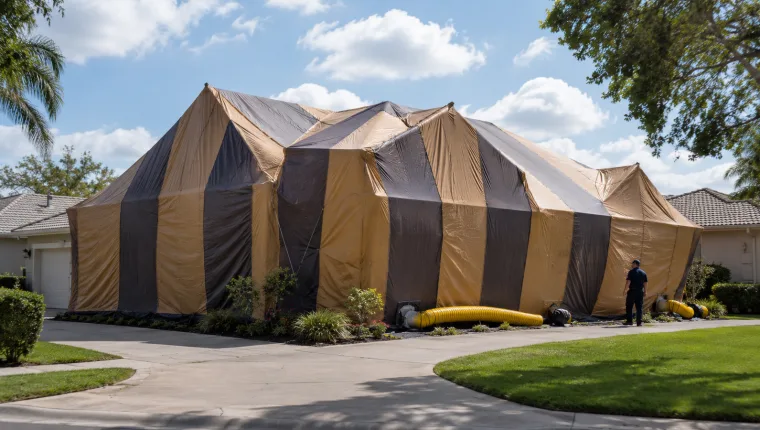
Termite tenting is a whole-structure fumigation process used mainly when drywood termite colonies may be widespread, hidden, or impossible to map confidently with localized inspection. A licensed fumigation company encloses the structure, introduces a registered fumigant, maintains the treatment under controlled conditions, aerates the building, and tests the air before authorizing reentry.
The main decision factor is infestation coverage. Tenting is most defensible when the risk of missed colonies is greater than the cost, disruption, and preparation
required for whole-structure treatment. It is not automatically necessary for every pellet pile, damaged board, or single furniture item.
Termite tenting also has important limits:
- It does not repair damaged wood.
- It does not leave a lasting barrier after the gas dissipates.
- It does not prevent a later drywood termite introduction.
- It is not a substitute for soil treatment or baiting when an underground subterranean colony is the problem.
- Occupants cannot perform the process themselves.
Begin with a documented termite inspection that identifies the termite group, evidence locations, inaccessible areas, and probable distribution. Our termite control guide explains how fumigation fits among soil treatment, bait systems, wood treatments, heat, and prevention.
- How Termite Tenting Works
- When Termite Tenting Is Considered
- Termite Tenting and Subterranean Termites
- What Tenting Can and Cannot Do
- Termite Tenting Preparation
- What Happens During the Fumigation Process?
- How Long Does Termite Tenting Take?
- Reentry After Termite Tenting
- Do You Need to Wash Everything After Tenting?
- Termite Tenting vs. Local Treatment vs. Heat
- How Much Does Termite Tenting Cost?
- Common Reasons Tenting Does Not Solve the Entire Problem
- How to Choose a Fumigation Company
- Professional Fumigation Preparation Checklist
- Frequently Asked Questions
- What is termite tenting?
- What termites require tenting?
- Does termite tenting kill every termite?
- Does tenting kill termite eggs?
- How long do you stay out after termite tenting?
- Can I enter after the tent is removed?
- How is a home cleared after fumigation?
- Do I need to remove all food?
- Do medications need to be removed?
- Do pets and plants have to leave?
- Does fumigation leave a residue?
- Do I need to wash everything afterward?
- Is heat treatment an alternative to tenting?
- Can local treatment replace tenting?
- Will termite tenting prevent reinfestation?
- When should I call a fumigation specialist?
How Termite Tenting Works
Structural fumigation treats the enclosed volume of a building rather than one visible gallery at a time. The structure is covered or otherwise sealed according to the registered product label and local rules. A certified applicator introduces the fumigant, monitors the treatment, begins aeration, and verifies clearance before anyone returns.
EPA identifies sulfuryl fluoride as the only fumigant currently registered for residential structural use in the United States. It is colorless, odorless, and classified as a restricted-use pesticide. Residential labels require chloropicrin as a warning agent because sulfuryl fluoride cannot be detected by smell.
At a consumer level, the process has six stages:
- Confirm the pest and determine whether whole-structure coverage is justified.
- Receive a written contract, preparation instructions, and anticipated vacancy window.
- Prepare food, medications, pets, plants, access points, exterior areas, and belongings as directed.
- Vacate the structure and allow the licensed team to secure and fumigate it.
- Allow the company to aerate and perform required clearance testing.
- Reenter only after the certified operator provides authorization.
The exact fumigant quantity, exposure period, sealing method, fan placement, warning-agent procedure, aeration sequence, and monitoring protocol belong to the certified applicator and product label. They should not be improvised from online instructions.
When Termite Tenting Is Considered
Tenting is most closely associated with drywood termites
because their colonies live entirely inside wood and can occur in several unconnected structural areas.
A company may recommend whole-structure fumigation when:
- Pellets or swarm evidence occur in several rooms or exterior components.
- Colonies may be hidden in roofs, walls, eaves, floors, trim, or inaccessible framing.
- Previous localized treatments did not stop recurring activity.
- The inspection cannot establish that activity is limited to one reachable item.
- The building contains numerous finished surfaces that restrict gallery access.
- The owner wants broader one-event coverage rather than repeated localized treatment.
Tenting may be excessive when the evidence is limited to one removable piece of furniture, one nonstructural board, or one clearly mapped colony that can be treated and monitored effectively.
The Florida Department of Agriculture and Consumer Services describes structural tent fumigation as a common professional option for extensive drywood termite infestations, alongside heat and localized treatments.
Termite Tenting and Subterranean Termites
Subterranean termites normally maintain colonies in soil or another moist location and enter buildings through underground routes or mud tubes. Tenting can kill termites present inside the enclosed structure, but it does not create a treated soil zone or eliminate every underground colony outside the tent.
Properties with subterranean termites are generally evaluated for:
- Liquid soil-applied termiticide
- Professional termite bait stations
- Localized structural treatment
- Moisture and wood-to-soil corrections
- Continuing monitoring
A proposal for tenting should identify the termite group. If the inspection documents mud tubes and soil-connected activity, ask how the underground source will be addressed after the structure is reopened.
What Tenting Can and Cannot Do
| Question | What tenting can do | What it cannot guarantee |
|---|---|---|
| Hidden colonies | Fumigant gas can penetrate many inaccessible structural spaces within the enclosed treatment area | It cannot treat areas excluded from the enclosure or separate untreated structures |
| Drywood termite life stages | A properly performed fumigation is designed to control termites present in the enclosed structure | It cannot prevent new swarmers from establishing later |
| Damage | It can stop feeding by termites killed during treatment | It does not restore wood strength or replace damaged components |
| Subterranean colonies | It may kill subterranean termites present above ground inside the enclosure | It does not provide a soil barrier or eliminate every underground colony |
| Residual protection | The structure is cleared after the fumigant dissipates | No lasting fumigant barrier remains after aeration |
| Future monitoring | It provides a clear treatment event that can be documented | It does not replace inspections, prevention, or warranty follow-up |
Termite Tenting Preparation
The fumigation company must provide a property-specific checklist based on the current product label, state rules, structure, target pest, and treatment plan. Their instructions control; a general internet checklist does not.
Food, Medication, and Ingestible Products
Food, beverages, medications, tobacco products, pet food, animal feed, and other ingestible items may need to be removed or sealed in special fumigation bags supplied or approved for that purpose. Factory-sealed items may be treated differently under the label.
Do not assume ordinary storage bags, containers, refrigerators, freezers, cabinets, or unopened retail packaging meet the fumigator’s requirements. Ask for written direction on:
- Prescription and over-the-counter medication
- Vitamins and supplements
- Infant formula and baby food
- Pet food and treats
- Refrigerated and frozen products
- Opened and unopened pantry goods
- Wine, liquor, and other beverages
- Tobacco and edible products
People, Pets, and Plants
Every person and animal must leave before fumigation begins. This includes fish, reptiles, birds, small mammals, and animals that may be hiding in the structure. Indoor plants are normally removed.
Tell the company about:
- Aquariums and terrariums
- Service animals and indoor pets
- Attic, crawl-space, or garage animals
- Beehives or sensitive outdoor animals nearby
- People who may attempt to enter for medication, work equipment, or valuables
Arrange lodging, transportation, prescriptions, work materials, chargers, keys, identification, and essential documents before the final walkthrough. No one may return briefly while the structure is under fumigation or aeration.
Exterior and Access Preparation
The company may require access to gates, rooms, attics, garages, sheds, crawl spaces, cabinets, and locked areas. Exterior preparation can involve trimming plants away from the building, moving furniture or stored items, and addressing soil or irrigation near the enclosure.
Ask who is responsible for:
- Unlocking interior and exterior spaces
- Managing alarms and access systems
- Moving vehicles
- Trimming landscaping
- Protecting roof, gutters, solar components, antennas, and exterior equipment
- Notifying neighbors, property management, or attached-unit occupants
- Securing the property during vacancy
Belongings and Sensitive Materials
Most ordinary furnishings remain inside, which is one advantage of structural fumigation. However, the company should identify items that must be removed, opened, protected, or handled separately.
Discuss:
- Mattresses with waterproof coverings
- Safes and locked cabinets
- Medical equipment
- Valuable artwork and instruments
- Vehicles inside attached garages
- Waterbeds and unusual sealed containers
- Plastic-covered furniture or storage
- Items governed by product-specific instructions
What Happens During the Fumigation Process?
After preparation is verified, the licensed company controls the site. Warning signs and barriers are posted, access is restricted, and the fumigation team follows the registered label and applicable state requirements.
EPA’s current residential mitigation framework includes site-specific fumigation logs, additional training, warning requirements, updated clearance-device provisions, and longer aeration procedures on amended labels approved in July 2024.
Homeowners should expect documentation covering:
- Company and certified applicator
- Target pest
- Structure and treatment areas
- Preparation confirmation
- Fumigation and aeration dates
- Clearance authorization
- Warranty and follow-up
Do not enter the tent, move warning signs, reconnect systems, retrieve belongings, feed pets, or inspect the structure during treatment or aeration.
How Long Does Termite Tenting Take?
The complete process usually includes preparation, enclosure setup, fumigation, exposure time, aeration, clearance testing, and reentry. The vacancy window varies by structure, weather, fumigant label, target pest, treatment plan, and local requirements.
A company may provide an anticipated schedule, but reentry cannot be guaranteed solely by the clock. The building must meet the clearance requirement before the certified operator releases it.
Ask the proposal to distinguish:
- When preparation must be completed
- When keys are transferred
- When fumigation begins
- When active and passive aeration occur
- When clearance testing is expected
- Who can authorize reentry
- What happens if weather or testing delays the schedule
Reentry After Termite Tenting
Do not reenter until the certified operator or authorized person has cleared the structure. EPA requires sulfuryl fluoride levels to be at or below 1 part per million in the breathing zones of each room before residential reentry.
The EPA clearance-device guidance explains that the certified operator must verify that the fumigant has dissipated using an effective portable analyzer. Smell is not a clearance method because sulfuryl fluoride is odorless.
Before taking possession, ask for:
- Written or documented clearance
- The date and approximate time of clearance
- Confirmation that every room and required breathing zone was checked
- Instructions for opening windows, operating ventilation, and restoring utilities
- A contact number for questions or suspected exposure
Chloropicrin, the warning agent, has a pungent odor and may cause eye or respiratory irritation. Any unexpected symptoms or suspected exposure after fumigation warrant leaving the structure and obtaining urgent professional guidance.
Do You Need to Wash Everything After Tenting?
Properly aerated sulfuryl fluoride fumigation is not intended to leave a surface coating throughout the home. Routine washing of every wall, dish, article of clothing, and piece of furniture is not generally the basis of clearance.
However, follow the provider’s current written instructions for food-contact items, special packaging, warning-agent residue, dust, preparation materials, and anything handled during the service. Do not rely on a generic claim that either “everything must be washed” or “nothing ever needs cleaning.”
Termite Tenting vs. Local Treatment vs. Heat
| Method | Where it fits | Main strength | Main limitation |
|---|---|---|---|
| Localized wood or gallery treatment | One or a small number of accurately mapped colonies | Less disruption and lower treatment scope | Hidden colonies may be missed |
| Removal of infested wood or furniture | One removable item or replaceable component | Physically removes the known colony | Fails if termites remain elsewhere |
| Professional localized heat or device-based treatment | Reachable, defined areas with compatible materials | Nonfumigant localized option | Coverage, heat sinks, and hidden colonies remain concerns |
| Whole-structure heat | Buildings suited to monitored heating | Broad treatment without fumigant gas | Cold spots, material sensitivity, and no residual protection |
| Whole-structure tent fumigation | Widespread, inaccessible, or uncertain drywood termite distribution | Treats accessible and inaccessible areas within the enclosure simultaneously | Evacuation, preparation, licensing, cost, and no residual protection |
UF/IFAS describes both structural fumigation and whole-structure heat as broad drywood termite treatments. Both can control hidden insects when performed correctly, and both leave the building open to future reinfestation after treatment ends.
How Much Does Termite Tenting Cost?
Pricing depends on structure volume, regional labor, access, roof shape, enclosure complexity, target pest, preparation support, attached structures, insurance, permits, and warranty terms. Companies may quote by cubic volume, structure, or treatment scope.
A useful quote should specify:
- Structures and attached areas included
- Preparation responsibilities
- Fumigation, aeration, and clearance
- Security and access arrangements
- Damage responsibility for roof, landscaping, gutters, antennas, or coverings
- Follow-up inspection
- Retreatment and warranty terms
- Excluded repairs and excluded structures
Compare the full scope using our termite treatment cost guide.
Common Reasons Tenting Does Not Solve the Entire Problem
- The termite group was misidentified.
- A detached garage, shed, fence, furniture item, or addition was not included.
- Subterranean termites continued entering from an untreated soil colony.
- Infested wood or furniture was brought back after treatment.
- New drywood termite swarmers established later.
- Old pellets or damage were mistaken for new activity.
- Structural repairs were not completed after termite control.
- The property lacked a post-treatment inspection and monitoring plan.
New pellets after tenting require investigation, but they do not automatically prove treatment failure. Old pellets can fall from galleries when wood is disturbed. Clean and document the area, then watch for repeated fresh deposits, live termites, or new swarmers.
How to Choose a Fumigation Company
Verify the company’s structural fumigation license or certification through the state pesticide regulator. General pest-control experience does not necessarily authorize fumigation.
Ask:
- What evidence confirms drywood termites?
- Why is whole-structure fumigation recommended instead of localized treatment or heat?
- Which structures and contents are included?
- Who is the certified applicator in charge?
- What current registered product and label apply?
- What written preparation checklist will be used?
- How is the property secured?
- Which clearance device is used?
- Who authorizes reentry?
- What warranty and follow-up are included?
Avoid providers that minimize evacuation, suggest that someone may enter briefly, fail to discuss ingestible items, or treat a scheduled time as automatic proof of safe reentry.
Professional Fumigation Preparation Checklist
| Category | What to confirm in writing |
|---|---|
| Diagnosis | Termite type, evidence locations, inaccessible areas, and why tenting is recommended |
| Scope | Main structure, attached garage, additions, decks, sheds, vehicles, and excluded areas |
| Food and medication | What must be removed, specially bagged, opened, or may remain sealed |
| People and animals | Vacancy dates, pets, aquariums, terrariums, service animals, and emergency access prohibition |
| Plants and exterior | Plant removal, trimming, irrigation, furniture, gates, landscaping, and roof equipment |
| Security | Keys, locks, alarms, warning signs, property access, and responsibility during vacancy |
| Aeration and clearance | Expected sequence, clearance device, certified operator, and reentry authorization |
| Aftercare | Ventilation, utilities, cleaning instructions, repairs, inspection, and warranty |
Frequently Asked Questions
What is termite tenting?
Termite tenting is a whole-structure fumigation in which a licensed company encloses a building, applies a registered fumigant, aerates the structure, and tests the air before reentry.
What termites require tenting?
Tenting is mainly considered for widespread or inaccessible drywood termite infestations. It is not the standard primary treatment for an underground subterranean colony.
Does termite tenting kill every termite?
A properly conducted fumigation is designed to control termites inside the enclosed treatment area. It does not treat excluded structures, underground colonies outside the enclosure, or future introductions.
Does tenting kill termite eggs?
Professional fumigation is designed to control the target pest according to the registered label and treatment plan, including hidden life stages present within the enclosure.
How long do you stay out after termite tenting?
The vacancy period varies. Reentry is allowed only after aeration and professional testing confirm the building meets the label’s clearance requirement.
Can I enter after the tent is removed?
No. Tent removal does not by itself authorize reentry. Wait for the certified operator’s clearance.
How is a home cleared after fumigation?
The fumigator aerates the building and uses an effective portable analyzer to verify sulfuryl fluoride is at or below 1 ppm in required breathing zones.
Do I need to remove all food?
Some food and ingestible products must be removed or sealed in special approved bags, while certain factory-sealed items may be handled differently. Follow the written provider instructions and current label.
Do medications need to be removed?
Medication handling is product- and label-specific. Ask the fumigator for written instructions covering prescriptions, over-the-counter products, vitamins, and medical supplies.
Do pets and plants have to leave?
Yes. People, pets, and indoor plants must be removed, and the company should be told about fish, reptiles, birds, and animals in attics or crawl spaces.
Does fumigation leave a residue?
Sulfuryl fluoride dissipates during aeration rather than leaving a protective surface coating. It also leaves no residual termite barrier.
Do I need to wash everything afterward?
Not necessarily. Follow the fumigator’s written aftercare instructions for food-contact items, warning-agent residue, preparation materials, and anything handled during service.
Is heat treatment an alternative to tenting?
Whole-structure heat can be an alternative for suitable buildings, but success depends on reaching lethal temperatures throughout target wood and avoiding cold spots or material damage.
Can local treatment replace tenting?
Localized treatment can work when every colony is accurately located and reached. Its main limitation is the possibility of hidden or separate colonies.
Will termite tenting prevent reinfestation?
No. Drywood termites can establish again after the structure is reopened. Inspection, maintenance, and prevention remain necessary.
When should I call a fumigation specialist?
Seek a licensed evaluation when drywood termite evidence appears in several areas, inaccessible structural wood is involved, or localized treatments have failed.
