
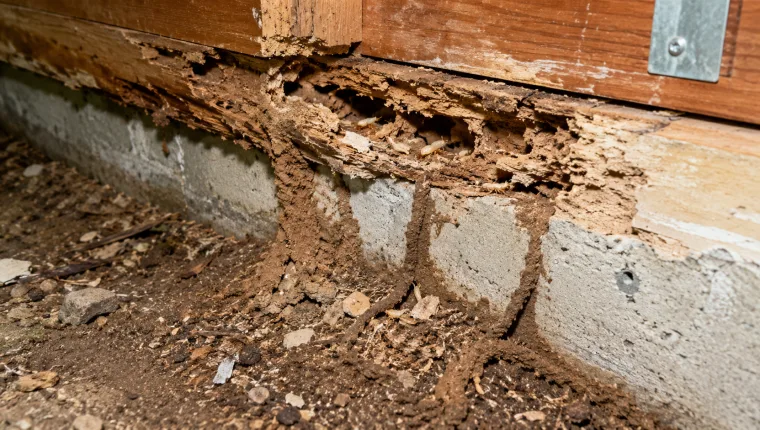
Subterranean termites are termites that normally live in soil and travel into buildings to feed on wood and other cellulose materials. They are the most common structural termite group across much of the United States. Their key identifying feature is the protected connection they maintain between a moist colony environment and the food source, often through soil-filled galleries or visible mud tubes.
The main decision factor after finding suspected subterranean termites is whether there is evidence of an active route between soil, moisture, and the structure. Indoor swarmers, fresh mud tubes, live workers, soil inside damaged wood, or repeated activity require a professional termite inspection. Spraying visible insects or breaking a tube does not control the hidden colony.
Subterranean termite management usually relies on one of two primary professional strategies:
- A liquid soil-applied termiticide designed to create a continuous treated zone around or beneath the structure
- A monitored bait system that uses termite foraging and food sharing to affect the colony over time
The correct choice depends on termite type, foundation design, access, soil conditions, moisture, previous treatment, wells and drains, infestation distribution, and warranty structure. Our termite inspection guide explains how these conditions should be documented before treatment. For the broader method overview, see our termite control guide.
- What Are Subterranean Termites?
- Subterranean Termite Castes
- Subterranean Termites vs. Drywood Termites
- Signs of Subterranean Termites
- Where Subterranean Termites Enter a House
- How Subterranean Termite Infestations Develop
- How Much Damage Can Subterranean Termites Cause?
- Professional Subterranean Termite Inspection
- Subterranean Termite Treatment Options
- Liquid Barrier vs. Termite Bait System
- Can You Treat Subterranean Termites Yourself?
- Subterranean Termite Prevention
- Monitoring After Treatment
- Common Subterranean Termite Mistakes
- When to Call a Termite Professional
- Foundation Termite Risk Checklist
- Frequently Asked Questions
- What are subterranean termites?
- What is the clearest sign of subterranean termites?
- Do subterranean termites always come from the ground?
- What do subterranean termite workers look like?
- What do subterranean termite mud tubes look like?
- Do subterranean termites leave droppings?
- Are subterranean termites worse than drywood termites?
- What is the best treatment for subterranean termites?
- How long do termite baits take to work?
- Can a spot treatment eliminate subterranean termites?
- Does fixing moisture eliminate subterranean termites?
- Can I treat subterranean termites myself?
- When should I call a termite professional?
What Are Subterranean Termites?
Subterranean termites are social insects that live in colonies divided into castes. A colony may contain workers, soldiers, reproductive swarmers, a queen and king, and developing immature termites.
Workers are soft-bodied, pale, wingless termites responsible for gathering food, maintaining galleries, feeding other colony members, and most structural damage. Soldiers defend the colony and have larger, darker heads with prominent mandibles or other defensive adaptations. Swarmers are winged reproductive adults that leave mature colonies to mate and attempt to establish new colonies.
Most native subterranean colonies are based in soil because workers lose moisture easily. They build protected tunnels through soil and mud tubes across concrete, masonry, metal, foam, and other exposed surfaces to reach structural wood.
The soil-contact rule has exceptions. Formosan subterranean termites can establish aboveground carton nests when enough moisture is available inside the structure. Native subterranean termites can also maintain unusual aboveground activity around long-term roof, plumbing, or condensation problems. The absence of an obvious soil tube therefore does not rule out subterranean termites.
Subterranean Termite Castes
| Caste | Appearance | Role | What finding it may mean |
|---|---|---|---|
| Worker | Creamy white, soft-bodied, wingless, with beadlike antennae | Feeds, excavates, repairs tubes, and maintains the colony | Live workers inside a tube or wood confirm active termite presence |
| Soldier | Pale body with a larger pigmented head and defensive jaws | Defends openings and damaged galleries | Useful for distinguishing termite groups, especially when workers look similar |
| Swarmer | Dark or pigmented body with four approximately equal-length wings | Leaves the colony to reproduce | Indoor emergence strongly suggests a mature colony in or beneath the structure |
| Dealate reproductive | Former swarmer that has shed its wings | Attempts to establish a new colony with a mate | May be found near a swarm site but does not reveal the parent colony’s full location |
| Immature termite | Small, pale developing form | Develops into a worker, soldier, or reproductive pathway | Usually remains hidden within the protected colony environment |
Subterranean Termites vs. Drywood Termites
Subterranean and drywood termites require different inspection and treatment strategies. Subterranean colonies usually originate in soil or another constant moisture source. Drywood termites live entirely inside relatively dry wood and do not require a continuous soil connection.
| Feature | Subterranean termites | Drywood termites |
|---|---|---|
| Primary colony location | Usually soil, with foraging routes into the structure | Inside wood |
| Moisture relationship | Normally require soil or another reliable moisture source | Obtain sufficient moisture from wood and metabolism |
| Common travel evidence | Mud tubes and soil-lined galleries | No soil tubes |
| Typical debris | Soil or mud inside damaged wood | Hard, dry fecal pellets pushed through kickout holes |
| Common treatment focus | Soil-applied liquid termiticide or bait system | Localized wood treatment or whole-structure treatment, depending on distribution |
| Monitoring focus | Foundation, soil access, tubes, stations, and conducive conditions | Pellets, kickout holes, swarm evidence, and infested wood |
Signs of Subterranean Termites
Mud Tubes
Mud tubes are narrow protective tunnels made from soil, termite secretions, and other material. They allow termites to cross exposed surfaces while maintaining a humid, dark environment.
Common locations include:
- Exterior foundation walls
- Basement walls
- Crawl-space piers and support posts
- Slab edges
- Plumbing and utility penetrations
- Behind siding, stucco, foam insulation, or stored materials
- Inside expansion joints and foundation cracks
A tube can be active, inactive, abandoned, or associated with an older treated infestation. A professional should interpret it with the building’s treatment history and other evidence. Destroying the visible tube does not eliminate the colony.
Indoor Swarmers and Discarded Wings
Subterranean termite swarmers have broad waists, straighter antennae, and four wings of roughly equal length. Winged ants have narrow waists, elbowed antennae, and front wings longer than their hind wings.
Swarmers emerging from an interior wall, floor, ceiling, baseboard, or structural wood are strong evidence of a mature nearby colony. Large piles of fresh equal-sized wings near windows can indicate that swarmers emerged indoors and moved toward light.
Soil-Lined Wood Galleries
Subterranean termites commonly line their feeding galleries with soil or mud. Damaged wood may appear layered, hollow, honeycombed, or covered by a thin intact surface.
Drywood termite galleries are cleaner and are associated with dry pellets rather than soil. Carpenter ants excavate smoother galleries and commonly leave coarse wood debris rather than mud.
Hidden Surface Changes
Possible signs include blistered paint, sunken trails in drywall, soft flooring, distorted trim, small areas of soil appearing at cracks, and wood that sounds hollow when gently tapped. None of these signs is exclusive to termites; leaks, fungal decay, carpenter ants, and construction defects can look similar.
Where Subterranean Termites Enter a House
Subterranean termites can use gaps much smaller than most homeowners expect. They may enter through direct wood-to-soil contact or build tubes across materials they cannot eat.
| Entry pathway | Why it creates risk | Inspection focus |
|---|---|---|
| Wood, siding, lattice, or posts touching soil | Provides concealed access without a visible foundation tube | Check every soil-contact point and the wood above it |
| Foundation cracks and expansion joints | Allow hidden movement through the slab or wall | Review cracks, plumbing penetrations, and slab transitions |
| Porches, patios, steps, and additions | Construction joints can interrupt older treated zones | Ask whether every addition was included in treatment diagrams |
| Foam insulation or stucco below grade | Can conceal tubes and reduce visual inspection access | Identify inaccessible foundation edges and local code requirements |
| Firewood, buried lumber, stumps, or cardboard | Provides cellulose close to the foundation and can hide activity | Remove unnecessary debris and inspect soil-contact wood |
| Plumbing, roof, or drainage leaks | Creates moisture that supports feeding and unusual aboveground activity | Map chronic moisture, damaged wood, and nearby termite evidence |
| Crawl spaces with poor drainage or ventilation | Increase humidity and reduce inspection access | Check piers, sills, joists, plumbing, vents, and standing water |
How Subterranean Termite Infestations Develop
A mature colony releases swarmers under suitable seasonal conditions. After mating, a successful pair begins a small colony in moist soil or another protected location. Colony growth is slow at first, but the worker population eventually expands its underground foraging network.
Workers search widely and may encounter buried wood, roots, construction debris, foundation cracks, or structural wood. They create concealed galleries and shelter tubes, return food to the colony, and recruit other termites to productive feeding sites.
A property may have more than one entry point or more than one colony. The visible tube or damaged board is not necessarily the only affected location. Conversely, old damage does not prove that live termites remain. Inspection must distinguish active, historical, and uncertain evidence.
How Much Damage Can Subterranean Termites Cause?
Damage severity depends on colony size, termite species, duration, construction, moisture, number of entry points, previous treatments, and the structural role of the affected wood.
Higher-concern findings include:
- Live termites in beams, joists, sills, posts, subfloors, stairs, or roof supports
- Activity on several sides or floors of the building
- Multiple active tubes entering structural wood
- Indoor swarmers emerging from more than one area
- Soft or visibly distorted structural components
- Chronic leaks combined with extensive wood deterioration
Termite treatment and structural repair are separate decisions. A pest professional can define the activity and treatment scope, but a contractor or structural professional may be needed to assess load-bearing damage.
Professional Subterranean Termite Inspection
A useful inspection should document:
- Confirmed or suspected termite type
- Live termites, swarmers, wings, tubes, and damaged wood
- Foundation type and accessible perimeter
- Slabs, crawl spaces, basements, additions, porches, and attached garages
- Wells, cisterns, drains, ducts, utilities, and sensitive treatment areas
- Moisture and wood-to-soil contact
- Previous treatment drill holes, station locations, diagrams, and warranties
- Areas that could not be inspected
Ask for a written diagram rather than a verbal statement such as “termites are around the house.” Our termite inspection cost guide explains the difference between a free treatment estimate, a paid diagnostic inspection, and a real-estate wood-destroying organism report.
Subterranean Termite Treatment Options
Liquid Soil-Applied Termiticides
Liquid treatment creates a treated zone in soil where termites enter or move around the structure. Depending on foundation design and the product label, treatment may involve trenching, rodding, or drilling to reach soil beside or beneath structural elements.
The goal is not simply to spray the visible tube. The treatment must address likely access routes and avoid untreated gaps.
Important variables include:
- Foundation type
- Soil type and drainage
- Slab thickness and construction joints
- Porches, patios, additions, and attached garages
- Wells, drains, ducts, and utility lines
- Previous treatment and disturbed soil
- Product label and licensed application requirements
The U.S. Environmental Protection Agency states that improperly performed barrier treatments can contaminate a home or nearby drinking-water sources and may fail to protect the structure. Structural soil treatment is normally professional work.
Termite Bait Systems
Bait systems place cellulose monitoring or bait material in stations around the building or at active locations. Foraging termites must find the stations, feed, and share the active ingredient through the colony.
Advantages can include lower total insecticide volume and the ability to monitor activity over time. Limitations include slower response, variable station discovery, disturbance, landscaping conflicts, and the need for scheduled inspection and maintenance.
A bait contract should state:
- Station type and spacing
- Monitoring frequency
- What happens after termite activity is detected
- Whether active ingredient is present continuously or added after discovery
- Annual renewal cost
- Retreatment and damage warranty terms
- Conditions that void coverage
Localized Wood and Void Treatments
Foams, liquids, dusts, or wood preservatives may be applied to accessible galleries, wall voids, damaged wood, or construction details when the product label permits it. These treatments can support a broader plan but may miss the soil colony, separate entry points, and inaccessible feeding sites.
A company proposing only a small spot treatment should explain why a soil-based or bait-based strategy is unnecessary.
Physical Barriers and Treated Materials
Steel mesh, graded particle barriers, termite shields, treated building materials, and borate-treated wood are most useful when incorporated during construction or renovation. Some barriers prevent access; others force termites into visible tubes that are easier to inspect.
No physical barrier removes the need for periodic inspection. Utility penetrations, additions, soil movement, landscaping, and later construction can create bypasses.
Liquid Barrier vs. Termite Bait System
| Factor | Liquid soil treatment | Bait system |
|---|---|---|
| Primary strategy | Creates a treated zone at likely soil entry routes | Uses termite foraging and food sharing to affect the colony |
| Speed | Can reduce entry quickly when treatment is continuous and correctly placed | Depends on termites finding and feeding on stations |
| Inspection burden | Requires treatment verification and periodic inspections | Requires scheduled station monitoring and maintenance |
| Construction complexity | Slabs, additions, wells, drains, and inaccessible soil can complicate application | Hardscape, property boundaries, landscaping, and station disturbance can complicate placement |
| Insecticide distribution | Applied to soil or labeled structural locations | Contained primarily in monitored stations or active placements |
| Main failure risk | Untreated gaps, disrupted soil, incorrect volume, or unaddressed entry points | Stations not found, not maintained, damaged, or removed too early |
| Best choice | Depends on structure, risk, access, previous treatment, and owner priorities | Depends on structure, risk, access, previous treatment, and owner priorities |
Can You Treat Subterranean Termites Yourself?
Homeowners can correct moisture, remove cellulose debris, improve foundation visibility, preserve evidence, and monitor accessible conditions. Those actions reduce risk but do not reliably eliminate a structural colony.
Many retail products kill termites that contact the material but have not demonstrated that they protect an entire structure. The U.S. Environmental Protection Agency specifically distinguishes contact-kill claims from products registered for structural termite protection.
DIY treatment can fail because:
- The insect or termite group is misidentified
- The visible tube is not the main entry route
- Required treatment zones are inaccessible
- Concrete slabs and additions create hidden gaps
- Wells, drains, or ducts create contamination risks
- Applied volume or placement does not match the label
- The colony continues entering elsewhere
Subterranean Termite Prevention
Prevention focuses on reducing concealed access, moisture, and missed inspection areas.
- Maintain drainage and grade soil away from the foundation.
- Repair roof, plumbing, flashing, air-conditioning, and irrigation leaks.
- Keep gutters and downspouts functional.
- Prevent wood, siding, lattice, and foam insulation from extending into soil or mulch.
- Remove stumps, form boards, buried lumber, cardboard, and wood debris near the structure.
- Store firewood away from the house and off the ground.
- Keep crawl-space vents, access doors, and foundation edges visible.
- Document additions, patios, landscaping, excavation, and utility work that may disturb a treated zone.
- Maintain inspection, bait-station, and warranty schedules.
Moisture correction helps, but it does not guarantee colony elimination. Subterranean termites can forage through soil toward dry structural wood as long as they can maintain a protected route.
Monitoring After Treatment
Monitoring should match the treatment method. Liquid-treated structures require periodic inspections for new tubes, swarmers, damage, disturbed soil, and construction changes. Bait systems require the contractually specified station checks and replacement schedule.
Do not assume that old tubes, wings, or wood damage prove treatment failure. Likewise, the absence of visible termites for a few weeks does not prove complete control.
Document:
- New live termites
- Fresh or repaired tubes
- Indoor swarmers
- New structural damage
- Station activity
- Leaks, excavation, additions, or landscaping changes
- Every inspection and service visit
Common Subterranean Termite Mistakes
- Breaking a mud tube and assuming the colony is gone
- Spraying indoor swarmers instead of preserving specimens
- Confusing drywood pellets with subterranean termite evidence
- Treating one damaged board without evaluating soil entry
- Covering foundation edges with mulch, foam, storage, or dense vegetation
- Ignoring an older addition or attached garage in the treatment scope
- Disturbing treated soil without notifying the warranty provider
- Buying a contact-kill product and assuming it protects the structure
- Comparing quotes only by price rather than scope, monitoring, and warranty
When to Call a Termite Professional
Arrange a licensed termite inspection after:
- Live workers or soldiers are found
- Mud tubes appear on the foundation or inside the building
- Swarmers emerge indoors
- Fresh equal-sized wings accumulate repeatedly
- Wood contains soil-lined galleries
- Structural components feel soft, hollow, or unstable
- Activity continues after treatment
- A bait station shows termite feeding
- Excavation, construction, or landscaping may have disrupted protection
Ask each company to identify the termite type, map evidence and inaccessible areas, explain why the proposed method fits the structure, list the registered product or bait system, state follow-up frequency, and provide the warranty and renewal terms in writing.
Foundation Termite Risk Checklist
| Risk area | What to check |
|---|---|
| Foundation visibility | Exposed inspection gap, hidden slab edges, foam, stucco, storage, or vegetation |
| Wood-to-soil contact | Posts, siding, lattice, stairs, decks, fences, form boards, or buried lumber |
| Water management | Grade, gutters, downspouts, irrigation, standing water, and crawl-space drainage |
| Leaks | Roof, plumbing, air-conditioning, water heater, shower, and exterior faucet leaks |
| Construction joints | Additions, garages, patios, porches, expansion joints, and utility penetrations |
| Termite evidence | Mud tubes, swarmers, wings, live termites, soil-lined galleries, and damaged wood |
| Previous protection | Treatment date, product or system, drill holes, stations, diagrams, and warranty |
| Recent disturbance | Excavation, landscaping, drainage work, additions, plumbing, or foundation repair |
Frequently Asked Questions
What are subterranean termites?
They are termites that normally live in soil and travel through protected tunnels or mud tubes to feed on wood and other cellulose in structures.
What is the clearest sign of subterranean termites?
Live termites, mud tubes, indoor swarmers, equal-sized discarded wings, and soil-lined galleries are strong evidence. A professional inspection should determine whether the activity is current.
Do subterranean termites always come from the ground?
Most colonies depend on soil, but Formosan termites can form aboveground carton nests when enough moisture is available. Native subterranean termites can rarely persist aboveground around chronic leaks.
What do subterranean termite workers look like?
Workers are creamy white, soft-bodied, wingless insects with straight beadlike antennae. They are usually seen only when a tube or infested wood is opened.
What do subterranean termite mud tubes look like?
They are narrow soil-colored tunnels built across foundations, piers, walls, pipes, or other exposed surfaces to maintain humidity and protection.
Do subterranean termites leave droppings?
They do not normally create the dry pellet piles associated with drywood termites. Their galleries commonly contain soil or mud.
Are subterranean termites worse than drywood termites?
Neither group is always worse. Subterranean colonies can be large and use multiple soil entry routes, while drywood colonies can remain hidden inside separate pieces of wood. Treatment differs substantially.
What is the best treatment for subterranean termites?
Liquid soil treatment and monitored bait systems are the two main professional approaches. The better fit depends on foundation design, access, soil, risk, previous treatment, and warranty goals.
How long do termite baits take to work?
Timing varies because termites must discover, feed on, and distribute the bait. Monitoring and maintenance are essential, and the system should not be judged like an instant contact treatment.
Can a spot treatment eliminate subterranean termites?
A localized treatment may address accessible activity but can miss the soil colony, separate entry points, and hidden feeding sites.
Does fixing moisture eliminate subterranean termites?
No. Correcting leaks and drainage reduces risk but does not reliably eliminate an established colony or every underground route.
Can I treat subterranean termites myself?
Homeowners can correct conducive conditions and document evidence, but structural liquid treatment and bait management normally require professional inspection, registered products, equipment, and licensing.
When should I call a termite professional?
Call after finding live termites, mud tubes, indoor swarmers, repeated wing piles, soil-lined damage, or activity after an existing treatment.
