
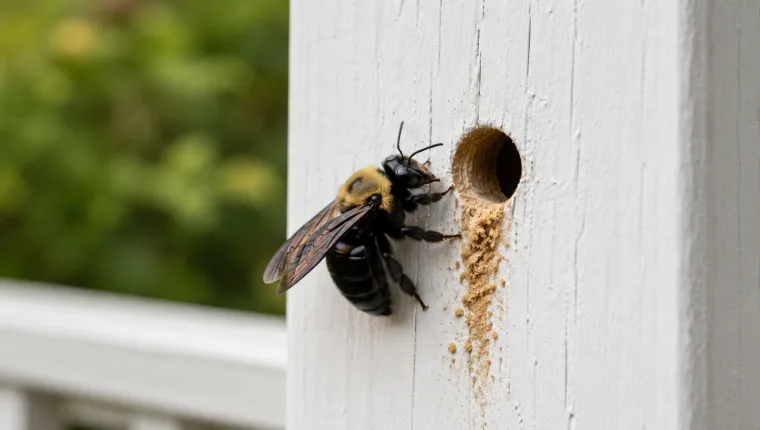
Carpenter bees are large, mostly solitary bees that excavate nearly round tunnels in bare, weathered, or unfinished wood. They often appear around decks, fascia boards, porch ceilings, railings, sheds, fences, and outdoor furniture in spring. A few holes may cause mostly cosmetic damage, but repeated nesting in the same wood can create longer galleries, staining, woodpecker damage, and localized weakening.
The most important first step is correct identification. Carpenter bees can resemble bumble bees, but their nesting behavior, body appearance, and the type of evidence they leave behind are different. Because carpenter bees are pollinators, control should be targeted and proportional rather than automatic.
- What Is a Carpenter Bee?
- Carpenter Bee Identification
- What Do Carpenter Bee Holes Look Like?
- Where Carpenter Bees Nest
- Inside a Carpenter Bee Tunnel
- How Much Damage Can Carpenter Bees Cause?
- Carpenter Bee Life Cycle and Seasonal Activity
- How to Inspect for Carpenter Bees Safely
- How to Get Rid of Carpenter Bees
- Do Carpenter Bee Traps Work?
- Common Carpenter Bee Control Mistakes
- Carpenter Bee Prevention
- When to Call a Carpenter Bee Exterminator or Removal Professional
- Carpenter Bee Treatment Cost
- Safety Around Carpenter Bees
- Frequently Asked Questions
- Are carpenter bees dangerous?
- Do carpenter bees eat wood?
- How can I tell whether a carpenter bee hole is active?
- Should I plug carpenter bee holes?
- Will painting wood prevent carpenter bees?
- Are carpenter bees beneficial?
- Can carpenter bees damage a house?
- What is the best way to get rid of carpenter bees?
- Key Takeaway
What Is a Carpenter Bee?
Carpenter bees belong to the genus Xylocopa. Unlike honey bees and most bumble bees, they do not build large social colonies. A female typically excavates or reuses a tunnel in wood, divides the gallery into brood cells, provisions each cell with pollen and nectar, and lays an egg.
The bees are most visible during warm weather, especially in spring and early summer. Males may hover near nesting areas and appear aggressive, but male carpenter bees do not have stingers. Females can sting, although they are generally less defensive than social wasps and are more likely to sting when handled or directly threatened.
Carpenter bees also provide pollination services. They visit many flowers and can contribute to pollination around gardens and landscapes. That value is one reason broad, indiscriminate treatment is usually a poor first response.
Carpenter Bee Identification
Adult carpenter bees are robust and often about three-quarters to one inch long, although size and color vary by species and region. Many common U.S. species are black with yellow or pale hairs on the thorax.
Carpenter Bee vs. Bumble Bee
| Feature | Carpenter Bee | Bumble Bee |
|---|---|---|
| Abdomen | Often shiny, dark, and relatively hairless on the upper surface | Usually fuzzy across much of the abdomen |
| Nesting | Excavates or reuses tunnels in wood | Usually nests in ground cavities, abandoned rodent burrows, or protected spaces |
| Colony type | Mostly solitary, though several females may nest near one another | Social colony with a queen and workers |
| Typical property evidence | Round wood holes, coarse sawdust, staining below an entrance | Repeated traffic to a ground or cavity entrance, without wood-boring holes |
Do not rely on color alone. Lighting, wear, sex, and species can change how a bee appears. The combination of body shape, abdomen texture, flight behavior, and nest evidence is more reliable than any single visual clue.
Male and Female Carpenter Bees
Males often patrol or hover near nesting wood. In some species, males have a pale or yellow facial marking, while females have a darker face. A hovering male may repeatedly approach people, but he cannot sting. Females do have stingers and should not be handled.
What Do Carpenter Bee Holes Look Like?
Carpenter bee holes are usually close to round and commonly measure about one-half inch in diameter. The opening may look as if it were made with a drill. It often appears on the underside or sheltered face of a board, where rain and direct sun are reduced.
Common Clues Around an Active Hole
- A smooth, round entrance in wood.
- Fresh, coarse sawdust or wood shavings below the opening.
- Yellowish or brown staining beneath the hole from pollen, waste, or moisture.
- Repeated bee traffic to the same opening.
- Hovering males nearby.
- Woodpecker pecking or widened surface damage around a gallery.
Sawdust is an especially useful clue because carpenter bees remove wood while excavating. They do not eat the wood. However, old sawdust can remain after a tunnel is no longer active, so activity should be confirmed by observation from a safe distance rather than by approaching or probing the opening.
Old Hole vs. Active Hole
An old hole may be weathered, darkened, partially blocked with debris, or surrounded by older staining. An active hole may have fresh sawdust, clean edges, and repeated bee traffic. These are clues, not guarantees. Carpenter bees often reuse old galleries, and activity can be intermittent.
A practical approach is to observe the area at different times during warm, dry weather. Note which holes receive repeated traffic. Do not insert wire, tools, sprays, or other objects into a tunnel to test it.
Where Carpenter Bees Nest
Carpenter bees prefer relatively soft, weathered, or unfinished wood, especially when it is sheltered. Common nesting locations include:
- Fascia boards, soffits, and roof trim.
- Porch ceilings and exposed beams.
- Deck joists, railings, and stair components.
- Fence rails and posts.
- Sheds, barns, pergolas, and gazebos.
- Unpainted outdoor furniture.
- Wood shingles or siding in susceptible condition.
They often select wood that is easy to access and protected from heavy rain. Painted or properly sealed surfaces are generally less attractive than bare or weathered wood, although no finish provides an absolute guarantee.
Inside a Carpenter Bee Tunnel
The entrance usually runs inward for a short distance and then turns to follow the grain of the wood. The female creates a gallery and partitions it into a series of brood cells. Each cell receives a pollen-and-nectar food mass and an egg.
A tunnel can become substantially longer when it is reused or extended over multiple seasons. Several females may also create separate galleries in the same board. This repeated activity, not a single shallow entrance by itself, is what creates the greatest concern.
How Much Damage Can Carpenter Bees Cause?
One carpenter bee tunnel usually does not cause catastrophic structural failure. The more realistic concerns are cumulative gallery expansion, repeated nesting in the same wood, moisture entry, staining, and secondary damage from woodpeckers searching for larvae.
Damage Is More Concerning When:
- Many holes occur in the same beam, railing, or trim board.
- Old galleries are being reused and extended year after year.
- Woodpeckers have opened long grooves over the galleries.
- The affected wood is already decayed, split, or undersized.
- The member supports a deck, stair, roof edge, or other load.
- Moisture has entered and accelerated deterioration.
- The nesting area is inaccessible, high, or difficult to inspect safely.
If the affected component appears soft, cracked, sagging, extensively tunneled, or structurally important, a pest professional can address active bees while a qualified contractor or structural specialist evaluates the wood itself. Pest treatment does not repair weakened material.
Carpenter Bee Life Cycle and Seasonal Activity
Timing varies by climate and species, but carpenter bee activity often increases in spring as overwintered adults emerge, mate, and establish or reuse galleries. Females provision brood cells during spring and early summer. New adults may emerge later in the season and can return to sheltered galleries to overwinter.
This seasonal pattern matters because a hole that appears quiet for a few days may still contain developing brood or adults. Sealing an active gallery too early can trap bees inside, force them to chew a new exit, or leave brood and organic material enclosed in the wood.
How to Inspect for Carpenter Bees Safely
Inspect visually from the ground or another stable, safe location. Do not climb onto roofs, lean from windows, or use an unsecured ladder to approach bee activity. Binoculars or a zoom camera can help document high trim and fascia without close contact.
Wood-Surface Inspection Checklist
- Record the date, weather, and time of observation.
- Map each round hole by building side and structural component.
- Note fresh sawdust, staining, or woodpecker damage.
- Observe repeated entry or exit from a safe distance.
- Distinguish bare, weathered wood from painted or sealed surfaces.
- Photograph the broad area and then the evidence using zoom.
- Mark inaccessible, elevated, or structurally important locations for professional review.
- Do not probe, plug, spray, or disturb an opening during inspection.
How to Get Rid of Carpenter Bees
Effective carpenter bee control combines identification, targeted management of active galleries, repair at the correct time, and prevention. The right approach depends on the number of holes, their accessibility, whether they are active, the condition of the wood, and whether anyone nearby has a serious sting allergy.
1. Confirm the Pest and Active Locations
Before treating or repairing anything, confirm that the insects are carpenter bees and identify which holes are active. Bumble bees, solitary ground-nesting bees, and wasps require different responses. Treating the wrong insect can waste time and harm beneficial pollinators.
2. Reduce Access to Attractive Wood
Where practical, maintain exposed wood with a durable exterior paint or suitable protective finish. Paint generally provides a more complete surface barrier than a light stain, but product selection and preparation should match the wood and exposure conditions.
Replace severely weathered or damaged trim when necessary. Covering vulnerable wood with properly installed non-wood materials may be an option in recurring problem areas, but moisture management and construction details matter.
3. Use Targeted Treatment Only When Needed
If active galleries require pesticide treatment, use only products legally labeled for the site and pest, and follow every label direction. The label determines where, how, and by whom a product may be used. Keep children and pets away as directed.
Because galleries can be long, hidden, elevated, or numerous, professional treatment is often the safer choice. A licensed pest professional can identify active tunnels, select an appropriate labeled method, reduce exposure, and plan follow-up.
4. Repair Holes After Activity Is Resolved
Do not simply plug a hole while it may still be active. After activity has been resolved and the appropriate waiting period has passed, damaged wood can be repaired according to the material and structural condition. Options may include replacing a component or filling and refinishing a nonstructural surface.
Repair alone does not prevent new holes in adjacent unfinished wood. Pair repair with surface preparation, painting or sealing, and monitoring.
5. Monitor for Reuse
Check previously affected areas during the next spring and summer. Early detection of fresh sawdust or new holes makes targeted response easier. Keep a simple map so old evidence is not mistaken for new activity.
Do Carpenter Bee Traps Work?
Carpenter bee traps may capture some adults in certain settings, but they should not be treated as a complete solution. Performance depends on placement, design, competing nesting sites, and local behavior. Traps do not repair galleries, protect all exposed wood, or address structural deterioration.
They may be considered as one monitoring or management component, but claims of guaranteed elimination should be viewed cautiously. A prevention plan based on wood condition, finishing, repair, and targeted professional treatment is more comprehensive.
Common Carpenter Bee Control Mistakes
- Sealing an active hole immediately: bees may be trapped inside or chew another exit.
- Painting over fresh activity without resolving it: this can conceal evidence without addressing the gallery.
- Treating every large bee as a pest: bumble bees and other pollinators may be misidentified.
- Using broad outdoor spraying: this can expose people, pets, and non-target pollinators without addressing galleries.
- Ignoring woodpecker damage: secondary excavation can exceed the original entrance damage.
- Assuming one quiet day means a nest is inactive: activity changes with weather and brood development.
- Relying only on traps: traps do not correct attractive wood conditions or repair old galleries.
- Attempting elevated treatment: ladders, roof edges, and stinging insects create a combined fall and sting hazard.
Carpenter Bee Prevention
Prevention focuses on making vulnerable wood less attractive and catching new activity early.
- Keep exterior wood painted or properly finished.
- Repair peeling paint, exposed end grain, and weathered trim.
- Replace badly damaged boards when appropriate.
- Inspect sheltered undersides of decks, rails, fascia, and porch ceilings in spring.
- Document old holes so fresh activity is easy to identify.
- Address moisture and decay that weaken wood.
- Use targeted, label-compliant management rather than broad spraying.
No single coating, trap, or treatment guarantees permanent prevention. Carpenter bees can move to nearby suitable wood, so ongoing maintenance and seasonal monitoring are important.
When to Call a Carpenter Bee Exterminator or Removal Professional
Professional help is appropriate when:
- There are many active holes or repeated annual activity.
- Nesting is high, inaccessible, or near roof edges.
- The affected wood is structural, decayed, cracked, or heavily tunneled.
- Woodpecker damage is extensive.
- Bees are entering a concealed structural area that cannot be inspected safely.
- Children, pets, tenants, customers, or people with sting allergies use the area.
- Previous DIY treatment did not stop activity.
- Correct identification is uncertain.
Ask the provider how they confirm active galleries, what the service includes, which repairs are excluded, whether follow-up is included, and what prevention steps should occur after treatment. If structural damage is suspected, ask whether a contractor or other building professional should also inspect the wood.
Carpenter Bee Treatment Cost
Cost varies with the number of galleries, building height, access, treatment method, follow-up, and whether repair or refinishing is included. A small, accessible area is different from widespread activity along second-story fascia or a large deck system.
Do not compare quotes only by the headline price. Confirm whether the quote includes inspection, species identification, treatment of active galleries, follow-up, hole repair, painting or sealing, structural repair, and any warranty. These services are often priced separately.
A dedicated bee-removal cost guide is planned as Article 66. Its internal link should not be activated until that article is produced and verified.
Safety Around Carpenter Bees
Most carpenter bee encounters do not result in stings, but females can sting if handled or threatened. Avoid swatting, grabbing, or blocking active flight paths. Keep children and pets away from concentrated activity.
Anyone with a known serious sting allergy should not inspect or treat active nesting areas. If a sting causes difficulty breathing, swelling of the tongue or throat, faintness, widespread hives, or other signs of a severe allergic reaction, seek emergency medical help immediately.
For pesticide questions, follow the product label and use official EPA information. The U.S. Environmental Protection Agency recommends integrated pest management, which combines accurate identification, prevention, monitoring, and the least-risk effective control appropriate to the situation.
Frequently Asked Questions
Are carpenter bees dangerous?
They are usually less defensive than social wasps. Males cannot sting, while females can sting if handled or strongly threatened. The larger property concern is repeated wood tunneling, not routine aggression.
Do carpenter bees eat wood?
No. They excavate wood to create nesting galleries, pushing out coarse sawdust. They feed on nectar and pollen.
How can I tell whether a carpenter bee hole is active?
Fresh sawdust, clean entrance edges, staining, and repeated bee traffic are useful clues. Observe from a safe distance over multiple warm-weather periods. Do not probe or plug the hole to test it.
Should I plug carpenter bee holes?
Only after activity has been resolved and the gallery is no longer occupied. Plugging an active tunnel can trap bees or cause them to create another exit.
Will painting wood prevent carpenter bees?
Painting or properly finishing exposed wood can reduce its attractiveness, but it is not a guarantee. Surface preparation, complete coverage, ongoing maintenance, and monitoring all matter.
Are carpenter bees beneficial?
Yes. Carpenter bees pollinate many flowers. Control should therefore focus on active problem areas and property protection rather than indiscriminate killing.
Can carpenter bees damage a house?
A few isolated holes are often mainly cosmetic. Damage becomes more concerning when galleries are reused and expanded, many holes occur in one component, woodpeckers open the galleries, or the wood is already weak or structural.
What is the best way to get rid of carpenter bees?
Confirm the species, identify active galleries, use targeted label-compliant treatment when needed, repair only after activity is resolved, finish vulnerable wood, and monitor for reuse. Extensive, elevated, or structurally important activity should be handled professionally.
Key Takeaway
Carpenter bees are identifiable by their large size, often shiny abdomen, and smooth round holes in wood. One hole rarely means severe structural damage, but repeated gallery reuse can create a larger problem. Protect the property by confirming activity, avoiding premature sealing, using targeted control, repairing at the correct time, maintaining wood finishes, and calling a professional when access, allergies, or structural conditions raise the risk.
