
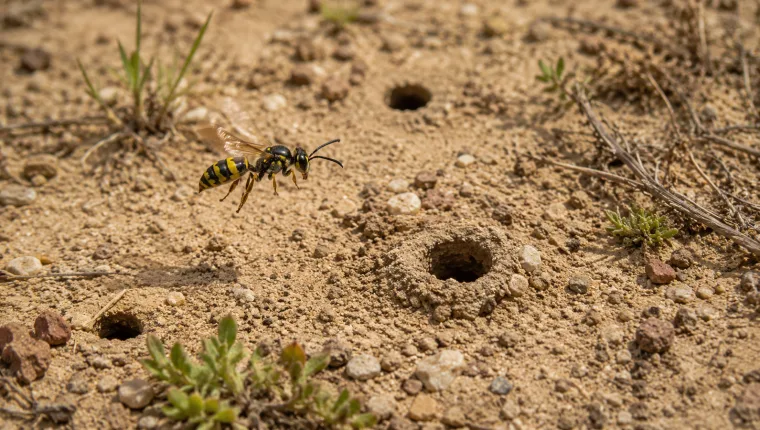
“Ground wasps” can describe several very different insects, from defensive yellow jackets sharing one underground colony to solitary cicada killers, sand wasps, and harmless ground-nesting bees. The safest response depends on identifying the nesting pattern, estimating exposure risk, and avoiding disturbance until you know what is using the hole.
- What are ground wasps?
- How to identify ground wasps without getting close
- Common ground-nesting wasps and lookalikes
- How dangerous are ground wasps?
- Should you leave ground wasps alone or remove the nest?
- Ground wasp removal and control options
- Ground-wasp methods to avoid
- When to call a professional
- How to document ground-nesting activity safely
- How to reduce future ground-nesting conflicts
- Frequently asked questions about ground wasps
- Are all ground wasps aggressive?
- Why are ground wasps flying around my lawn?
- Are cicada killers dangerous?
- Are ground bees the same as ground wasps?
- Can I cover a ground wasp hole?
- Will ground wasps leave on their own?
- Does one hole mean one wasp?
- What should I do after finding a suspected ground nest?
What are ground wasps?
Ground wasps are wasp species that use soil cavities or excavated burrows for nesting. The term is not a precise species name. Homeowners often use it for ground-nesting yellow jackets, cicada killers, sand wasps, and other solitary wasps. Ground-nesting bees, especially mining bees, are also frequently mistaken for wasps.
The most important distinction is whether the insects are part of a social colony using a shared entrance or are solitary nesters using separate burrows. Social yellow jackets may defend the nest in large numbers. Solitary species generally defend only themselves and often tolerate normal activity when people keep their distance.
How to identify ground wasps without getting close
Observe from a protected location where you are not standing in the insects’ flight path. Use several clues together rather than relying on color alone. Many wasps, bees, and flies share yellow, black, brown, or reddish markings.
One busy entrance or many separate holes?
A single opening with frequent arrivals and departures may indicate a social colony, particularly if many similar insects disappear into the same cavity. Yellow jackets often use abandoned rodent burrows, spaces under roots, landscape voids, or openings beside structures.
By contrast, cicada killers, sand wasps, and mining bees commonly use individual burrows. A lawn or sandy bank may contain many holes, but each hole may belong to one female rather than one large coordinated colony.
Watch the flight pattern
- Fast, direct traffic into one opening: more consistent with a shared nest, including yellow jackets.
- Large insects carrying prey: may indicate cicada killers or another solitary hunting wasp.
- Small insects hovering low over bare soil: may be solitary wasps or mining bees searching for their own burrows.
- Patrolling insects that approach people but do not land: may be territorial male solitary wasps. This behavior can look threatening even when the insect cannot sting.
Look at the soil from a distance
Solitary burrowers may leave a fan-shaped pile or low mound of excavated soil. Yellow jacket entrances may have little visible loose soil because the colony adopted an existing cavity. Soil appearance alone is not enough for identification, especially after rain, mowing, irrigation, or foot traffic.
Consider season and setting
Activity changes by species and climate. Solitary bees and wasps may appear for only a few weeks when adults are nesting. Yellow jacket colonies typically grow through the warm season and may become more noticeable later, when worker numbers and food-seeking activity increase. Local timing varies, so behavior and nest structure matter more than a calendar date by itself.
Common ground-nesting wasps and lookalikes
| Likely insect | Nesting pattern | Common clues | Typical risk | Best next step |
|---|---|---|---|---|
| Ground-nesting yellow jackets | Social colony, usually one or a few shared entrances | Steady traffic; compact yellow-and-black insects; nest may be in an old burrow or hidden cavity | High when disturbed, near people, or late in the season | Keep people and pets away; arrange professional assessment when exposure is meaningful |
| Cicada killers | Solitary burrows, sometimes grouped in favorable soil | Very large wasps; females may carry cicadas; loose soil near burrow; males patrol | Usually low when left alone, but stings are possible from females if handled or trapped | Observe and tolerate when practical; address recurring habitat or high-contact locations carefully |
| Sand wasps and related solitary wasps | Individual burrows, sometimes in dense aggregations | Often active over sandy or bare soil; each female generally provisions her own nest | Usually low unless insects are handled or the nesting area is heavily disturbed | Avoid unnecessary treatment; reduce conflict by redirecting traffic and protecting the area temporarily |
| Mining bees | Individual burrows in seasonal aggregations | Bee-like body hair; many small holes; activity may last only a short nesting period | Generally low; important pollinators | Preserve when possible; confirm identity before considering any intervention |
| Bumble bees in ground cavities | Social colony in an existing cavity | Large, fuzzy bees using one entrance; often associated with an abandoned burrow | Variable; colony can defend the nest if disturbed | Favor professional identification and pollinator-conscious management |
For a broader comparison of open-comb, enclosed paper, wall-void,
mud, and underground nests, see how to identify wasp nests by shape and location. When the flight traffic, body pattern, and nest entrance
suggest yellow jackets, use the more specific guide to yellow jacket nests in the ground and walls.
How dangerous are ground wasps?
Risk depends less on the fact that the nest is underground and more on four factors: species, colony structure, proximity to people, and likelihood of disturbance.
Higher-risk situations
- Many insects use the same entrance.
- The opening is beside a doorway, walkway, mailbox, deck, playground, sports area, garden work zone, or pet route.
- Landscaping, mowing, digging, irrigation repair, utility work, or construction will disturb the soil.
- A person in the household has a history of severe allergic reactions to stings.
- Insects are entering a wall, crawl space, utility penetration, or another concealed structural void.
- The species is uncertain and activity is increasing.
Lower-risk situations
- Separate solitary burrows are located in an unused area.
- Activity is seasonal and not intersecting with people or pets.
- The insects do not react when observed from a safe distance.
- The area can be temporarily marked and avoided.
Lower risk does not mean zero risk. Solitary females may sting if squeezed, stepped on, caught in clothing, or handled. Avoid walking barefoot near active burrows and supervise children and pets around the area.
Should you leave ground wasps alone or remove the nest?
Leaving the nest alone is often reasonable when the insects are solitary, the nesting period is brief, and the location does not create repeated contact. Solitary ground nesters can contribute to pollination or prey on other insects, and unnecessary treatment can affect beneficial species.
Removal or targeted control becomes more reasonable when the nest creates an unavoidable sting hazard, a social colony is using a high-traffic location, work must occur in the soil, or the nest is connected to a structure. The decision guide on when to leave, treat, or professionally remove a wasp nest explains how location, access, allergy risk, season, and colony behavior change the recommendation.
Do not treat solely because there are many holes
Dozens of openings may represent dozens of solitary females, not one aggressive colony. Treating before identification can kill pollinators or beneficial predators without solving the conditions that made the site attractive.
Do not wait when exposure is unavoidable
A suspected yellow jacket colony beside a daily path, play area, animal enclosure, or work zone deserves prompt assessment. Restrict access without approaching the entrance and contact a qualified pest-management professional.
Ground wasp removal and control options
Control should follow an integrated pest management sequence: identify the insect, assess whether action is necessary, reduce conflict or habitat where practical, monitor, and use a targeted treatment only when justified.
1. Temporary avoidance and site management
For a low-risk solitary nesting area, the most practical response may be to mark a generous boundary, redirect foot traffic, postpone soil work, and allow the short nesting period to finish. Do not place markers so close that installation disturbs the entrance.
2. Long-term habitat adjustments
Different species prefer different soil conditions. Some solitary nesters favor dry, bare, well-drained soil. Improving turf density or changing bare-soil conditions may reduce future use in certain sites, but changes should be gradual and should not involve working directly over active burrows. Habitat modification is not an instant removal method and may not affect social colonies using deep existing cavities.
3. Professional identification and targeted treatment
A professional can evaluate the traffic pattern, likely species, nest location, exposure, and legal product options. When pesticide treatment is appropriate, the product must be registered for the target pest and site, and every direction on the accepted label must be followed. Product choice, application method, protective equipment, reentry, and follow-up depend on the label and site conditions.
4. Structural or landscape coordination
If insects are associated with a wall void, irrigation box, utility opening, retaining wall, drainage structure, or construction zone, pest control may need to be coordinated with a qualified contractor. Do not open a wall, remove covers, excavate, or seal an active route before the insect risk has been managed.
Ground-wasp methods to avoid
- Do not pour gasoline, fuel, bleach, solvents, or mixed household chemicals into a hole. These create fire, poisoning, soil, groundwater, and legal hazards.
- Do not use fire or smoke. Fire can spread underground or ignite landscaping, structures, and utilities.
- Do not flood the nest or pour boiling water into it. This can provoke defensive insects, cause burns, damage soil or structures, and fail to reach the colony.
- Do not seal an active entrance. Social insects may search for another exit, including one closer to people or inside a building.
- Do not mow, trim, dig, or operate vibrating equipment over suspected yellow jacket activity. Vibration can trigger defensive behavior.
- Do not improvise pesticide mixtures or use products outside the label. “More” does not mean safer or more effective.
- Do not rely on a generated image or one online photo for definitive identification. Use reviewed comparison resources or a qualified local expert.
When to call a professional
Professional assessment is the safer choice when:
- many insects share one entrance;
- yellow jackets are suspected;
- the nest is near a doorway, path, playground, pet area, workplace, or public space;
- any nearby person has a known severe sting allergy;
- the entrance connects to a wall, foundation, utility box, crawl space, or other concealed cavity;
- mowing, excavation, construction, or repair cannot be postponed;
- the nest cannot be observed without approaching closely;
- an earlier treatment did not stop activity; or
- identification remains uncertain.
Ask the provider what species they believe is present, what evidence supports that identification, whether treatment is necessary, which areas must remain vacant, what the label requires, how follow-up activity will be evaluated, and whether structural repair or habitat correction is separate from pest treatment.
How to document ground-nesting activity safely
Good documentation helps a professional identify the problem without requiring you to approach the nest. Use the downloadable ground-nester observation checklist to record:
- date, time, weather, and recent mowing or irrigation;
- approximate number of visible entrances;
- whether insects share one entrance or use separate holes;
- traffic level: occasional, steady, or heavy;
- approximate insect size and dominant colors;
- whether insects are carrying prey or pollen;
- distance from doors, paths, play areas, pets, and work zones;
- any reaction to normal activity observed from a safe distance; and
- known sting-allergy concerns.
Photographs can help when taken with zoom from a protected position. Do not stand over the hole or block the flight path to get a close-up.
How to reduce future ground-nesting conflicts
No landscape can be guaranteed wasp-free, and many ground nesters are beneficial. Prevention should focus on reducing conflict rather than eliminating every insect.
- Inspect high-use areas before mowing, digging, parties, sports, or landscape work.
- Repair recurring rodent burrows and voids only after confirming they are not actively used by stinging insects or protected wildlife.
- Maintain healthy ground cover where repeated solitary nesting in bare soil conflicts with property use.
- Keep outdoor food, sweet drinks, and trash controlled, especially during periods of heavy yellow jacket foraging.
- Address gaps around utility penetrations and structural voids during inactive periods, not while insects are using them.
- Train household members or staff to report flight traffic early instead of disturbing the site.
Frequently asked questions about ground wasps
Are all ground wasps aggressive?
No. Ground-nesting yellow jackets can defend a social colony in large numbers, while cicada killers and many sand wasps are solitary and usually avoid stinging unless handled or trapped. Identification and nesting pattern matter more than the fact that the insect uses soil.
Why are ground wasps flying around my lawn?
The lawn may contain a shared colony entrance, many separate solitary burrows, or insects searching for nesting sites. Watch from a safe distance to see whether they converge on one opening or use multiple holes.
Are cicada killers dangerous?
Cicada killers are intimidating because of their size. Males may patrol and approach intruders but cannot sting. Females can sting, although they generally avoid people unless handled, stepped on, or trapped. Their burrows can still create conflict in high-use areas.
Are ground bees the same as ground wasps?
No. Mining bees and some bumble bees nest in the ground but are bees. Mining bees are usually solitary, important pollinators, and active for a limited seasonal period. Confirm identification before considering control.
Can I cover a ground wasp hole?
Do not cover an active entrance. Social insects may create another exit or emerge somewhere closer to people. Covering a hole also does not identify the insect or confirm that the colony is inactive.
Will ground wasps leave on their own?
Many solitary species complete a short seasonal nesting cycle and activity declines. Social colonies also have seasonal cycles, but waiting may be unsafe when the entrance is in a high-contact area or a person nearby has a severe sting allergy.
Does one hole mean one wasp?
Not necessarily. One opening may lead to a social colony containing many yellow jackets, or it may be a solitary burrow. The traffic pattern is a critical clue.
What should I do after finding a suspected ground nest?
Keep people and pets away, avoid vibration and soil disturbance, observe only from a safe location, document the traffic pattern, and seek professional identification when the nest is shared, close to activity, structurally connected, or uncertain.
