
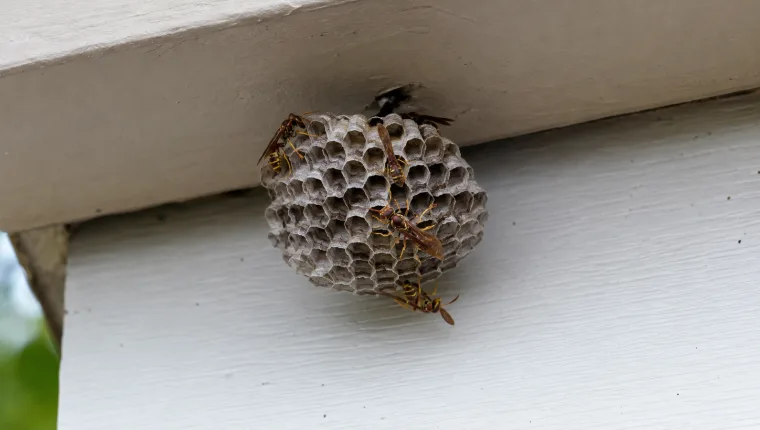
A wasp nest can often be narrowed down by its shape, building material, location, entrance pattern, and the way insects move around it. Open umbrella-shaped combs usually suggest paper wasps. Enclosed gray paper nests may be made by hornets or certain yellow jackets. Repeated traffic into a hole in the ground, a wall gap, or a roof opening may indicate a hidden yellow jacket or other social-wasp colony. Mud tubes or small clay cells usually point to mud daubers or related solitary wasps.
The nest alone does not always confirm the exact species. Several wasps build similar structures, and a hidden nest may reveal almost nothing except a steady flight path. The safest approach is to observe from a distance, document what you can see, and use the nest’s structure and location as clues rather than absolute proof.
- Quick wasp nest identification by shape and location
- What does a paper wasp nest look like?
- How to recognize a yellow jacket nest
- What does a hornet nest look like?
- Mud dauber nests and other mud structures
- Ground-nesting wasps: one colony or many separate burrows?
- Wasp nests in walls, attics, roofs, and soffits
- How can you tell whether a wasp nest is active or old?
- Common wasp nest lookalikes
- How to estimate the risk of a wasp nest
- What to do after finding a wasp nest
- What should appear in a wasp nest observation record?
- Frequently asked questions
- What is the easiest way to identify a wasp nest?
- What does a small wasp nest look like?
- Are all gray paper nests hornet nests?
- Can wasps build nests in the ground?
- Can wasps build nests inside walls?
- How do I know whether a wasp nest is abandoned?
- Should I remove an old wasp nest?
- When should I call a professional?
- Bottom line
Quick wasp nest identification by shape and location
| Nest clue | Likely group | Common location | Important limitation |
|---|---|---|---|
| Open comb with visible hexagonal cells and no outer envelope | Paper wasps | Eaves, railings, shutters, soffits, branches, outdoor furniture | Small early nests can be easy to overlook |
| Enclosed gray or tan paper nest, often layered | Hornets or aerial yellow jackets | Trees, shrubs, eaves, building exteriors | Shape alone may not identify the species |
| Frequent traffic into one ground hole | Ground-nesting yellow jackets or other wasps | Lawns, landscape beds, root cavities, abandoned burrows | The underground nest may extend well beyond the visible entrance |
| Traffic into siding, soffit, wall, roof, or utility gap | Yellow jackets, paper wasps, hornets, or solitary wasps | Wall voids, attics, roof edges, vents | The nest may be concealed and inaccessible |
| Mud tubes, organ-pipe shapes, or clusters of clay cells | Mud daubers and related solitary wasps | Garages, sheds, porches, protected walls | Old mud nests may be empty or reused by other insects |
| Loose soil mound or many small burrow openings | Solitary ground-nesting wasps or bees | Sunny bare soil, lawns, sand, garden edges | Multiple independent burrows are not necessarily one social colony |
The most useful first question is not “What product kills it?” but “What type of nest is this, where is it located, and how much contact do people or pets have with the flight path?” Those factors determine whether simple monitoring is reasonable or professional assessment is the safer choice.
What does a paper wasp nest look like?
Paper wasps typically build exposed combs made from chewed wood fibers mixed with saliva. The result looks like gray or brown paper. The comb is usually attached by a narrow stalk and contains visible open cells. From below, it may resemble a small umbrella.
Common locations include:
- Under eaves and porch roofs
- Inside open sheds or garages
- Behind shutters
- Under deck railings
- Inside unused grills, play structures, or outdoor furniture
- On branches protected from heavy rain
Early in the season, a paper wasp nest may contain only a few cells and one or several adults. Later, it can become larger and more active. Size alone does not predict behavior, but a growing colony in a doorway, play area, balcony, or other high-contact location deserves more caution than a small nest far from routine activity.
Paper wasps often fly directly to the exposed comb, so the structure itself is visible. This differs from yellow jackets that may disappear into a ground opening or wall gap. Still, do not approach closely to count cells or photograph adults. Zoom from a safe location instead.
How to recognize a yellow jacket nest
Yellow jackets can nest underground, inside structural voids, or in enclosed paper nests, depending on the species. Their nests are usually made from paper-like material and contain layered combs protected by an outer envelope. When the colony is underground or inside a wall, the paper structure is often invisible.
The clearest clue may be traffic rather than the nest itself:
- Many wasps entering and leaving the same small opening
- A steady flight line near the ground
- Activity at a siding gap, soffit edge, roof joint, vent, or utility penetration
- Increased activity around food, trash, or sugary drinks later in the season
A ground entrance can look insignificant even when the colony is well developed. Do not assume that a small hole means a small nest. The cavity may be in an abandoned rodent burrow, under roots, beneath landscape materials, or inside another protected space.
Hidden yellow jacket nests are among the situations most likely to require professional assessment, especially when the entrance is beside a walkway, lawn area, school, pet route, or work zone. Sealing an active structural entrance can redirect insects into occupied areas, so a visible entry gap should not be closed until the colony status is properly evaluated.
What does a hornet nest look like?
Many people use “hornet” for any large wasp, but true hornets and closely related aerial nesters commonly build enclosed paper nests. These nests may be round, oval, football-shaped, or teardrop-shaped, with layered gray, tan, or brown patterns. A single entrance is often located near the lower portion.
Typical sites include:
- Tree branches
- Dense shrubs
- Roof edges and eaves
- Utility structures
- Protected exterior building surfaces
Large enclosed nests may become obvious only after leaves thin or the colony expands. A nest high in a tree and far from human activity may present a different practical risk than one over a door, near a patio, or beside routine landscaping work.
Do not use nest color as the only identification clue. Weathering, wood sources, age, and lighting can change appearance. Adult insect markings, nest placement, entrance location, and regional species information all matter.
Mud dauber nests and other mud structures
Mud daubers are solitary wasps that build nests from mud rather than paper. Their structures may appear as parallel tubes, rounded cells, or irregular clay clusters attached to a protected surface. Some resemble organ pipes; others look like small lumps of dried mud.
Common locations include garages, sheds, barns, porches, bridges, and sheltered walls. Because these are solitary nests rather than large social colonies, activity patterns differ from paper wasps or yellow jackets. You may see one adult provisioning individual cells instead of dozens of workers using one entrance.
An old mud nest may be empty. Small holes in the mud can indicate that adults emerged. Other insects may also use abandoned cells. Visual inspection can suggest whether a structure is old, damaged, or recently maintained, but close handling is unnecessary for routine identification.
Mud nests are commonly confused with termite tubes. Termite shelter tubes usually form narrow earthen pathways connected to wood, soil, foundations, or structural seams. Mud dauber cells are more likely to form discrete chambers or tubes attached to a surface. When the material is connected to suspected wood damage or soil contact, termite inspection may be more appropriate than wasp control.
Ground-nesting wasps: one colony or many separate burrows?
Ground-nesting wasps include both social species and solitary species. This distinction matters.
A social yellow jacket colony may use one main entrance with frequent two-way traffic. The nest is concealed in a cavity. Disturbance near the entrance can trigger defensive activity from multiple workers.
Solitary ground-nesting wasps often create individual burrows. Many females may nest in the same favorable patch of dry, sunny, well-drained soil, making the area look like one large infestation even though each tunnel is separate. Activity may be intense for a limited seasonal period.
Observe these clues from a distance:
- One heavily used hole versus many separate holes
- Large numbers entering one point versus individuals visiting separate burrows
- Whether insects hover low over the soil or follow one direct flight path
- Whether the site is bare, sandy, compacted, landscaped, or associated with an old animal burrow
Do not stand over the entrance, mow across active ground traffic, dig into the area, or flood the opening. Ground nests can be difficult to assess, and improvised disturbance can increase sting risk without resolving the colony.
Wasp nests in walls, attics, roofs, and soffits
A structural nest may not be visible at all. Instead, you may notice repeated insect traffic through a crack or gap. Common access points include:
- Soffit and fascia gaps
- Loose siding
- Roof intersections
- Attic vents
- Pipe, cable, and utility penetrations
- Window and door trim gaps
- Openings around exterior fixtures
The visible entry point may be several feet from the actual nest. Wasps can travel through a void before reaching the colony. Buzzing sounds do not confirm exact placement, and cutting into walls or ceilings can create additional hazards involving insects, wiring, insulation, and structural materials.
Do not seal a gap while insects are actively using it. Trapping a social colony inside a structure may cause workers to search for another route, including toward interior living spaces. Structural nests are strong candidates for professional service because treatment, removal, exclusion, and repair must be sequenced correctly.
How can you tell whether a wasp nest is active or old?
The best evidence of an active nest is repeated adult traffic. Observe for several minutes from a safe location during suitable daylight and weather. One insect passing nearby is less meaningful than multiple insects entering and leaving the same point.
Signs that may suggest current activity include:
- Regular arrivals and departures
- Adults standing on or maintaining exposed comb
- Fresh-looking paper expansion or mud repair
- Guarding behavior near an entrance
- Larvae or capped cells visible in an exposed comb from a safe viewing distance
Signs that may suggest an old or inactive structure include severe weathering, broken comb, no repeated traffic over several appropriate observation periods, or emergence holes in old mud cells. Even so, inactivity cannot always be confirmed from one quick look. Cool weather, rain, shade, time of day, and seasonal changes affect visible activity.
Do not shake, tap, spray, or dismantle a nest to test whether it is active.
Common wasp nest lookalikes
Bee nests and bee activity
Honey bees may enter a structural cavity, while bumble bees may use ground or wall cavities. Bee identification matters because management options, ecological considerations, and local removal resources can differ. A fuzzy body, pollen carried on the legs, and different flight behavior may help, but photographs taken from a distance are often more useful than attempting close inspection.
Termite shelter tubes
Earthen tubes running from soil or masonry toward wood are not typical wasp nests. They may indicate subterranean termite activity and warrant a termite inspection.
Potter wasp cells
Small pot-shaped mud structures may be built by solitary potter wasps. These are different from the large social colonies most homeowners associate with aggressive nest defense.
Bird, rodent, and debris nests
Dry plant fibers, insulation, leaves, or animal nesting material can be mistaken for old paper nests in attics and sheds. Do not reach into concealed spaces without knowing what is present.
How to estimate the risk of a wasp nest
Risk depends on more than nest size. Use the following factors:
| Factor | Lower practical concern | Higher practical concern |
|---|---|---|
| Location | Remote area with little contact | Doorway, walkway, play area, school, patio, work zone |
| Access | Visible from a safe ground position | High roofline, ladder access, attic, wall void, confined space |
| Colony type | Possibly solitary nest with limited activity | Social colony with frequent traffic |
| People and pets | No routine exposure | Children, pets, workers, visitors, or allergy history nearby |
| Behavior | Insects remain near the nest | Defensive flight, collisions, repeated stings, indoor emergence |
| Uncertainty | Clear, observable structure | Hidden nest, unclear species, multiple entrances |
Anyone with a known severe sting allergy should avoid approaching or testing a nest. If a sting causes breathing difficulty, swelling of the face or throat, widespread hives, faintness, or another severe systemic reaction, seek emergency medical care immediately.
What to do after finding a wasp nest
- Increase distance. Keep people and pets away from the entrance or flight path.
- Document from a safe position. Use zoom to capture the nest shape, opening, location, and adult insects.
- Mark the area indirectly. Warn household members or workers without placing markers directly beside the entrance.
- Observe traffic. Note time of day, number of insects, direction of travel, and whether activity enters a structure.
- Assess exposure. Consider doors, paths, play spaces, mowing routes, maintenance work, and allergy risk.
- Avoid disturbance. Do not strike, burn, flood, seal, excavate, or dismantle the nest.
- Choose the next step based on risk. Remote, apparently inactive structures may only need monitoring. Hidden, elevated, ground, high-traffic, or active social nests often justify professional assessment.
The upcoming guide to wasp nest removal will compare when monitoring, treatment, physical removal, or professional service may be appropriate. For budgeting, the dedicated wasp nest removal cost guide will explain access, species, height, structural location, repeat visits, and repair factors. Activate those links only after the destination pages are published.
What should appear in a wasp nest observation record?
A useful record includes:
- Date and time
- Weather conditions
- Nest or entrance location
- Approximate height from the ground
- Open comb, enclosed paper, mud, ground hole, or hidden void
- Number of visible entrances
- Approximate traffic over five minutes from a safe distance
- Nearby doors, paths, play areas, pets, or work zones
- Photos taken with zoom
- Any indoor insect sightings
- Known sting-allergy concerns
Frequently asked questions
What is the easiest way to identify a wasp nest?
Start with the structure: open comb, enclosed paper envelope, mud cells, ground entrance, or hidden structural gap. Then add location and adult traffic. Those combined clues are more reliable than color or size alone.
What does a small wasp nest look like?
An early paper wasp nest may look like a tiny open umbrella with only a few visible cells. A small mud-dauber nest may look like one or several clay tubes. A small entrance in the ground or wall does not reveal the size of a hidden social colony.
Are all gray paper nests hornet nests?
No. Several social wasps make paper nests, and weathering changes color. Nest shape, entrance position, location, adult appearance, and regional species all help narrow identification.
Can wasps build nests in the ground?
Yes. Some yellow jackets use underground cavities, while many solitary wasps dig individual burrows. One heavily traveled entrance suggests a different situation from many independent holes across bare soil.
Can wasps build nests inside walls?
Yes. Wasps may enter through siding, soffits, vents, roof gaps, and utility openings. The visible entrance may be far from the nest. Do not seal an active opening before the colony is assessed.
How do I know whether a wasp nest is abandoned?
Lack of repeated traffic over several suitable observation periods, weathered material, broken comb, or old emergence holes may suggest inactivity. One brief observation is not enough because temperature, rain, shade, and time of day affect activity.
Should I remove an old wasp nest?
An old exposed nest may not require urgent action. Removal decisions depend on accessibility, certainty that it is inactive, structural damage, sanitation, and whether the location will be reused or disturbed. Hidden or elevated structures may be safer to leave for a professional.
When should I call a professional?
Professional assessment is strongly favored for ground nests, wall or attic nests, high nests, large active colonies, indoor emergence, unclear entrances, difficult access, repeated stings, or any situation involving a known severe sting allergy.
Bottom line
Wasp nest identification is strongest when you combine shape, material, location, entrance pattern, and repeated adult activity. Open combs point toward paper wasps; enclosed paper structures may indicate hornets or aerial yellow jackets; mud cells suggest solitary mud-building wasps; and steady traffic into ground or structural openings can reveal a concealed colony.
Use those clues to estimate risk, not to justify close inspection. Keep distance, document safely, avoid disturbing or sealing active nests, and seek professional help when the nest is hidden, elevated, underground, heavily trafficked, or close to people with sting-allergy risk.
