
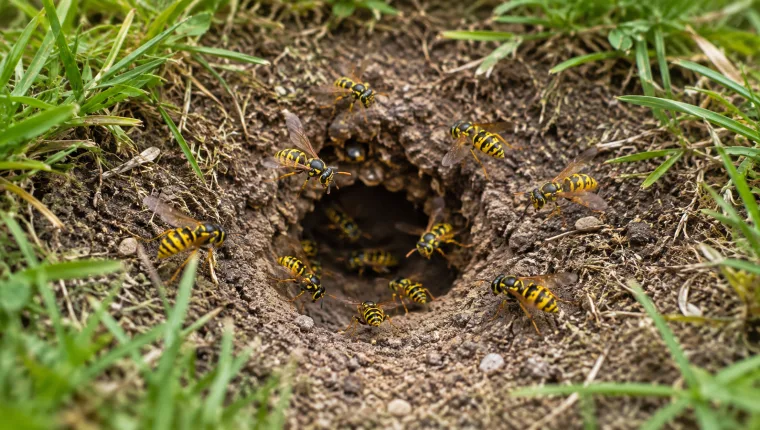
A yellow jacket nest is often discovered because workers repeatedly disappear into a small ground opening, a gap in siding, a soffit, or another protected cavity. Some species also build visible paper nests above ground.
The safest way to identify the problem is to observe the flight path from a distance, note the nest location, and avoid disturbing the entrance.
- Quick answer: what does a yellow jacket nest look like?
- How to identify yellow jackets safely
- Yellow jacket nests in the ground
- Yellow jacket nests in walls, soffits, and roof voids
- Aerial yellow jacket nests
- Yellow jackets vs. bees, paper wasps, and hornets
- How to estimate whether the nest is active
- When a yellow jacket nest requires professional help
- What not to do around a yellow jacket nest
- Sting response and emergency warning signs
- Frequently asked questions
- How do I know where a yellow jacket nest is?
- Can yellow jackets build nests inside walls?
- Are all ground wasps yellow jackets?
- Do yellow jackets reuse the same nest?
- Can I plug a yellow jacket hole at night?
- Why are yellow jackets more noticeable in late summer and fall?
- What should I photograph for identification?
Quick answer: what does a yellow jacket nest look like?
Yellow jackets are social wasps that build layered paper combs inside a protective envelope or concealed cavity. Depending on the species and available shelter, the colony may be underground, inside a wall or roof void, or in an exposed aerial nest.
- Ground nests: workers fly in and out of one or more openings in soil, turf, a rodent burrow, a landscape void, or the space beneath a structure.
- Wall or building-void nests: traffic concentrates at a crack, utility penetration, siding gap, soffit opening, vent edge, or roofline junction.
- Aerial nests: a gray or tan enclosed paper nest may hang from a tree, shrub, eave, or other support, depending on the species.
The visible entrance is not necessarily the center of the nest. In a wall, for example, workers may travel through a hidden cavity before reaching the comb. Do not seal an active entrance or open the structure to investigate.
How to identify yellow jackets safely
Identification should begin with behavior, not a close-up encounter. Watch from a location where you are not blocking the insects’ flight line. Use binoculars or a phone camera with optical zoom rather than approaching the entrance.
Look for repeated, purposeful traffic
A foraging yellow jacket may visit food, flowers, garbage, or outdoor drinks without a nest nearby. Nest activity looks different: multiple workers follow a consistent route and repeatedly enter or leave the same small area. The traffic may be light at one moment and much busier later, so a short observation does not prove that the colony is small.
Note the insect’s shape and movement
Typical yellow jackets are compact social wasps with a narrow waist and sharply defined yellow-and-dark markings. They fly quickly, land directly near the entrance, and may disappear immediately into the opening. Color patterns vary, and several harmless flies mimic wasps, so markings alone are not enough for a confident identification.
Observe without testing the colony
Do not tap the wall, probe the ground, mow over the opening, throw objects at the nest, or spray water to “see what comes out.” Vibration, impact, and blocked flight paths can trigger defensive behavior. Keep children and pets away from the area while you document what you can see from a safe position.
Yellow jacket nests in the ground
Ground nests are among the most commonly encountered and highest-risk yellow jacket situations because the entrance may be nearly invisible until someone steps nearby, uses lawn equipment, or works in the landscape.
Common ground-nest locations
- Abandoned rodent or small-animal burrows
- Voids beneath roots, stones, pavers, decks, steps, or landscape timbers
- Edges of lawns, gardens, slopes, retaining walls, and brushy areas
- Gaps where soil has settled around posts, foundations, or utility lines
What the entrance may look like
The opening may resemble a simple hole in the soil with little or no visible paper. Repeated worker traffic is usually more informative than the hole itself. There may be more than one opening, and the underground cavity may extend beyond the point where the insects enter.
Why ground nests are easy to misidentify
Many insects nest in soil. Solitary wasps and mining bees can create multiple individual burrows across a sunny patch, while yellow jackets generally operate as a social colony from a shared cavity. Cicada killers are much larger and often fly around visible soil excavations. Bumble bees may also occupy old burrows but look hairier and move differently.
Because beneficial solitary species are often treated unnecessarily, compare the behavior with our broader guide to wasp nest identification. The dedicated ground wasps guide should be linked only after Article 64 is published.
Yellow jacket nests in walls, soffits, and roof voids
A hidden nest may be suspected when yellow jackets repeatedly use a gap in siding, masonry, trim, a soffit, a vent edge, or a utility penetration. The exterior opening can be several feet away from the actual comb.
Exterior signs of a wall-void nest
- Steady traffic to one crack or construction gap
- Workers crawling beneath siding or flashing
- Activity concentrated around a soffit, fascia, window frame, vent, pipe, or cable entry
- Insects appearing indoors near lights, windows, or the room adjacent to the exterior entry point
Sounds inside the structure
A large hidden colony may produce faint rustling, chewing, or buzzing sounds, especially in a quiet room. Sound alone is not proof; plumbing, electrical components, rodents, and other insects can create similar noises. Do not press on drywall, drill a hole, or open the wall to confirm the source.
Why sealing the entrance can make the problem worse
Sealing an active exterior opening does not necessarily trap every worker in the nest. Wasps may search for another exit and can emerge inside the building. The entrance should remain undisturbed until the nest has been professionally assessed and any treatment has been completed according to the product label and the building conditions.
When indoor sightings are urgent
One yellow jacket entering through an open door is different from repeated indoor appearances near the same wall, ceiling, light fixture, or window. Recurrent indoor activity, a nest near occupied rooms, or anyone with a history of severe sting reactions is a strong reason to restrict access and contact a qualified pest professional.
Aerial yellow jacket nests
Some yellow jacket relatives and certain species build enclosed paper nests above ground. These nests may be football-shaped, rounded, or irregular, with layered gray or tan paper and a small entrance. They can occur in trees, shrubs, eaves, sheds, play structures, or other sheltered locations.
A visible enclosed nest is sometimes called a “hornet nest,” but common names are inconsistent. Bald-faced hornets, for example, are actually a type of social wasp rather than true hornets. Identification should consider the insects, nest form, location, and regional species—not the label people commonly use.
Never use a ladder to approach an active aerial nest. Height, limited escape routes, and defensive flight make elevated nests unsuitable for close inspection or removal by an untrained person.
Yellow jackets vs. bees, paper wasps, and hornets
| Insect or group | Typical body clues | Typical nest clues | Behavior near people |
|---|---|---|---|
| Yellow jackets | Compact, relatively smooth body; bold yellow-and-dark pattern | Often concealed underground or in a void; some enclosed aerial nests | May defend the colony strongly, especially near the entrance |
| Honey bees | Hairier, often golden-brown rather than sharply striped | Wax comb in a cavity; swarms may temporarily cluster in the open | Usually focused on flowers or the colony entrance; valuable pollinators |
| Paper wasps | Slender body with long legs that may hang during flight | Open umbrella-shaped comb with visible cells | Defensive near the comb but often less numerous than a mature yellow jacket colony |
| Bald-faced hornets and related aerial nesters | Robust social wasps; pattern may be white-and-dark or yellow-and-dark | Enclosed paper nest above ground | Can defend the nest aggressively |
| Solitary ground wasps or bees | Highly variable; often one insect per burrow | Individual holes, sometimes many across suitable soil | Often less defensive because there is no large shared colony |
Photos can help, but do not rely on a generative illustration as definitive anatomical evidence. A clear telephoto image of the insect and the entrance, taken without approaching the flight path, is more useful for professional identification.
How to estimate whether the nest is active
An active nest usually shows repeated entry and exit during suitable daylight weather. Activity can drop during cool, rainy, or windy periods, so no movement during a brief check does not prove abandonment.
Use a simple observation log:
- Record the date, time, weather, and exact location.
- From a safe distance, note whether traffic uses one opening or several.
- Count visible entries and exits for a short, consistent interval without approaching.
- Note nearby risks such as a doorway, path, play area, pet run, school zone, or work area.
- Stop immediately if insects begin investigating or approaching you.
The downloadable yellow-jacket-flight-path-observation-log.pdf should provide fields for these observations. Counts are useful for showing a pattern to a professional, but they do not reveal the exact colony size or the depth of a hidden nest.
When a yellow jacket nest requires professional help
Professional assessment is the safest choice when the nest is underground, inside a wall or roof void, elevated, difficult to escape from, or located near regular human activity. The need is stronger when children, pets, older adults, workers, customers, or anyone with a known sting allergy may be exposed.
Call a qualified service provider when:
- The entrance is beside a door, walkway, patio, playground, mailbox, equipment area, or animal enclosure.
- Yellow jackets are entering a wall, soffit, vent, roofline, or utility opening.
- Wasps are appearing repeatedly inside the building.
- The nest is high, hidden, or reachable only by ladder or structural access.
- You cannot identify the insect confidently.
- Previous disturbance or treatment attempts have increased activity.
- Anyone nearby has a history of severe allergic reactions to stings.
Our wasp nest removal guide explains how location, access, allergy risk, and public exposure affect the decision to leave, monitor, treat, or hire a professional.
What not to do around a yellow jacket nest
- Do not seal an active ground, wall, soffit, or roof entrance.
- Do not pour gasoline, bleach, boiling water, or other improvised liquids into a nest.
- Do not use fire, smoke, explosives, or flooding.
- Do not mow, trim, dig, hammer, drill, or pressure-wash near the entrance.
- Do not open walls, ceilings, soffits, or roof assemblies to find the comb.
- Do not climb a ladder to inspect or treat an active aerial nest.
- Do not apply a pesticide anywhere the label does not permit, and do not exceed label directions.
Improvised methods can cause multiple stings, fire, chemical exposure, contaminated soil or water, structural damage, or indoor emergence from a hidden colony.
Sting response and emergency warning signs
Move away from the nest area without swatting at the insects. For a routine local sting reaction, follow appropriate first-aid guidance and seek medical advice when needed. Call emergency services immediately for trouble breathing, swelling of the tongue or throat, widespread hives, faintness, confusion, or other signs of a severe allergic reaction.
Multiple stings, stings inside the mouth or throat, or reactions in a person with a known severe allergy also warrant urgent medical attention. This article cannot diagnose or treat a sting reaction.
Frequently asked questions
How do I know where a yellow jacket nest is?
Look for repeated worker traffic to the same ground opening, crack, siding gap, soffit, vent edge, or aerial paper nest. Observe from a distance and do not block the flight path. The visible entrance may be separated from the hidden comb.
Can yellow jackets build nests inside walls?
Yes. They may enter through a small exterior gap and build in a wall, ceiling, soffit, or roof void. Do not seal the entrance or open the wall while the colony is active, because the insects may find a route indoors.
Are all ground wasps yellow jackets?
No. Bumble bees, cicada killers, sand wasps, mining bees, and other solitary species also use soil. Colony traffic, body form, and nest pattern help distinguish them, but uncertain cases should be identified by a knowledgeable professional.
Do yellow jackets reuse the same nest?
In many temperate regions, a colony declines after cold weather and the exact paper nest is not reused as an active colony the next year. However, new queens may select nearby protected sites, and regional climates can change seasonal patterns. Do not assume a nest is inactive without observing conditions safely.
Can I plug a yellow jacket hole at night?
Do not plug an active entrance. Workers and queens may be inside, and a hidden wall colony may redirect into the building. Treatment and closure should follow a professional assessment and applicable pesticide-label directions.
Why are yellow jackets more noticeable in late summer and fall?
Colonies may contain more workers later in the season, and foragers can become more visible around sugary foods, outdoor meals, trash, and fallen fruit. Defensive behavior near the nest can also become a greater concern.
What should I photograph for identification?
From a safe distance, photograph the entrance location, surrounding structure or soil, and any insect visible with optical zoom. Include context rather than approaching for a macro image. Record the time, weather, and flight direction.
