
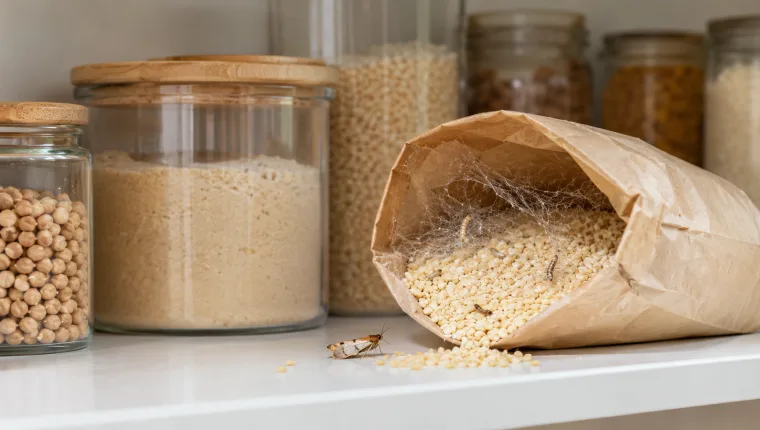
Pantry moths are small stored-food pests that can turn a quiet cabinet into a recurring source of larvae, webbing, and adult moths. In many U.S. homes, the species involved is the Indianmeal moth. The adults are the insects people usually notice first, but the larvae are the stage that feeds on dry foods and causes contamination.
The most important step is not killing the moths you see flying. It is finding and removing the infested food source. A complete response combines product-by-product inspection, disposal of contaminated items, detailed vacuuming, secure storage, and monitoring long enough to catch activity from any source that was missed.
Quick answer: Pantry moths usually come from an infested dry food product. Inspect every package, discard food with larvae, webbing, clumps, shed skins, or unusual dust, vacuum cabinet seams, store replacement food in pest-resistant containers, and use pheromone traps only for monitoring. Traps alone will not eliminate an infestation.
- What pantry moths look like
- Pantry moths vs. other small moths in the house
- Where pantry moths come from
- How to inspect food for pantry moths
- How to clean a pantry after finding moths
- Do pheromone traps get rid of pantry moths?
- How long pantry moths can continue appearing
- How to prevent pantry moths from returning
- Should you use pesticides for pantry moths?
- Common reasons pantry moth control fails
- When to call a pest control professional
- Frequently asked questions
- Can pantry moths get into sealed packages?
- Why are pantry moth larvae on the ceiling?
- Do pantry moths eat clothes?
- Will vinegar kill pantry moths?
- Can I keep food from an infested pantry?
- How do I know the infestation is over?
- Are pantry moths dangerous?
- What is the fastest way to get rid of pantry moths?
- Final action plan
What pantry moths look like
Adult Indianmeal moths are small, narrow-winged moths often seen flying in kitchens, pantries, utility rooms, or nearby hallways. Their wings are typically two-toned, with the outer portion appearing coppery, reddish brown, or gray-brown and the inner portion lighter. At rest, the wings fold close to the body.
The larvae are pale caterpillar-like insects with a darker head. Depending on age and food, they may appear cream, white, pinkish, yellowish, or faintly green. Mature larvae often leave the food package and wander upward across walls, cabinet corners, or ceilings before forming a cocoon and pupating.
That wandering behavior explains why pantry moth larvae may appear far from the original food. Finding one on a ceiling does not necessarily mean it is feeding there. The source may be a bag of flour, pet food, birdseed, nuts, cereal, or another dry product several rooms away.
Signs that are more reliable than seeing one moth
- Silk-like webbing inside a package or along its seams
- Food particles held together in clumps by webbing
- Small caterpillar-like larvae in or near dry foods
- Shed skins, cocoons, or pupal cases in corners and cracks
- Unusual dust, frass, or debris in a package
- Repeated adult moth sightings over several days
- Larvae crawling on cabinet walls, ceilings, or shelf edges
One moth entering from outdoors is possible, but repeated indoor sightings—especially near food storage—justify a full inspection.
Pantry moths vs. other small moths in the house
Not every small indoor moth is a pantry moth. Clothes moths and carpet moths are associated with animal-based fibers, lint, feathers, hair, fur, and stored textiles rather than flour or cereal. Outdoor moths may enter through doors or windows and never reproduce indoors.
| Clue | Pantry moths | Clothes or carpet moths | Outdoor moths |
|---|---|---|---|
| Primary source | Dry stored foods, pet food, birdseed | Wool, fur, feathers, lint, natural fibers | Outdoor vegetation and light attraction |
| Typical evidence | Webbing, larvae, clumped food, package damage | Fabric damage, cases, webbing, larvae in dark areas | Usually no indoor breeding evidence |
| Common location | Kitchen, pantry, garage food storage | Closets, rugs, upholstery, stored textiles | Near doors, windows, and lights |
| Best next step | Inspect all dry goods | Inspect vulnerable textiles and lint sources | Improve screens and entry prevention |
Because treatment depends on the source, avoid applying pesticides or discarding large amounts of food based only on a blurry photo or a single flying moth. Confirm the evidence first.
Where pantry moths come from
Pantry moth infestations often begin when eggs or small larvae arrive inside a purchased food product. The package may look normal when it enters the home. Once larvae develop, they can leave the original container, move into nearby products, and pupate in protected cracks.
Common sources include:
- Flour, cornmeal, baking mixes, and grains
- Breakfast cereal, crackers, pasta, and rice
- Nuts, seeds, dried fruit, and chocolate
- Spices, tea, powdered drink mixes, and dried herbs
- Dry pet food and animal treats
- Birdseed, grass seed, and decorative dried corn
- Protein powders, meal replacements, and bulk foods
- Stored beans, lentils, and other dry pantry staples
Products used infrequently are often missed. A small bag of nuts behind an appliance, an open box of pet treats, or birdseed stored in a garage can support an infestation for months.
How to inspect food for pantry moths
A successful inspection is systematic. Do not inspect only the package closest to where an adult moth was seen. Adults fly, and mature larvae wander. The source may be on another shelf or in another room.
- Empty one storage area at a time. Move products to a clean table or counter where packages can be examined under bright light.
- Check dates and package condition. Look for torn corners, loose seams, pinholes, webbing, and food dust outside the package.
- Inspect the contents. When safe and practical, examine food for larvae, webbing, clumps, shed skins, or unusual movement.
- Check unopened packages. Thin cardboard, paper, and flexible plastic are not always pest-proof. Inspect folds, seams, and the space under inner bags.
- Inspect overlooked foods. Include pet food, birdseed, spices, holiday baking supplies, dried decorations, and products in garages or basements.
- Separate clean products from suspect products. Do not return anything to the cabinet until the cabinet is cleaned and the product has been evaluated.
- Record uncertain items. Isolate them in clear, sealed containers so any emerging activity can be detected without spreading insects.
When food should be discarded
Discard food when it contains live or dead larvae, webbing, cocoons, cast skins, frass, unexplained clumping, or package damage consistent with insect entry. Also discard items that cannot be inspected adequately and are strongly associated with the active infestation.
Place infested food in a sealed bag before carrying it through the home. Move it to an outdoor trash container promptly. Leaving a bag of contaminated food in an indoor trash can can allow larvae to escape.
People with food allergies, respiratory sensitivity, compromised immunity, or uncertainty about contamination should take a conservative approach and consult an appropriate health or food-safety professional rather than trying to salvage questionable food.
How to clean a pantry after finding moths
Cleaning removes food residue and insects hidden outside packages. It also makes later monitoring more meaningful.
- Vacuum shelves, corners, peg holes, and seams. Use a crevice attachment around shelf supports, cabinet joints, drawer tracks, hinges, and the underside of shelves.
- Inspect above the food zone. Look at ceiling edges, wall corners, crown molding, and the tops of cabinets for cocoons.
- Empty the vacuum promptly. Seal disposable contents and place them in outdoor trash. Clean reusable vacuum components according to the manufacturer’s directions.
- Wipe food-storage surfaces. Use a normal cleaning method suitable for the cabinet material. Remove crumbs and residue, then allow surfaces to dry fully.
- Clean nearby spills and hidden debris. Check under shelf liners, behind appliances, beneath bins, and around pet-feeding areas.
- Return only inspected food. Transfer vulnerable products to containers that close securely and resist insect entry.
Bleach is not required to eliminate pantry moths, and mixing cleaning chemicals can create dangerous fumes. Do not combine bleach with ammonia, acids, or other cleaners. The objective is physical removal of insects and food residue, not chemical sterilization.
Do pheromone traps get rid of pantry moths?
Pheromone traps can be useful, but their role is often misunderstood. Most pantry moth traps attract adult males. They help confirm activity, show whether moth numbers are declining, and indicate whether a source may still be present.
They do not remove eggs, larvae, pupae, or infested food. A trap may catch many adults while larvae continue feeding inside a forgotten package. It is also possible to catch few moths even though an infestation remains.
How to use traps effectively
- Use a product specifically labeled for the target pantry moth species.
- Place traps near—but not inside—food-storage zones according to the product directions.
- Do not overuse traps or place them throughout the home without a reason.
- Record the date and catch count so trends can be compared.
- Replace traps according to the manufacturer’s instructions.
- Continue inspecting food if moths are still appearing.
A zero-catch trap does not prove that the home is clear. Monitoring works best when combined with direct product inspection.
How long pantry moths can continue appearing
Adults may continue to emerge after the original food source is removed because some larvae may already have wandered away and formed cocoons. This does not always mean the cleanup failed. However, repeated moths over time, new larvae, or increasing trap counts suggest that another source remains.
Keep a simple monitoring log with the date, room, number of adults, larvae seen, trap counts, and any newly discovered food source. Patterns are more useful than isolated sightings.
How to prevent pantry moths from returning
Prevention is based on reducing the chance that one infested item can spread insects to an entire pantry.
- Buy dry foods in quantities that will be used within a reasonable period.
- Rotate stock so older products are used first.
- Inspect bulk foods and damaged packages before storage.
- Store flour, grains, nuts, cereal, pet food, and birdseed in containers with secure lids.
- Clean spills promptly, including behind appliances and under shelving.
- Keep pantry shelves uncluttered enough for regular inspection.
- Separate birdseed and large pet-food bags from the main kitchen pantry when possible.
- Do not combine new food with old food in a container unless the container has been emptied and cleaned.
- Check rarely used baking supplies, spices, and decorative dried materials several times a year.
What makes a good storage container?
A good container has a rigid body and a lid that closes tightly. Thin bags, folded paper packages, twist ties, and lightly clipped inner bags may reduce spills but are not reliable barriers against stored-product insects.
Clear containers make inspection easier because webbing, larvae, and food dust can be seen without opening every product. Label containers with the product name and purchase date so stock can be rotated.
Should you use pesticides for pantry moths?
Source removal and sanitation are the foundation of pantry moth control. Routine spraying inside food cabinets is usually unnecessary and may create avoidable exposure or contaminate food-contact areas.
Never apply a pesticide to food, food packaging, dishes, utensils, food-contact surfaces, or cabinet areas unless the product label explicitly permits that exact use. Remove or protect food and kitchen items as required by the label. Keep children and pets away for the specified period, and ventilate only as directed.
Do not use mothballs in kitchens, pantries, open rooms, or any location not specifically permitted by the label. Mothballs release pesticide vapors and are not a general-purpose pantry treatment. Foggers, essential-oil mixtures, and homemade sprays do not replace source removal.
Common reasons pantry moth control fails
- Only visible moths were killed. The breeding food remained in place.
- Unopened packages were assumed to be clean. Larvae or eggs were hidden in seams or inner packaging.
- Pet food or birdseed was missed. These can be major sources outside the kitchen.
- The pantry was cleaned but not emptied completely. Cocoons remained in shelf holes, corners, or above cabinets.
- Traps were treated as the solution. Monitoring replaced source inspection instead of supporting it.
- New food was returned in vulnerable packaging. Surviving larvae reached another product.
- Activity was not tracked. The household could not tell whether numbers were declining or increasing.
When to call a pest control professional
Professional help may be useful when moths continue despite two careful inspection-and-cleanup cycles, the source is in an inaccessible wall or commercial storage area, the infestation involves a large quantity of food, or identification remains uncertain.
A qualified professional should begin with identification and source investigation. Ask what evidence confirms pantry moths, which areas will be inspected, whether pesticides are proposed, where they would be applied, what the label permits, and what food-safety preparation is required.
Restaurants, food businesses, shared kitchens, warehouses, and multifamily properties may need a documented integrated pest management plan because products and insects can move between storage areas or units.
Frequently asked questions
Can pantry moths get into sealed packages?
They may be present before purchase, and small larvae can sometimes enter thin paper, cardboard, or flexible packaging through seams and small openings. Rigid containers with secure lids provide better protection.
Why are pantry moth larvae on the ceiling?
Mature larvae often leave food and crawl upward to find a protected place to pupate. The food source may be in a cabinet, closet, garage, or pet-feeding area below or nearby.
Do pantry moths eat clothes?
Pantry moth larvae primarily feed on stored foods. Clothes moth larvae feed on animal-based fibers and related materials. Correct identification and source evidence are needed before choosing a response.
Will vinegar kill pantry moths?
Normal surface cleaning can remove crumbs and residue, but vinegar is not a complete treatment. It does not replace finding and removing infested food, vacuuming hidden areas, and monitoring.
Can I keep food from an infested pantry?
Food with larvae, webbing, contamination, or package damage should be discarded. Products with no evidence may be retained after careful inspection and transferred to secure containers. When food safety is uncertain, discard it.
How do I know the infestation is over?
There should be no new larvae, webbing, or contaminated packages, and adult sightings and trap catches should decline to zero over time. Continue periodic inspection because one missed product can restart activity.
Are pantry moths dangerous?
They are primarily a food-contamination and nuisance problem. Do not eat visibly infested food. People with allergies or health concerns should seek advice from an appropriate healthcare or food-safety professional.
What is the fastest way to get rid of pantry moths?
The fastest reliable approach is to identify and discard every infested product, vacuum all storage seams and pupation sites, clean food residue, move vulnerable foods into secure containers, and monitor for continued activity.
Final action plan
- Confirm pantry-moth evidence rather than relying on one adult sighting.
- Inspect every dry food, pet food, birdseed, and rarely used pantry item.
- Seal and discard contaminated products promptly.
- Vacuum cabinet seams, shelf holes, corners, and nearby pupation sites.
- Return only inspected food in secure containers.
- Use pheromone traps as monitors, not as the only treatment.
- Track sightings and repeat inspection if activity continues.
- Call a qualified professional when the source cannot be found or the infestation persists.
Pantry moth control succeeds when the hidden food source is removed. Adult moths are a warning signal; the real work is a careful inspection of packages, shelves, cracks, and overlooked storage areas. Once the source is gone and food is stored securely, the remaining life stages can be monitored until activity ends.
