
Last reviewed: July 2026
Effective carpenter ant control requires locating and treating the nest, correcting moisture or damaged wood, reducing access to the building, and monitoring for additional parent or satellite colonies. Spraying the worker ants visible on a counter may temporarily reduce activity
, but it usually does not eliminate a hidden colony inside a wall, ceiling, attic, hollow door, insulation, or moisture-damaged structural area.
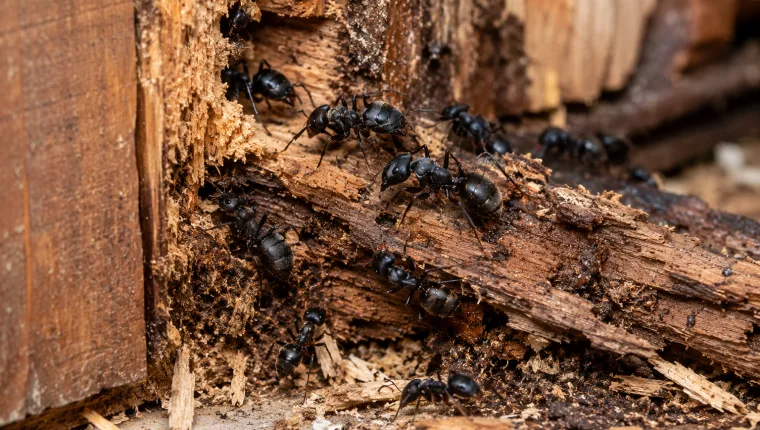
Carpenter ants do not eat wood. They excavate it to create smooth tunnels and nesting galleries. The material removed from the nest may appear as coarse sawdust mixed with insect fragments and other debris.
The most important decision is determining whether the ants are:
- Foraging indoors from an outdoor nest
- Living in a parent nest inside damp or decayed wood
- Occupying a satellite nest inside a drier wall or structural void
- Using more than one nest around the property
- Another ant species that requires a different treatment
- Winged termites rather than carpenter ants
Indoor carpenter ant activity during winter, repeated sightings of numerous workers, coarse wood debris, rustling sounds inside a wall, or large numbers of winged ants emerging indoors can indicate a nest inside the structure.
When the nest cannot be located, the property has extensive moisture damage, or activity continues after baiting and exclusion, professional inspection is usually the safest and most effective next step.
For general ant evidence, see our ant infestation signs guide.
When the ants have not been identified, begin with our guide to
- What Are Carpenter Ants?
- What Do Carpenter Ants Look Like?
- Carpenter Ants vs. Termites
- Do Carpenter Ants Eat Wood?
- Can Carpenter Ants Damage a House?
- Parent Nests and Satellite Nests
- Signs of a Carpenter Ant Infestation
- Where Carpenter Ants Commonly Nest
- How to Find a Carpenter Ant Nest
- Carpenter Ant Control Step by Step
- Carpenter Ant Treatment Options
- Carpenter Ant Baits
- Direct Nest and Void Treatment
- Why Spraying Visible Carpenter Ants Usually Fails
- Outdoor Carpenter Ant Control
- Moisture Correction and Structural Repair
- How Long Does Carpenter Ant Treatment Take?
- Why Carpenter Ant Treatments Fail
- DIY Carpenter Ant Control vs. Professional Treatment
- Carpenter Ant Treatment Safety
- Carpenter Ant Treatment Cost Factors
- How to Prevent Carpenter Ants
- Carpenter Ant Inspection Checklist
- Frequently Asked Questions
- What is the best way to get rid of carpenter ants?
- Do carpenter ants eat wood?
- How do I know whether I have carpenter ants?
- What is the difference between carpenter ants and termites?
- Does seeing one carpenter ant mean there is a nest in the house?
- Where do carpenter ants usually nest?
- What does carpenter ant frass look like?
- Why are carpenter ants appearing in winter?
- Do carpenter ant baits work?
- How long does carpenter ant bait take to work?
- Will spraying carpenter ants eliminate the colony?
- Can carpenter ants damage structural wood?
- Do carpenter ants only nest in rotten wood?
- Can carpenter ants live in foam insulation?
- Should a tree with carpenter ants be removed?
- Can moisture correction eliminate carpenter ants?
- How do professionals find carpenter ant nests?
- How much does carpenter ant treatment cost?
- When should I call a carpenter ant exterminator?
- Can carpenter ants return after treatment?
What Are Carpenter Ants?
Carpenter ants are large ants in the genus Camponotus. Several species occur across the United States, and their size and color vary by region.
Workers may be:
- Black
- Dark brown
- Red and black
- Reddish brown
- Different sizes within the same colony
A mature carpenter ant colony may contain smaller minor workers and larger major workers. This size variation is one reason homeowners sometimes believe they are seeing several different ant species.
Carpenter ants have:
- A narrow waist with one visible node
- Elbowed antennae
- An evenly rounded upper thorax when viewed from the side
- Strong jaws used to excavate wood and handle food
- Winged reproductive forms at certain times of year
They feed on proteins and sugars rather than wood. Food sources may include:
- Living and dead insects
- Honeydew produced by aphids and scale insects
- Syrup
- Honey
- Sugar
- Meat
- Pet food
- Other household food residue
The University of Minnesota Extension explains that carpenter ants remove wood to construct tunnels and galleries but do not consume it as food.
What Do Carpenter Ants Look Like?
Carpenter ants are among the larger ants commonly found around homes. Worker size varies substantially, so size alone is not enough for identification.
| Feature | Carpenter ant appearance | Important limitation |
|---|---|---|
| Worker size | Medium to large, with workers of different sizes in the same colony | Several other ant species can also appear relatively large |
| Color | Black, brown, reddish, or red and black depending on species | Not every carpenter ant is black |
| Waist | Narrow, with one node between the thorax and abdomen | Magnification may be needed |
| Thorax | Upper surface appears evenly rounded when viewed from the side | A clear side view is required |
| Antennae | Elbowed | May be difficult to see in a blurry photograph |
| Winged forms | Front wings are longer than the hind wings | Winged ants are frequently confused with termite swarmers |
Capture several specimens when possible, especially if the workers differ in size or color. Use clear tape or a sealed container and include a ruler or coin in photographs.
Do not begin structural treatment based only on a blurry image of one ant.
Carpenter Ants vs. Termites
Carpenter ants and termites can both be associated with wood, but they are different insects with different biology and treatment requirements.
| Feature | Carpenter ants | Termites |
|---|---|---|
| Body shape | Clearly constricted waist | Broad connection between body sections |
| Antennae | Elbowed | Straight or beadlike |
| Wing length | Front wings longer than hind wings | Front and hind wings approximately equal in length |
| Worker appearance | Dark or reddish ants commonly visible while foraging | Usually pale, soft-bodied, and hidden inside wood or soil-connected galleries |
| Use of wood | Excavate wood to create nesting space | Consume cellulose as food |
| Gallery appearance | Generally smooth and clean, without soil | May contain soil, mud, fecal material, or layered damage depending on the termite type |
| Discarded material | Coarse wood fragments, insulation, insect parts, and nest debris | Subterranean termites generally keep galleries enclosed; drywood termites may produce distinct fecal pellets |
Winged carpenter ants have a narrow waist, elbowed antennae, and front wings that are longer than the rear wings. Winged termites have a broader waist, straighter antennae, and two pairs of wings of approximately equal length.
Collect the insects and wings when possible. A termite infestation should be evaluated through a dedicated termite inspection.
Do not assume that smooth wood damage proves carpenter ants or that every pile of wood material is carpenter ant frass. Wood-boring beetles, carpenter bees, rodents, construction activity, and decay can produce different forms of debris or damage.
If the ants are associated with outdoor soil mounds or aggressive stinging behavior, do not assume they are carpenter ants; compare the evidence with our fire ant control guide before choosing a treatment approach.
Do Carpenter Ants Eat Wood?
No. Carpenter ants do not digest wood as termites do.
They use their jaws to remove wood fibers and enlarge natural cracks, soft areas, insect tunnels, or structural voids. The excavated material is carried or pushed out of the nest.
This debris may contain:
- Coarse wood particles
- Fibrous wood fragments
- Dead ants
- Parts of other insects
- Insulation
- Other nest material
The material is often less uniform than the fine powder produced by certain wood-boring beetles.
Carpenter ant galleries frequently look smooth, as though the inner wood surface has been sanded.
Can Carpenter Ants Damage a House?
Carpenter ants can damage wood as they enlarge nesting galleries. The severity depends on:
- Colony size
- Length of time the nest remains active
- Number of nests
- Condition of the wood
- Whether structural members are involved
- Whether moisture or decay has already weakened the material
They commonly begin in wood that is damp, decayed, softened, or previously damaged. A satellite nest may later occupy a drier void, insulation, hollow door, or sound wood near the parent colony.
Visible carpenter ant damage does not show whether a beam, wall, sill plate, roof component, or floor is structurally safe.
After the infestation is controlled, damaged structural material should be evaluated by a qualified carpenter, contractor, engineer, or other appropriate building professional.
Pest treatment and structural repair are separate services unless both are specifically included in writing.
Parent Nests and Satellite Nests
Carpenter ant colonies can maintain more than one nesting location.
Parent Nest
The parent nest contains the queen, eggs, young larvae, workers, and other colony members. It generally requires more consistent moisture than a satellite nest.
Outdoor parent nests may occur in:
- Decaying trees
- Tree roots
- Stumps
- Logs
- Fence posts
- Landscape timbers
- Wood buried in soil
- Damaged exterior structures
Indoor parent nests are commonly associated with:
- Roof leaks
- Leaking windows
- Damaged flashing
- Plumbing leaks
- Bathtubs and showers
- Dishwashers
- Condensation
- Poor ventilation
- Damp crawl spaces
Satellite Nests
Satellite nests may contain workers, older larvae, and pupae but not necessarily the queen or eggs. They can occur in relatively dry areas because their contents require less moisture than the early brood in the parent colony.
Possible satellite nest locations include:
- Wall voids
- Ceilings
- Attics
- Hollow doors
- Foam insulation
- Window frames
- Roof voids
- Sound structural wood
- Areas around warm pipes or equipment
Workers may move between the parent colony, satellite nests, and feeding areas. Treating only one nest can leave other colony locations active.
The NC State Extension notes that carpenter ants can maintain satellite nests in addition to the primary colony and that control may require locating more than one nesting area.
Signs of a Carpenter Ant Infestation
Repeated Indoor Sightings
One carpenter ant may have entered while searching for food. Repeated sightings, particularly in the same room or during winter, are more concerning.
Record:
- Date
- Time
- Room
- Exact location
- Number of ants
- Direction of travel
- Whether workers were carrying food
- Whether winged ants were present
Coarse Sawdust or Frass
Carpenter ant nest debris may appear beneath:
- Wall cracks
- Window frames
- Baseboards
- Ceilings
- Roof components
- Porches
- Attic beams
- Hollow doors
Clean the material after documenting it and check whether a new pile appears. Recurring debris can help locate the point where ants are removing material from the nest.
Rustling Inside Walls
An active colony may produce a faint dry rustling sound. The sound may become more noticeable when the area is tapped or disturbed.
Building movement, pipes, insects, and other animals can create similar sounds. Listening supports inspection but does not confirm a carpenter ant nest by itself.
Winged Ants Indoors
Large numbers of winged carpenter ants emerging indoors can indicate a mature nest inside the structure.
One or two winged ants near a door or window may have entered from outdoors. Preserve the specimens and determine whether the insects are ants or termites.
Activity During Winter
Carpenter ants are normally less active outdoors during cold weather. Repeated indoor activity during winter can indicate a nest receiving heat from the building or sunlight.
Workers can also be carried indoors in firewood, but individual workers cannot establish a new colony without a queen.
Moisture or Damaged Wood
Carpenter ant evidence near a leaking roof, window, shower, dishwasher, sink, pipe, gutter, or damp crawl space increases the likelihood of a nearby nest.
Moisture does not prove that ants are present, but it identifies a high-priority inspection area.
Where Carpenter Ants Commonly Nest
| Area | Possible nesting condition | What to inspect |
|---|---|---|
| Bathrooms | Leaks and condensation | Tub surrounds, shower walls, sinks, toilets, tiles, and plumbing voids |
| Kitchens | Dishwasher, sink, refrigerator, or pipe leaks | Cabinet bases, wall penetrations, subflooring, and appliance areas |
| Windows and doors | Failed flashing, damaged seals, and rainwater intrusion | Frames, trim, wall cavities, and exterior joints |
| Roof and attic | Roof leaks, condensation, and damaged flashing | Rafters, sheathing, insulation, vents, and roof intersections |
| Crawl spaces | High humidity, plumbing leaks, and wood-to-soil conditions | Joists, beams, subflooring, sill areas, and insulation |
| Porches and decks | Weathered or moisture-damaged wood | Posts, ledgers, railings, steps, and wall connections |
| Exterior trees | Decay, cavities, old wounds, and dead wood | Roots, trunks, branch cavities, and contact routes to the building |
| Insulation and voids | Protected satellite nesting space | Foam insulation, wall voids, ceilings, and hollow doors |
How to Find a Carpenter Ant Nest
Locating the nest is often the most difficult part of carpenter ant control.
Observe Ants at Night
Carpenter ants commonly forage from evening through the night during warmer months. Use a flashlight to observe workers without disturbing their trails.
Look for ants traveling:
- Along foundation walls
- Across tree branches
- Along utility wires
- Through window or door gaps
- Behind appliances
- Along plumbing lines
- Into cracks or wall openings
Follow Workers Carrying Food
Workers returning with food may be easier to follow than ants moving randomly.
A small food attractant may help reveal a trail, but food preferences can change by season and colony needs. Place it only where ants are already active and remove it after observation.
Do not place food where it creates a contamination, child, pet, or wildlife issue.
Inspect Moisture Sources
Prioritize:
- Current and historical leaks
- Water-stained ceilings
- Damaged window frames
- Plumbing penetrations
- Roof valleys and flashing
- Overflowing gutters
- Dishwasher connections
- Damp crawl spaces
- Condensation around pipes
A pest professional may use a moisture meter to identify areas requiring closer inspection. Moisture readings do not independently confirm a nest.
Look for Debris Openings
Follow recurring piles of coarse wood material upward to the crack, gap, trim joint, or other opening where debris is being expelled.
Listen Carefully
Rustling may help narrow the nest location, but walls should not be opened solely because of an uncertain sound.
Inspect the Exterior
An indoor satellite nest may be connected to a parent nest in:
- A tree
- A stump
- A fence post
- Firewood
- A landscape timber
- An exterior wall
- A damaged porch or roof component
Workers may travel substantial distances between the parent nest, satellite nests, and food.
Carpenter Ant Control Step by Step
Step 1: Confirm the Ant
Capture workers or winged specimens. Confirm that they are carpenter ants rather than termites, field ants, acrobat ants, or another large ant.
Step 2: Map the Activity
Record sightings, trails, debris, moisture, winged ants, sounds, and exterior access routes.
Step 3: Identify Moisture and Damaged Wood
Locate current and historical leaks, condensation, drainage problems, decayed wood, and damaged building materials.
Step 4: Locate Parent and Satellite Nests
Follow workers and inspect both interior and exterior areas. Finding one nest does not prove that no additional nest exists.
Step 5: Select a Targeted Treatment
The treatment may include:
- Removing infested wood
- Correcting moisture
- Applying ant bait
- Treating a confirmed nest or void
- Applying an appropriate exterior treatment
- Sealing access routes after control
Step 6: Repair and Exclude
Replace damaged materials, correct leaks, trim branches, seal gaps, and remove outdoor wood harborages where appropriate.
Step 7: Monitor
Continue checking for workers, winged ants, new debris, sounds, and moisture problems.
Carpenter Ant Treatment Options
| Treatment method | Where it may fit | Main limitation |
|---|---|---|
| Removal of infested wood | Accessible outdoor nests, damaged trim, decayed structural components, and remodeling | Additional nests may remain elsewhere |
| Moisture correction | Leaks, condensation, drainage, and damp wood | Does not immediately eliminate an established colony |
| Ant bait | Active foraging trails when the nest cannot be reached | Carpenter ants may ignore a formulation or change food preference |
| Direct nest treatment | Confirmed and accessible nest or structural void | Requires accurate location and label-compliant application |
| Exterior perimeter treatment | Workers entering from outdoor nesting areas | May not eliminate an indoor nest or inaccessible parent colony |
| Exclusion | Branches, wires, gaps, windows, doors, vents, and utility routes | Should be coordinated with colony control to avoid trapping ants inside |
| Routine surface spraying | Limited contact control of exposed workers | Usually fails to reach the nest |
Carpenter Ant Baits
Baits combine food attractants with a slow-acting active ingredient. Foraging workers consume the bait and may distribute it to other colony members.
Bait can be useful when:
- A clear foraging trail is present
- The nest cannot be reached directly
- Workers feed consistently from the product
- The bait can be placed safely
- Monitoring and replacement are possible
Bait performance depends on:
- Placement
- Freshness
- Food preference
- Season
- Competing food
- Colony nutritional needs
- Active ingredient
- Whether repellent insecticides were applied nearby
Carpenter ants may prefer sugar at one time and protein at another. A bait that is ignored should not automatically be assumed defective.
Never spray pesticide on or around a bait placement unless the labels and treatment plan specifically allow it. Repellent contamination can stop ants from feeding.
Baits may require weeks or longer to affect a colony and do not guarantee that every satellite nest will receive a sufficient dose.
See our ant bait guide.
Direct Nest and Void Treatment
When a nest has been located, a professional may apply an appropriately labeled dust, foam, aerosol, or liquid into the nest or structural void.
Possible locations include:
- Wall voids
- Ceilings
- Subfloors
- Attics
- Window frames
- Hollow doors
- Damaged exterior wood
- Other confirmed nesting areas
This work may require drilling small access holes. Randomly drilling walls or injecting pesticide throughout the building is not appropriate.
Professional treatment should identify:
- The evidence supporting the nest location
- The product used
- EPA registration number
- Application site
- Access holes or openings
- Occupant precautions
- Repair responsibility
- Follow-up schedule
Do not inject pesticides into electrical outlets, wiring areas, HVAC equipment, or structural voids unless the product label specifically permits the use and the application can be completed safely.
Why Spraying Visible Carpenter Ants Usually Fails
Only part of the colony is outside the nest at one time. Surface sprays may kill the workers directly contacted without reaching:
- The queen
- Brood
- Workers remaining inside the nest
- Satellite nests
- The outdoor parent colony
Repellent sprays can also disrupt trails, interfere with bait feeding, or cause activity to shift to another route.
A reduction in visible ants for several days does not prove colony elimination.
Outdoor Carpenter Ant Control
Inspect trees, stumps, roots, fence posts, landscape timbers, firewood, sheds, decks, and other wooden features.
When a parent nest is found outdoors, possible actions include:
- Removing a decayed stump or loose wood
- Replacing damaged landscape timbers
- Moving firewood away from the structure
- Having a labeled treatment applied to the confirmed nest
- Trimming branches that contact the house
- Correcting exterior moisture and drainage
Carpenter ants occupying a cavity in a living tree do not necessarily cause the tree’s decay. They often use wood that was already damaged by disease, injury, moisture, or previous decay.
Tree removal should be based on tree condition and safety, not only the presence of ants. Consult a qualified arborist when the tree’s structural stability is uncertain.
Moisture Correction and Structural Repair
Carpenter ant control is incomplete when the underlying moisture problem remains.
Inspect and repair:
- Roof leaks
- Damaged flashing
- Leaking windows
- Overflowing gutters
- Plumbing leaks
- Shower and bathtub seals
- Dishwasher connections
- Crawl-space moisture
- Exterior drainage
- Condensation around pipes
- Damaged siding and trim
Water-damaged wood may require removal or replacement. Pest-control companies do not always perform plumbing, roofing, carpentry, or structural repairs.
The proposal should state which company or property owner is responsible for each correction.
How Long Does Carpenter Ant Treatment Take?
The timeline depends on the nest location, number of nests, treatment method, food preference, building conditions, and follow-up.
| Situation | Possible timeline | Main variable |
|---|---|---|
| Accessible outdoor nest removed | Activity may decline quickly | Whether additional parent or satellite nests exist |
| Direct treatment of a confirmed indoor nest | Visible activity may decline within days | Completeness of treatment and presence of other nests |
| Bait program | May require several weeks or longer | Bait acceptance, placement, colony size, and food preference |
| Unlocated nest | May require repeated inspection and monitoring | Hidden routes, moisture areas, and exterior colony connections |
| Multiple nests | May require several treatments and repairs | Number and accessibility of nesting areas |
One or two workers seen shortly after treatment do not automatically prove failure. Repeated activity, new debris, winged ants, or continuing trails should be documented and inspected.
Why Carpenter Ant Treatments Fail
- The ant species was incorrectly identified.
- Only foraging workers were sprayed.
- The parent nest was not located.
- A satellite nest remained untreated.
- The bait was not accepted.
- Repellent pesticide interfered with bait.
- Moisture damage remained.
- Decayed wood was not repaired.
- Exterior branches or utility routes remained open.
- Food sources continued attracting workers.
- Treatment was applied randomly rather than to confirmed activity.
- Monitoring stopped too soon.
Continuing activity should trigger a new inspection rather than indefinite repetition of the same surface spray.
DIY Carpenter Ant Control vs. Professional Treatment
DIY Control May Be Reasonable When:
- The ants have been confidently identified
- Workers are foraging indoors from a visible outdoor nest
- The exterior nest or infested wood can be removed safely
- A small, accessible trail accepts an appropriately labeled bait
- Moisture and entry conditions can be corrected
- Activity is monitored and declines
Professional Treatment Is More Appropriate When:
- Ants remain active during winter
- Large numbers of winged ants emerge indoors
- Coarse debris repeatedly appears from a wall or ceiling
- The nest is inside a wall, roof, attic, floor, or structural void
- Several nests may be present
- Termites have not been ruled out
- Structural wood is damaged
- Baiting has failed
- Moisture damage is extensive
- Pesticide must be applied inside a void
- Children or pets complicate safe product placement
Carpenter Ant Treatment Safety
Pesticides must be used according to their EPA-registered labels.
The EPA recommends identifying the pest, removing food and water, blocking entry routes, and using targeted pesticide applications rather than automatically spraying entire rooms.
Before treatment, tell the provider about:
- Children
- Pregnant occupants
- Pets
- Aquariums and terrariums
- People with asthma
- Chemical sensitivities
- Food-preparation areas
- Wells, ponds, or drainage areas
Request:
- Product names
- EPA registration numbers
- Application locations
- Preparation instructions
- Re-entry instructions
- Pet precautions
- Cleaning instructions
Do not:
- Apply outdoor products indoors
- Use more pesticide than the label permits
- Mix products without label instructions
- Apply sprays over ant bait
- Drill into walls without checking for utilities
- Apply liquid pesticides inside electrical equipment
- Place bait where children or pets can reach it
Carpenter Ant Treatment Cost Factors
Carpenter ant treatment does not have one standard price. The quote may depend on:
- Whether the nest has been located
- Number of parent and satellite nests
- Interior or exterior location
- Need for drilling or void treatment
- Property size
- Attic or crawl-space access
- Moisture and structural damage
- Number of follow-up visits
- Exclusion work
- Warranty terms
Ask the company to separate:
- Inspection
- Pest treatment
- Follow-up visits
- Moisture correction
- Wood repair
- Exclusion
- Annual or recurring service
See our complete pest-control cost guide for general service pricing and quote-comparison guidance.
How to Prevent Carpenter Ants
Correct Moisture
- Repair roof and plumbing leaks.
- Maintain gutters and downspouts.
- Repair damaged window and door seals.
- Correct crawl-space moisture.
- Improve ventilation where needed.
- Replace decayed exterior wood.
Reduce Access
- Trim branches touching the roof or walls.
- Remove vines from the building.
- Seal gaps around utilities.
- Repair screens.
- Seal cracks around windows and doors.
- Inspect roof, siding, and foundation intersections.
Manage Outdoor Wood
- Move firewood away from the house.
- Raise stored wood from soil when practical.
- Remove decayed stumps and landscape timbers when appropriate.
- Repair damaged fences, decks, and sheds.
- Avoid burying scrap wood near the foundation.
Reduce Food Sources
- Store food in sealed containers.
- Clean syrup, sugar, grease, and pet food.
- Manage garbage.
- Correct aphid and scale insect problems on plants near the structure when appropriate.
Continue Monitoring
Inspect previously active areas during spring and summer and after roof, plumbing, window, or structural leaks.
Carpenter Ant Inspection Checklist
| Inspection item | Evidence found | Action required | Completed |
|---|---|---|---|
| Ant species confirmed | |||
| Winged ants compared with termites | |||
| Indoor trails mapped | |||
| Coarse wood debris located | |||
| Moisture sources inspected | |||
| Roof and attic inspected | |||
| Bathroom and kitchen plumbing inspected | |||
| Exterior trees and stumps inspected | |||
| Branches and utility access inspected | |||
| Parent nest located | |||
| Satellite nests evaluated | |||
| Treatment documented | |||
| Moisture repaired | |||
| Damaged wood evaluated | |||
| Follow-up completed |
Frequently Asked Questions
What is the best way to get rid of carpenter ants?
The most effective approach is to locate and treat the nest, correct moisture and damaged wood, remove exterior harborages, seal access routes, and monitor for additional nests.
Do carpenter ants eat wood?
No. Carpenter ants excavate wood to create nesting galleries but feed on insects, honeydew, proteins, sugars, and other food sources.
How do I know whether I have carpenter ants?
Carpenter ants commonly have one waist node, elbowed antennae, an evenly rounded thorax, and workers of different sizes. Capture specimens for confirmation.
What is the difference between carpenter ants and termites?
Carpenter ants have a narrow waist, elbowed antennae, and unequal wing pairs. Termites have a broader waist, straighter antennae, and wings of approximately equal length.
Does seeing one carpenter ant mean there is a nest in the house?
No. One worker may be foraging from an outdoor nest. Repeated winter activity, indoor winged ants, coarse debris, or numerous workers provide stronger evidence of an indoor nest.
Where do carpenter ants usually nest?
Parent nests commonly occur in damp or decayed wood. Satellite nests may occur in drier wall voids, insulation, hollow doors, ceilings, attics, and sound wood.
What does carpenter ant frass look like?
It often appears as coarse, fibrous wood debris mixed with insect fragments and other nest material. It is usually less uniform than fine wood-boring beetle powder.
Why are carpenter ants appearing in winter?
Repeated winter activity can indicate a nest inside a heated or sun-warmed part of the building. Individual workers may also be brought indoors with firewood.
Do carpenter ant baits work?
Baits may work when foraging workers accept the formulation and carry it to the colony. Food preference, placement, freshness, competing food, and nearby sprays affect performance.
How long does carpenter ant bait take to work?
A bait program may require several weeks or longer. Continuing monitoring is necessary because the colony may contain multiple nests.
Will spraying carpenter ants eliminate the colony?
Spraying visible workers may reduce sightings but usually does not reach the queen, brood, parent nest, or satellite nests.
Can carpenter ants damage structural wood?
Yes. Long-standing colonies can enlarge galleries in wood. Damage severity depends on colony size, duration, wood condition, and whether structural components are involved.
Do carpenter ants only nest in rotten wood?
Parent nests commonly begin in damp or decayed wood, but satellite nests may occupy relatively dry insulation, wall voids, hollow doors, or sound wood.
Can carpenter ants live in foam insulation?
Yes. Carpenter ants may excavate or occupy foam insulation and other soft materials even though these materials are not a food source.
Should a tree with carpenter ants be removed?
Not automatically. Carpenter ants often occupy wood already affected by decay. A qualified arborist should evaluate the tree’s health and structural safety.
Can moisture correction eliminate carpenter ants?
Moisture correction removes an important nesting condition but may not immediately eliminate an established colony. Nest treatment or removal may still be required.
How do professionals find carpenter ant nests?
Professionals may follow trails, inspect moisture-damaged areas, use moisture meters, listen for colony sounds, examine debris, and inspect exterior parent-nest locations.
How much does carpenter ant treatment cost?
Cost depends on nest location, number of nests, property size, void treatment, access, repairs, exclusion, and follow-up. Request a written scope separating pest treatment from building repairs.
When should I call a carpenter ant exterminator?
Call a professional for winter activity, indoor swarmers, hidden wall or attic nests, repeated frass, structural damage, several suspected nests, failed baiting, or uncertain termite identification.
Can carpenter ants return after treatment?
Yes. Activity can return when another nest remains, moisture is not corrected, exterior routes remain open, or ants establish a new colony.
Carpenter ant identification and control should be based on physical evidence and nest location. Pesticides must be used according to their EPA-registered labels. Structural damage and moisture problems may require qualified building, plumbing, roofing, engineering, or tree-care professionals.
