
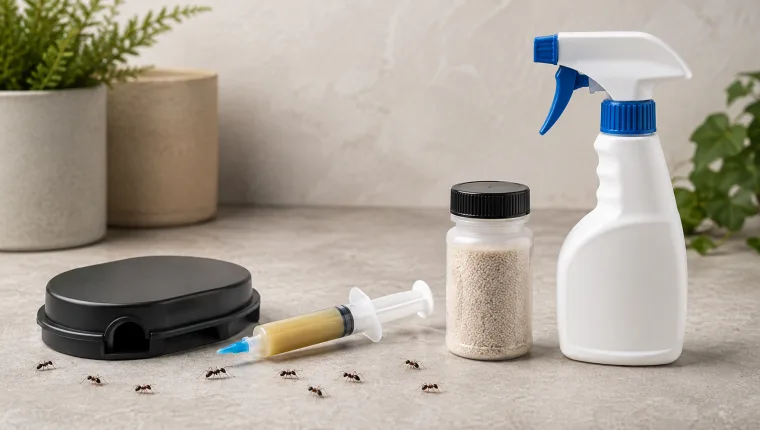
The best ant killer is not one universal spray. It is the product category that matches the ant species, nest location, colony behavior, infestation level, and place where the product will be used. For many indoor trails, a properly selected bait is the best starting point. Outdoor mounds, carpenter ants, and perimeter activity may require different tools.
- What Is the Best Ant Killer?
- In This Guide
- Identify the Ant Before Choosing a Product
- Best Ant Killer by Species and Location
- Ant Killer Categories Compared
- Active Ingredients and Mechanisms: What to Compare
- Ant Killer Product-Selection Decision Matrix
- How to Compare Cost Without Choosing the Cheapest Package
- Safety and Label Requirements
- Why Ant Killers Sometimes Fail
- When an Ant Product Is Not Enough
- How to Choose the Best Ant Control Option
- Frequently Asked Questions
- What is the best ant killer for inside the house?
- What kills ants instantly?
- What is the best fire ant killer?
- Are ant baits better than sprays?
- Can I use ant killer around pets?
- Why are ants ignoring the bait?
- Should I spray ants that are feeding on bait?
- When should I call an exterminator for ants?
- How Pest Decoded Evaluates Ant Killer Categories
What Is the Best Ant Killer?
For most indoor trailing ants, a slow-acting ant bait placed near active routes is usually a better first choice than a contact spray. Workers carry bait back toward the colony, while a spray may kill only the ants you can see. For fire ants in a yard, a label-approved broadcast bait, individual-mound treatment, or integrated two-step program may fit better.
For carpenter ants, product choice should follow an inspection for moisture, damaged wood, and nest location.
The main decision factor is simple: choose the product for the identified ant and the labeled application site. Do not choose by package claims such as “maximum strength” alone.
Identify the Ant Before Choosing a Product
Ants that look similar can behave very differently. Some nest outdoors and enter for food. Others establish colonies inside walls, cabinets, insulation, or damp wood. Some prefer sweets at one time of year and proteins or fats at another. A product that attracts one species may be ignored by another.
Start by documenting size, color, trail pattern, time of activity, food attraction, moisture nearby, and where ants enter. The ants in the house identification guide explains common household species and practical clues. If trails keep returning, swarmers appear indoors, or you find coarse sawdust-like debris, review the ant infestation signs guide before treating.
Common Situations That Change the Recommendation
- Small ants trailing through kitchens: enclosed bait stations or gel/liquid baits may fit, provided the label allows the location.
- Pharaoh ants or another budding species: avoid repellent spraying that can disrupt trails and fragment colonies; professional identification is valuable.
- Large ants associated with damp wood: investigate carpenter ants, moisture, and structural conditions instead of treating only visible workers.
- Outdoor fire-ant mounds: select a fire-ant product labeled for the exact site, such as lawns, ornamental turf, or another listed area.
- Occasional outdoor invaders: exclusion, vegetation management, sanitation, and a targeted exterior approach may matter more than indoor pesticide use.
Best Ant Killer by Species and Location
Best Ant Killer for Indoor Trails
For many indoor foraging ants, the best ant control starts with a bait rather than a fast contact spray. Place a label-approved bait near active trails but away from food preparation, children, and pets as the label directs. Do not spray on or near the bait because contamination or repellency can stop feeding.
Choose between sweet and protein-or-grease bait matrices based on what the ants accept. Preferences can change, so a rejected bait is not proof that all baits fail. The detailed ant bait guide explains placement, food competition, contamination, and response tracking.
Best Ant Killer for Carpenter Ants
Carpenter ants do not eat wood; they excavate it for nesting. The best response combines identification, moisture correction, inspection, and treatment directed toward the actual colony or travel routes. A bait may help in some situations, but product choice depends on species, foraging behavior, and nest accessibility.
Large workers, activity around damp framing, or coarse debris can justify a professional inspection. Review the carpenter ant control guide for nest clues, moisture issues, termite comparisons, and escalation points. Do not drill walls, open energized equipment, or inject products into voids unless the label specifically permits the application and the work can be performed safely.
Best Fire Ant Killer for Lawns and Yards
Fire-ant control commonly uses one of two broad strategies: broadcast bait across a labeled area or treatment of individual mounds. Broadcast baits target foraging colonies over a wider area but may take time. Mound treatments focus on visible colonies but can miss small or hidden mounds and may not prevent reinvasion.
The best fire ant killer depends on the size of the area, number of mounds, desired speed, season, weather restrictions, and label. Never assume a product labeled for one outdoor site is approved for vegetable gardens, pastures, playgrounds, or areas used by pets. Verify every site on the current label.
Best Ant Killer for Patios, Foundations, and Perimeters
For ants nesting outdoors and entering through cracks, an exterior program may combine sanitation, trimming vegetation away from the structure, sealing entry points, removing food sources, and a targeted label-approved product. Liquid perimeter treatments or granules can have a role when the label lists the pest and site.
A perimeter product should not substitute for finding why ants are entering. Leaking irrigation, honeydew-producing insects, pet food, trash, mulch against siding, and unsealed utility penetrations can sustain activity. Broad preventive spraying without evidence can increase exposure without solving the source.
Best Ant Killer for Sensitive Indoor Areas
Homes with young children, pets, food preparation, respiratory concerns, or limited placement options require extra caution. Enclosed bait stations can reduce direct access compared with exposed formulations, but they are not childproof or pet-proof unless the label and product design specifically support that claim. Place every product exactly as directed and keep it inaccessible.
In schools, childcare settings, healthcare facilities, multifamily buildings, or food-service environments, coordinated integrated pest management and professional oversight are often more appropriate than isolated consumer treatments.
Ant Killer Categories Compared
| Category | What It Is Designed to Do | Best-Fit Situations | Main Limitations |
|---|---|---|---|
| Gel or liquid bait | Attract foragers that share a slow-acting toxicant within the colony | Indoor trails, cracks, stations, and other label-approved placements | May be rejected; can dry out or become contaminated; slower than contact kill |
| Enclosed bait station | Provide bait in a contained housing | Homes where placement control and reduced contact are priorities | Opening size and bait matrix may not fit every species; still requires safe placement |
| Granular bait | Distribute bait across a labeled outdoor area for foraging ants | Lawns, ornamental areas, and fire-ant programs when listed on the label | Weather, irrigation, competing food, and timing affect acceptance |
| Individual-mound treatment | Target a visible mound directly | Limited numbers of confirmed outdoor mounds | Can miss satellite or hidden colonies; application rules vary greatly |
| Liquid residual treatment | Create a treated zone or target listed harborages and routes | Selected exterior, crack-and-crevice, or professional applications allowed by label | May repel or kill foragers before colony transfer; exposure and site restrictions matter |
| Contact aerosol or ready-to-use spray | Kill ants contacted by the spray | Limited spot treatment where the label allows and colony control is not the goal | Usually does not eliminate the colony; overspray and misuse increase exposure |
| Insecticidal dust | Provide a long-lasting deposit in specifically labeled dry, inaccessible areas | Professional or carefully controlled crack, crevice, or void uses when listed | Drift and inhalation risk; overapplication reduces effectiveness and increases exposure |
Active Ingredients and Mechanisms: What to Compare
Do not select an ant killer by brand name alone. Compare the active ingredient, formulation, target pest, approved site, signal word, precautions, and application directions on the current label. Products with similar packaging can have different ingredients or approved uses.
Slow-Acting Bait Active Ingredients
Ant baits may use ingredients designed to act slowly enough for foragers to return to the colony. Depending on the registered product, examples can include borate compounds, indoxacarb, hydramethylnon, abamectin, fipronil, or other active ingredients. This list is not a recommendation and does not mean every ingredient is registered for every ant or site.
The bait matrix is as important as the toxicant. A sweet liquid, carbohydrate gel, protein-based granule, or oil-based granule may attract different species or the same colony at different times.
Contact and Residual Ingredients
Contact sprays and residual products may use pyrethrins, pyrethroids, or other registered insecticides. They can reduce visible activity, but fast-acting or repellent effects may interfere with baiting and may not reach the nest. They require strict attention to indoor-versus-outdoor approval, food-area restrictions, ventilation, reentry instructions, and environmental precautions.
Insect Growth Regulators
Some professional or specialty programs may include an insect growth regulator. These products affect development or reproduction rather than providing an immediate knockdown. Their usefulness depends on species, formulation, registration, and integration with other measures.
“Natural” Does Not Automatically Mean Low Risk
Botanical oils, soaps, desiccants, and minimum-risk products can still irritate skin, eyes, or airways, harm plants, stain surfaces, or pose risks to pets and aquatic environments. “Natural ant killer” is a marketing category, not a safety guarantee. Read the entire label and do not improvise recipes from household chemicals.
Ant Killer Product-Selection Decision Matrix
| Observed Situation | Best Starting Category | Why | Stop and Reassess If |
|---|---|---|---|
| Small ants following a stable indoor trail | Label-approved bait accepted by the ants | Targets foragers and may reach more of the colony than contact kill | No feeding, trails split after spraying, or species is uncertain |
| Suspected pharaoh ants in a building | Professional identification and nonrepellent bait-based plan | Repellent disturbance can contribute to budding | Activity spreads to new rooms or units |
| Large ants associated with damp wood | Inspection, moisture correction, then species-appropriate treatment | Visible workers may be far from the nest | Structural damage, inaccessible voids, or repeated swarmers appear |
| Many fire-ant mounds across a lawn | Label-approved broadcast bait or integrated professional plan | Addresses colonies over a larger area | The site is not listed, weather conflicts with label, or people/pets cannot be excluded |
| One or a few confirmed fire-ant mounds | Label-approved individual-mound product | Targets visible colonies | Mounds rapidly return or activity is widespread |
| Ants entering from a clear exterior gap | Exclusion and sanitation, with targeted exterior treatment if needed | Corrects the route and attraction source | Ants are nesting indoors or the product cannot be applied safely |
Download the Ant Product Selector to compare species clues, location, product category, active ingredient, label-approved site, safety restrictions, monitoring date, and results.
How to Compare Cost Without Choosing the Cheapest Package
Package price does not show the true cost of ant control. Compare the amount of usable product, number of treatment or monitoring cycles, area covered according to the label, need for replacement bait, equipment required, and likelihood that the category addresses the colony.
- Bait stations and gels: compare placements and replacement needs, not only package count.
- Granular outdoor baits: compare labeled coverage and storage limits; never increase the rate to “make it stronger.”
- Concentrates: may appear economical, but mixing, measuring, protective equipment, storage, and application errors can add risk. Use only as labeled.
- Professional service: compare inspection, identification, follow-up, exclusion recommendations, warranty terms, and whether inaccessible nests or multiple units are included.
A low-cost contact spray that repeatedly kills foragers can cost more over time than a well-placed bait and sanitation plan. Conversely, buying several bait types at once is wasteful when the ants have not been identified or monitored.
Safety and Label Requirements
The U.S. Environmental Protection Agency recommends an integrated pest management approach: identify the pest, remove food and water, block entry, monitor, and use pesticides carefully when needed. Follow the current product label; it defines where, how, and against which pests the product may be used.
- Verify that ants and the intended site are listed on the label.
- Use only the labeled amount, placement, and frequency.
- Never mix pesticides or combine them with household cleaners.
- Keep products in the original container with the label intact.
- Keep children and pets away for the period and conditions stated on the label.
- Do not place exposed bait on food-contact surfaces or where it can contaminate dishes, toys, pet bowls, or stored food.
- Avoid applying outdoor products before rain or irrigation unless the label specifically directs it.
- Protect water, pollinators, and non-target organisms by observing environmental precautions.
- If exposure or poisoning is suspected, follow the label’s first-aid directions and contact the appropriate emergency or poison-control service.
For more detail, review the EPA’s integrated pest management framework and smart pest control guidance.
Why Ant Killers Sometimes Fail
The Ant Was Misidentified
The wrong species assumption can lead to the wrong bait, wrong placement, or a treatment that worsens dispersal. Photograph specimens with a scale and record trails before changing products.
The Product Targets Workers, Not the Colony
Contact sprays can create an impressive immediate kill while queens and brood remain protected. If the goal is colony control, evaluate whether the product can be carried or transferred to nestmates.
The Bait Is Not Attractive
Ants may prefer a different food matrix, encounter competing food, or reject stale and contaminated bait. Remove accessible crumbs and grease, keep the trail intact, and replace bait only as the label permits.
Spray Contaminated the Bait Area
Repellent residues, cleaners, fragrances, or pesticides can stop ants from feeding. Keep bait away from recently sprayed or strongly scented surfaces unless the product instructions explicitly allow the combination.
The Nest Is Outside the Treated Area
Indoor trails may originate outdoors, in a neighboring unit, under a slab, in a wall void, or in damaged wood. Monitoring entry points is more useful than repeatedly treating the center of a room.
Moisture and Food Sources Remain
Leaking pipes, condensation, pet food, recycling residue, grease, honeydew-producing insects, and open trash can sustain colonies. Chemical control without habitat correction often produces temporary results.
The Colony Budded or Shifted
Some ants form new colonies when disturbed. This is especially important with pharaoh ants and other multi-queen species. If activity suddenly appears in new rooms after spraying, stop changing products and seek expert identification.
When an Ant Product Is Not Enough
Call a qualified pest-management professional when identification is uncertain, ants persist after a label-compliant program, or the infestation involves structural, electrical, health, or access risks. Professional help is particularly appropriate for:
- suspected carpenter ants in damp or damaged wood;
- pharaoh ants or spreading activity in multifamily housing;
- large fire-ant populations in high-use yards, schools, or commercial sites;
- nests inside electrical equipment, inaccessible voids, roofs, or structural cavities;
- repeated indoor swarmers or signs that could be confused with termites;
- facilities with food safety, healthcare, childcare, or regulatory requirements;
- situations where children, pets, wildlife, water, or pollinators make consumer application difficult.
Ask the provider how the species was identified, which active ingredient and formulation are proposed, where the label permits use, how monitoring will be performed, what nonchemical corrections are required, and what follow-up is included.
How to Choose the Best Ant Control Option
- Confirm the pest. Do not treat winged insects or large ants until ants, termites, and lookalikes are separated.
- Map the activity. Record trails, entry points, food attraction, moisture, and time of day.
- Define the location. Indoor food area, wall void, lawn, mound, garden, patio, and foundation are different labeled sites.
- Choose the mechanism. Colony-transfer bait, mound treatment, targeted residual, or exclusion should match the problem.
- Read the label before buying. Check target ant, site, precautions, storage, and disposal—not just the front panel.
- Remove competing conditions. Correct food, water, moisture, vegetation, and access problems.
- Monitor before switching. Record feeding and activity over the label-consistent evaluation period.
- Escalate when needed. Do not keep layering products when activity spreads or risks increase.
Frequently Asked Questions
What is the best ant killer for inside the house?
For many indoor trailing ants, a label-approved slow-acting bait is a strong first option because workers can carry it toward the colony. The best formulation depends on species and food preference. Avoid spraying near bait.
What kills ants instantly?
Contact sprays and some ready-to-use products can kill ants they directly contact, but instant worker kill does not necessarily eliminate the colony. Fast knockdown may be less useful than colony transfer when trails are established.
What is the best fire ant killer?
The best fire-ant product depends on whether you have one mound or widespread yard activity, the labeled site, weather, desired speed, and who uses the area. Broadcast baits and mound treatments have different roles and limitations.
Are ant baits better than sprays?
For many colony-forming indoor ants, baits are often more useful because workers can share the toxicant. Sprays can kill visible ants but may not reach queens and brood. Species, location, and label directions determine the right choice.
Can I use ant killer around pets?
Only when the current label allows the site and you can follow all pet-related placement, exclusion, drying, and reentry directions. “Pet friendly” marketing does not replace the label. Prevent access to bait and treated areas as directed.
Why are ants ignoring the bait?
The bait matrix may not match their current preference, competing food may be available, the bait may be stale or contaminated, or the trail may have been disrupted. Identification and monitoring help determine the cause.
Should I spray ants that are feeding on bait?
No. Spraying feeding ants can kill the workers carrying bait and contaminate or repel ants from the placement. Allow the bait program to work according to its label and evaluation period.
When should I call an exterminator for ants?
Seek professional help for uncertain species, carpenter ants, pharaoh ants, repeated failures, activity in multiple units, inaccessible nests, structural or electrical concerns, or any situation where pesticide labels cannot be followed safely.
How Pest Decoded Evaluates Ant Killer Categories
We compare ant-control options by identification requirements, mechanism of action, target species, approved location, colony impact, exposure controls, limitations, monitoring needs, and the quality of label-supported claims. We do not treat package popularity, retailer rank, or “maximum strength” language as proof of performance.
Any future product recommendation or affiliate link must be rechecked against the current EPA registration and accepted label. Availability, formulation, and approved uses can change.
