
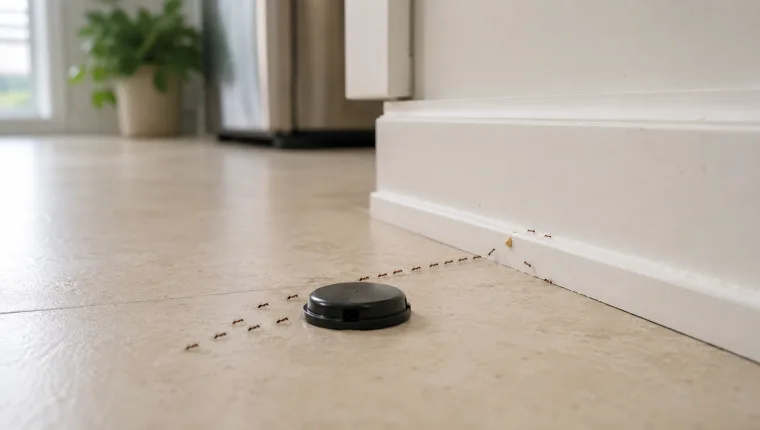
Ant baits work by attracting foraging worker ants to a food-based pesticide they can carry back and share within the colony. The most effective bait is not simply the strongest product. It is the bait the target ants will actually eat, in a location they can reach, used without competing food or repellent sprays. Results are usually gradual because the active ingredient must act slowly enough for workers to return to the nest.
For many household ant problems, baiting is more useful than killing the ants you can see. A contact spray may reduce a trail for a short time, but it often affects only exposed workers. A correctly selected bait can reach hidden nestmates, larvae, and queens through food sharing. That colony-level effect is the main reason baits are central to integrated pest management.
- Quick answer: which ant bait should you use?
- What ant baits are and why they matter
- How ant baits move from workers to the colony
- Sweet, protein, and grease baits: why preference changes
- Where to place ant baits indoors
- Where to place ant baits outdoors
- Why ant baits sometimes fail
- How long ant bait takes to work
- Downloadable: Bait Placement and Response Tracker
- Safety around children, pets, food, and water
- When ant bait is not enough
- How to choose an ant bait without relying on brand claims
- Ant bait checklist
- Frequently asked questions
- Do ant baits attract more ants?
- Should I kill ants that are feeding on bait?
- Why are ants ignoring a bait station?
- Can I use spray and bait at the same time?
- Are liquid ant baits better than solid baits?
- How often should ant bait be replaced?
- Will ant bait work on carpenter ants?
- What should I do if ants keep returning?
- Official research notes for editors
Quick answer: which ant bait should you use?
- Choose by species and feeding preference: some ants favor sweet liquids, while others respond better to protein- or oil-based baits.
- Place bait beside active trails: do not block the trail or put bait where children, pets, food, or water can contact it.
- Remove competing food: clean crumbs, grease, spills, pet food, and accessible trash.
- Do not spray around the bait: sprays and strong cleaners can repel ants, contaminate the bait, or kill workers before they carry it back.
- Monitor rather than guessing: if ants ignore the bait, change the food base, position, or product only as the label permits.
What ant baits are and why they matter
An ant bait combines two components: an attractive food matrix and a pesticide active ingredient. The food may be sugar-based, protein-based, oil-based, or a combination. The active ingredient is formulated at a level intended to allow workers to feed and carry the material back to the colony before they die.
This delayed action matters because most ants in a colony remain hidden. The workers traveling across a countertop or foundation are only the visible part of the problem. Workers collect food and share it with other workers, developing ants, and queens. Baiting uses that normal social behavior to distribute the treatment beyond the point where it was placed.
The U.S. Environmental Protection Agency recommends an integrated approach that combines identification, sanitation, exclusion, monitoring, and carefully selected pesticide use. Baits fit that model because they can be placed in small, targeted locations instead of being applied broadly. Always use only products registered for the intended site and follow the entire label, including placement, storage, and disposal directions.
How ant baits move from workers to the colony
- Foragers find the bait. Workers exploring for food encounter a station, gel, or labeled granular bait.
- Workers feed and recruit nestmates. A suitable bait may strengthen trail activity temporarily as more workers are recruited.
- Workers carry food back. Depending on the species and bait, ants transport or internally carry food to the nest.
- Food is shared. Workers distribute it to other colony members through feeding and exchange.
- Colony activity declines. The change may take days or weeks, not hours, because effective transfer depends on delayed action and continued feeding.
Seeing more ants at a bait during the first day does not automatically mean the treatment is failing. It can indicate that the bait is attractive and workers are recruiting. Avoid disturbing the trail unless the label requires a different action. The useful measure is whether feeding continues and activity declines over time.
Sweet, protein, and grease baits: why preference changes
Ants do not all eat the same foods, and even one colony may change preferences. Sugars provide energy for active workers. Proteins and fats may become more attractive when colonies are raising brood. Weather, season, species, nearby food, and colony condition can all affect which bait receives attention.
| Bait food base | Often useful for | Common formats | Main limitation |
|---|---|---|---|
| Sweet or carbohydrate | Many household ants, including Argentine and odorous house ants | Liquid stations and gels | Can dry out, spill, ferment, or become unattractive |
| Protein or grease | Species or seasonal colonies seeking protein and fats | Solid stations, gels, and labeled granules | May be ignored when ants are focused on sugars |
| Oil-based granular bait | Some outdoor ants, including products labeled for fire ants | Granules or broadcast bait | Moisture, sunlight, freshness, and label restrictions strongly affect use |
| Combination bait | Situations where preference is uncertain | Stations or products with mixed attractants | A combination formula is not automatically attractive to every species |
A practical way to reduce guesswork is to observe what the ants are already collecting. Are they concentrated around a sugary spill, pet food, grease, dead insects, or another source? For a small test, use only labeled products and place separate bait types near activity without mixing them. Observe which product receives sustained feeding, then continue according to its label.
Where to place ant baits indoors
Indoor placement should be targeted. Put enclosed stations or labeled gel placements close to active trails, entry points, or suspected harborages, while keeping them away from food-contact surfaces and places accessible to children or pets.
Common placement zones include:
- Along wall edges where a trail enters beneath baseboards
- Near plumbing penetrations under sinks, provided the location is dry and permitted by the label
- Behind or beside appliances without reaching into electrical or mechanical spaces
- Near window and door gaps used by foragers
- Inside cabinets only when the product label specifically permits that site and food is protected
Do not place bait in the middle of a cleaned countertop simply because ants were seen there once. Trace the trail toward the edge, crack, or gap the ants use.
Bait positioned near the travel route is more likely to be discovered and less likely to interfere with daily activity.
For a broader identification and response plan, see ants in the house. If the evidence includes large ants, sawdust-like frass, moisture-damaged wood, or repeated nighttime activity, review carpenter ant control rather than assuming a general household bait will solve the problem.
Where to place ant baits outdoors
Outdoor baiting can intercept colonies before workers enter the home.
Place stations or labeled outdoor bait near established trails, nest openings, foundation edges, utility penetrations, mulch boundaries, or other protected travel routes. Do not place bait where irrigation, rain, direct sunlight, or landscaping work will immediately damage or remove it unless the label specifically permits those conditions.
Outdoor placement is especially useful when ants are nesting in soil, under pavement, beneath landscape materials, or in exterior voids. However, the right method depends on the species. A bait designed for sweet-feeding household ants is not interchangeable with a product labeled for fire ant mound or broadcast treatment.
Never improvise by transferring pesticide bait into an unlabeled container, mixing it with household food, or placing it in a way the label does not authorize. Product labels define the legal treatment site, target pest, application method, amount, and safety precautions.
Why ant baits sometimes fail
| Failure cause | What it looks like | Safer corrective action |
|---|---|---|
| Wrong food base | Ants walk past the bait or inspect it briefly without feeding | Try a different labeled bait matrix suited to the species or observed preference |
| Competing food | Ants remain focused on crumbs, grease, pet food, trash, or spills | Remove accessible food and clean with ordinary sanitation methods away from active bait placements |
| Bait contamination | Ants stop feeding after nearby spraying, cleaning, or chemical use | Remove contaminated bait as directed and replace it in a clean location |
| Bait is stale or dry | Liquid crystallizes, gel hardens, or granules weather | Replace according to the label and monitor freshness |
| Poor placement | Bait is far from the trail, repeatedly disturbed, or exposed to water | Move it beside active travel routes in a protected labeled location |
| Too little bait | Stations empty quickly while heavy activity continues | Replenish or add labeled placements within label limits |
| Multiple colonies | One trail declines while activity persists elsewhere | Map separate trails and entry points; consider professional inspection |
| Species limitation | Repeated bait changes do not produce sustained feeding or decline | Confirm identification and use a species-specific plan |
| Expecting instant results | Bait is removed after one day because ants are still visible | Follow the product timeline and track activity before judging performance |
Spraying near bait
Applying a repellent insecticide near bait can disrupt feeding and trail behavior. It may kill workers before they return to the nest or cause ants to avoid the area. University extension guidance commonly advises against spraying on or around active bait placements. This is particularly important for species prone to colony fragmentation or budding, such as pharaoh ants, where poorly chosen repellent treatments can make control more difficult.
Cleaning away the trail too soon
Sanitation is essential, but timing matters. Remove competing food and spills, while avoiding strong cleaners directly on the active trail or bait placement during the feeding phase. Once baiting is complete and activity has declined, clean residual trail surfaces and seal entry points.
Using bait without fixing the conditions that support ants
Bait can suppress or eliminate a colony, but it does not repair a leaking pipe, seal a door gap, remove food residue, or correct decayed wood. Long-term control usually requires the full sequence: identify, bait when appropriate, remove food and moisture, seal entry points, and monitor.
How long ant bait takes to work
Some households notice fewer workers within several days. Other colonies may require several weeks, and difficult infestations may take longer. Timing depends on the species, colony size, number of nests, bait acceptance, active ingredient, weather, access, and whether alternative food remains available.
Do not use a fixed number of days as a guarantee. Instead, record:
- Where the trail begins and ends
- Which bait type is offered
- Whether ants feed continuously, intermittently, or not at all
- Whether stations empty or dry out
- The approximate activity level at the same time each day
- New trails, swarmers, or evidence in other rooms
Use the downloadable Bait Placement and Response Tracker to compare activity over time rather than relying on memory.
Safety around children, pets, food, and water
“Bait” does not mean harmless. Ant baits contain pesticides and must be handled as directed. Keep products in their original packaging, read the full label before use, and place them only where the label allows.
- Use tamper-resistant or enclosed stations where appropriate.
- Keep bait inaccessible to children and pets.
- Do not place pesticide bait on food-preparation surfaces unless the label explicitly permits that use and all label conditions are met.
- Do not put bait where it can contaminate food, dishes, pet bowls, toys, aquariums, or water.
- Do not refill a disposable station unless the label says it is refillable.
- Do not combine active ingredients or mix homemade pesticide recipes.
- Store and dispose of products according to the label and local requirements.
If a person or animal may have swallowed or contacted a pesticide, follow the first-aid directions on the label and contact the appropriate poison-control, medical, or veterinary service promptly. Keep the product container or registration information available.
When ant bait is not enough
Professional help is appropriate when the infestation continues despite correct bait acceptance and sanitation, when multiple colonies or units are involved, or when the species creates a structural or health concern.
Escalate the problem when:
- Large ants and wood debris suggest carpenter-ant nesting
- Winged insects may be termites rather than ants
- Ants are emerging from inaccessible electrical, plumbing, wall, or ceiling voids
- Pharaoh ants or another budding species is suspected
- Fire ants create repeated mounds or sting risk in occupied areas
- An apartment infestation spans neighboring units
- Children, pets, food service, medical sensitivity, or pesticide exposure complicates treatment
- There is no measurable decline after the product’s labeled evaluation period
The evidence guide at ant infestation signs can help distinguish routine foraging from a persistent colony problem.
How to choose an ant bait without relying on brand claims
Compare products by the information that determines fit:
- Target species: confirm that the label lists the ant and setting you need to treat.
- Treatment site: indoor, outdoor, cracks and crevices, stations, lawns, or mounds are not interchangeable uses.
- Food matrix: sweet liquid, protein, grease, oil, gel, or solid.
- Active ingredient: evaluate mechanism, label restrictions, and suitability rather than assuming a higher concentration is better.
- Station design: consider tamper resistance, spill control, weather protection, and ability to monitor consumption.
- Maintenance: determine whether the bait must be replaced, refilled, protected from moisture, or checked on a schedule.
- Evidence standard: favor clear registration and label information over unsupported “instant” or “permanent” claims.
Before recommending or purchasing a specific product, verify its current EPA registration, accepted label, target pest, approved treatment site, and availability. Product registration and labels can change. Retailer descriptions are not a substitute for the EPA-accepted label.
Ant bait checklist
- Identify the ant as closely as possible.
- Trace active trails and entry points.
- Remove competing food and accessible water.
- Select a bait matrix ants are likely to accept.
- Confirm the target pest and site on the label.
- Place bait beside, not across, the trail.
- Keep bait away from children, pets, food, and water.
- Do not spray or use strong chemicals near the bait.
- Check feeding and freshness regularly.
- Record activity for at least the label-recommended assessment period.
- Seal entry points and correct moisture after activity declines.
- Call a professional when identification, access, safety, or persistence makes DIY control unreliable.
Frequently asked questions
Do ant baits attract more ants?
A good bait can temporarily concentrate more workers at the placement because feeding ants recruit nestmates. That does not necessarily mean the infestation grew. Avoid disturbing the feeding trail and judge results by the longer-term activity trend.
Should I kill ants that are feeding on bait?
No. Those workers need time to return to the colony and share the bait. Killing them at the station can reduce transfer.
Why are ants ignoring a bait station?
The food base may not match their current preference, the bait may be stale, contaminated, badly positioned, or competing with another food source. Confirm species and label fit before changing products.
Can I use spray and bait at the same time?
Do not spray on or around bait placements unless both product labels and a qualified treatment plan explicitly support the combination. Repellent sprays can interfere with feeding and transfer.
Are liquid ant baits better than solid baits?
Neither format is universally better. Liquid sweet baits can work well for sugar-feeding ants, while protein, grease, or oil-based solid baits may fit other species or seasonal preferences.
How often should ant bait be replaced?
Follow the product label. Replace bait when directed, when it is empty, spoiled, dried, contaminated, or no longer attractive. Do not refill a nonrefillable station.
Will ant bait work on carpenter ants?
Some carpenter-ant colonies may feed on labeled baits, but success depends heavily on placement, food preference, and finding active routes. Repeated large ants, frass, moisture damage, or indoor satellite nests justify professional inspection.
What should I do if ants keep returning?
Confirm identification, map separate trails, remove food and moisture, inspect exterior nesting areas, refresh or change labeled bait as appropriate, and seal entry points after activity declines. Persistent or multi-unit infestations may require professional treatment.
Official research notes for editors
- U.S. EPA: Introduction to Integrated Pest Management — framework for prevention, monitoring, targeted treatment, and risk reduction.
- U.S. EPA: Smart Pest Control to Protect Your Health — consumer pesticide safety and label-based decision guidance.
- University of California Statewide IPM Program: Ants — bait transfer, food preferences, placement, monitoring, and common failure factors.
- University of Minnesota Extension: Ants — indoor baiting, delayed action, contamination, competing food, and label compliance.
Editorial note: verify every named product, active ingredient, EPA registration, accepted site, and label immediately before publication or affiliate linking. Do not convert the general information in this article into off-label application directions.
