
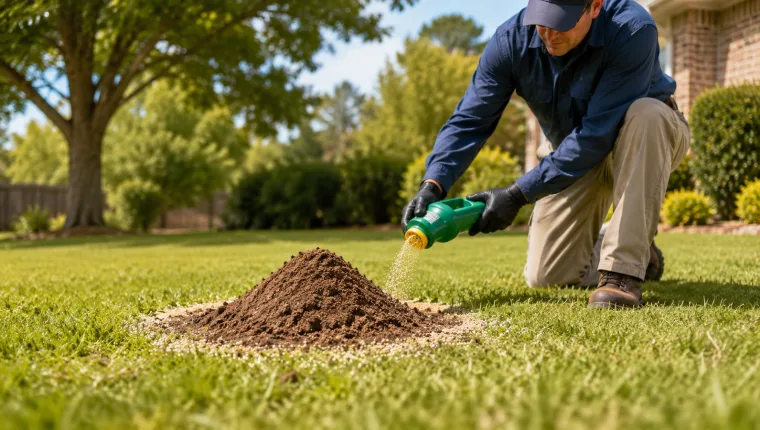
Fire ant control works best when you match the treatment to the size and pattern of the infestation. Treating individual mounds can make sense when only a few colonies are present. Broadcast baits can cover a larger yard where colonies are scattered or difficult to find. On heavily infested properties, a two-step program—area-wide bait followed by selective mound treatment—often provides the most practical balance of coverage, speed, and long-term management.
No method permanently prevents fire ants from returning. Colonies can move, split, or reinvade from neighboring land, so successful control includes identification, label-compliant treatment, follow-up inspection, and ongoing monitoring.
- Fire Ant Control at a Glance
- Confirm the Pest and the Infestation Level Before Treating
- Fire Ant Treatment Options and Where Each Method Fits
- The Two-Step Fire Ant Control Approach
- When Is the Best Time to Treat Fire Ants?
- Fire Ant Treatment Safety for Children, Pets, and the Yard
- How Long Does Fire Ant Control Take?
- Common Reasons Fire Ant Treatment Fails
- When to Stop DIY and Call a Fire Ant Control Professional
- Frequently Asked Questions About Fire Ant Control
- What is the best fire ant control method?
- Should I treat every mound individually?
- How quickly do fire ant baits work?
- Can I use boiling water or gasoline on a fire ant mound?
- Will one treatment keep fire ants away permanently?
- Is fire ant bait safe for dogs and children?
- What should I do if someone has a severe reaction to a fire ant sting?
Fire Ant Control at a Glance
The best fire ant control method depends on how many active mounds you have, how large the property is, how quickly you need relief, and whether the site can be treated under the selected product label.
| Situation | Most practical starting point | Main limitation |
|---|---|---|
| One or a few confirmed mounds | Label-approved individual mound treatment | Does not address hidden colonies elsewhere in the yard |
| Many mounds across a lawn or common area | Label-approved broadcast bait | Results are not immediate and depend on active foraging |
| Heavy pressure with some high-risk mounds | Two-step program: broadcast bait plus selective mound treatment | Requires correct timing, follow-up, and strict label compliance |
| Schools, multifamily housing, parks, athletic fields, or commercial grounds | Documented integrated pest management program | May require licensed service, notification, access control, and site-specific procedures |
If ants are indoors rather than forming outdoor soil mounds, begin with the broader guide to ants in the house. Indoor trails may involve a different species and a different treatment strategy.
Confirm the Pest and the Infestation Level Before Treating
Fire ants are aggressive mound-building ants found mainly in warm regions. Imported fire ant colonies commonly build loose soil mounds in sunny, open areas, but mound shape alone is not enough for a reliable identification. Weather, soil type, mowing, and colony age can change how a mound looks. Some colonies have no obvious central opening, and other ant species can build similar soil structures.
Do not kick, step on, probe, or handle a suspected mound to “test” the ants. Disturbance can trigger a rapid defensive response and multiple stings. Observe from a safe distance and document:
- where the mound is located;
- its approximate size;
- whether ants are actively foraging nearby;
- how many separate mounds appear on the property;
- whether the area is used by children, pets, workers, or livestock;
- whether anyone on the property has a history of severe sting reactions.
Use the downloadable fire ant yard mound map to mark colonies without repeatedly approaching them. If the identification remains uncertain, photograph the mound and ants from a safe distance and contact a local extension office, pest management professional, or qualified entomology resource.
For recurring trails, winged ants, or activity inside walls, see the guide to ant infestation signs. Large ants associated with damp or damaged wood may require a separate carpenter ant control assessment.
Fire Ant Treatment Options and Where Each Method Fits
Individual mound treatments
An individual mound treatment targets one known colony.
Depending on the registered product, the method may use a bait, drench, granule, dust, or another formulation specifically labeled for mound treatment. The label—not a general online instruction—determines where the product may be used, how it must be applied, whether watering is required, and when people or animals may reenter the area.
Mound treatment is most useful when:
- only a small number of confirmed colonies are present;
- a mound is close to a doorway, play area, sidewalk, equipment pad, or another high-contact location;
- faster suppression of a specific colony is more important than treating the entire yard;
- the property is too small or unsuitable for broadcast treatment.
The weakness is coverage. Treating visible mounds does not reach colonies that have not produced obvious mounds. It also does not stop ants from reinvading across a property line.
Broadcast fire ant baits
Broadcast baits are distributed over a labeled area so foraging worker ants can collect the bait and carry it back to colonies. Because colony transfer is part of the process, bait products generally work more slowly than direct contact treatments. They are designed for area-wide management rather than instant knockdown.
Broadcast bait is most useful when:
- mounds are numerous, scattered, or difficult to locate;
- the goal is to reduce fire ant pressure across a lawn or other labeled site;
- ants are actively foraging and weather conditions fit the label;
- the property can be kept within all label restrictions during and after application.
Baits may fail when they are applied during inactive foraging periods, exposed to unsuitable weather, stored improperly, contaminated, or used on a site not listed on the label. Read more about colony transfer, food preference, contamination, and placement in the guide to ant baits.
Contact treatments and property management
Some registered products suppress ants through direct contact or residual exposure, but broad routine spraying is not automatically better. Maintain vegetation so mounds can be seen, repair irrigation leaks, and manage outdoor food waste. Do not flood, burn, excavate, or chemically improvise a mound.
The Two-Step Fire Ant Control Approach
A two-step program combines broad coverage with targeted follow-up. It is commonly used where fire ant pressure is too widespread for mound-by-mound treatment alone.

Step 1: Treat the larger area with a labeled broadcast bait
Confirm the site appears on the label and that ants are actively foraging. Follow all label directions for weather, application, protective equipment, storage, reentry, and use around children, pets, water, edible plants, and pollinator habitat. Do not increase the rate or combine products unless the label expressly permits it.
Step 2: Reinspect and treat persistent high-risk mounds selectively
After the label’s expected response period, compare the yard with your original mound map. Prioritize active colonies near entrances, play areas, walkways, utility work zones, kennels, or other high-contact locations. Apply only a product labeled for the site and the intended mound-treatment method.
Continue monitoring
Record the date, conditions, product name, EPA registration information, treated area, and follow-up observations. Monitoring helps distinguish treatment failure from reinvasion and prevents repeated applications made simply because the exact treatment date was forgotten.
The EPA’s integrated pest management framework emphasizes combining identification, monitoring, prevention, and targeted controls rather than relying on a single routine pesticide action.
When Is the Best Time to Treat Fire Ants?
Timing matters most for bait-based control because workers must be actively searching for food and able to carry the bait back to the colony. Seasonal calendars are useful only as a rough guide. Soil temperature, recent rain, drought, extreme heat, and daily weather can matter more than the month.
Check for active foraging
Use a label-compatible observation method from a safe distance. Do not disturb the mound. If ants are not foraging, postpone bait treatment rather than assuming more bait will compensate.
Avoid unsuitable weather
Do not apply when rain, irrigation, wind, or extreme conditions conflict with label directions. Moisture can spoil some baits, and wind can move granules away from the intended area. The product label is the controlling instruction.
Plan around site use
Choose a time when the treated area can remain free of children, pets, workers, and equipment for the full label-required period. For schools, parks, multifamily properties, and workplaces, coordinate notices and access restrictions before treatment.
Expect reinvasion
Even a well-timed program may need later monitoring because untreated neighboring colonies can move into the property. Annual or seasonal review is more realistic than a promise of permanent elimination.
Fire Ant Treatment Safety for Children, Pets, and the Yard
Fire ant control involves two separate hazards: stings from defensive ants and potential exposure to pesticides. Manage both.
Reduce sting exposure
- Keep people and animals away from marked mounds.
- Wear closed shoes and clothing appropriate for yard work.
- Do not stand directly over a mound or kneel beside it.
- Do not let children or pets investigate treated or untreated mounds.
- Use a professional for colonies in high-contact areas when safe access cannot be controlled.
Follow the pesticide label exactly
Use only products registered and labeled for the target pest and site. The EPA advises consumers to read the entire label, keep pesticides in their original containers, use required protective equipment, and store products where children and pets cannot reach them. The agency’s smart pest control guidance also recommends using nonchemical prevention and the least risky effective approach as part of an integrated plan.
Do not use gasoline, diesel fuel, bleach, ammonia, boiling water, homemade mixtures, agricultural products on residential sites, or any product in a way not allowed by its label. Never mix pesticides unless the label specifically instructs you to do so.
What to do after a sting
Move away from the mound immediately and brush ants off rather than continuing to stand in the area. Wash the skin gently and avoid scratching. Seek emergency medical help for trouble breathing, swelling of the tongue or throat, faintness, widespread hives, or rapidly worsening symptoms. Anyone with a prescribed epinephrine auto-injector should follow their personal emergency plan and obtain medical care.
How Long Does Fire Ant Control Take?
The timeline depends on the method. A direct mound treatment may suppress a specific colony faster, while broadcast bait generally requires foraging, transfer, and colony-level effects. Weather, colony size, formulation, and reinvasion can change the observed response.
Do not judge a bait after only a few hours, and do not automatically reapply because ants are still visible the next day. Use the response period stated on the label. Then reinspect the same locations, mark active mounds, and compare activity with the original map.
Record the date, weather, product and EPA registration number, area treated, label-stated follow-up interval, and whether activity declined or new mounds appeared.
Common Reasons Fire Ant Treatment Fails
- The pest was misidentified. A treatment chosen for imported fire ants may not fit another mound-building ant.
- Only visible mounds were treated. Hidden colonies remained elsewhere in the yard.
- Bait was applied when ants were not foraging. Workers did not collect enough bait.
- Weather damaged or displaced the product. Rain, irrigation, heat, or wind conflicted with label conditions.
- The product was used on the wrong site. Lawn, garden, pasture, playground, and ornamental labels are not interchangeable.
- The application departed from the label. More product, extra mixtures, or a different method can increase risk without improving control.
- Follow-up was too early or undocumented. The expected response period was not allowed, or the treatment date was lost.
- Reinvasion was mistaken for complete failure. New colonies entered from adjacent untreated areas.
Persistent problems do not necessarily mean that the strongest available chemical is needed. They may indicate that the property needs better identification, broader coverage, coordinated neighboring treatment, or professional monitoring.
When to Stop DIY and Call a Fire Ant Control Professional
Professional service is justified when:
- mounds are numerous or spread across a large property;
- colonies are near schools, playgrounds, kennels, livestock areas, entrances, utilities, or public walkways;
- someone on the property has a history of severe sting reactions;
- the site has water, food production, pollinator, drainage, or regulatory constraints;
- previous label-compliant treatments have not produced acceptable control;
- the species is uncertain;
- the work requires application equipment, licensing, notification, or documentation beyond the homeowner’s capability.
Ask the provider to identify the ant, describe whether the plan uses mound treatment, broadcast bait, residual treatment, or a two-step approach, and explain the follow-up schedule. Request the product labels, EPA registration numbers, site restrictions, reentry requirements, and a written explanation of what the warranty does and does not cover.
Compare total scope rather than choosing only the lowest price. The broader pest control cost guide explains how inspection, visit frequency, treatment scope, follow-up, and exclusions affect a quote.
Frequently Asked Questions About Fire Ant Control
What is the best fire ant control method?
For a few confirmed colonies, an individual mound treatment may be sufficient. For many colonies across a yard, broadcast bait usually provides broader coverage. Heavy pressure may justify a two-step program that combines broadcast bait with selective treatment of persistent high-risk mounds.
Should I treat every mound individually?
Not always. Mound-by-mound treatment can work for a small number of colonies, but it may miss colonies without obvious mounds. Area-wide baiting can be more practical when activity is widespread.
How quickly do fire ant baits work?
They are generally slower than direct contact treatments because workers must collect the bait and transfer it within the colony. The expected response period varies by product and must be taken from the label.
Can I use boiling water or gasoline on a fire ant mound?
No. Gasoline creates serious fire, soil, exposure, and environmental hazards. Boiling water can cause severe burns and may damage plants without reliably eliminating the colony. Use only registered products according to the label or hire a qualified professional.
Will one treatment keep fire ants away permanently?
No method can guarantee permanent prevention. Colonies can reinvade from neighboring land, so monitoring and periodic reassessment are part of realistic fire ant management.
Is fire ant bait safe for dogs and children?
Safety depends on the exact product, site, use method, and compliance with the label. Keep children and pets away during application and for the full label-required period. Store the product in its original container in a secured location.
What should I do if someone has a severe reaction to a fire ant sting?
Call emergency services for trouble breathing, tongue or throat swelling, faintness, widespread hives, or rapidly worsening symptoms. Follow any prescribed personal emergency plan while help is on the way.
