
- What Is a House Centipede?
- How to Identify a House Centipede
- Why Are House Centipedes in My House?
- Where House Centipedes Hide
- Are House Centipedes Dangerous?
- Do House Centipedes Mean You Have Another Pest Problem?
- How to Get Rid of House Centipedes
- What Does Not Solve a House Centipede Problem?
- When to Call a Pest Control Professional
- How to Prevent House Centipedes
- Frequently Asked Questions
- Why do house centipedes run toward people?
- Should I leave a house centipede alone?
- Do house centipedes damage a home?
- Can house centipedes climb walls and ceilings?
- Will a dehumidifier get rid of house centipedes?
- Are house centipedes a sign of cockroaches?
- What is the difference between a house centipede and a millipede?
- When should I worry about a centipede bite?
What Is a House Centipede?
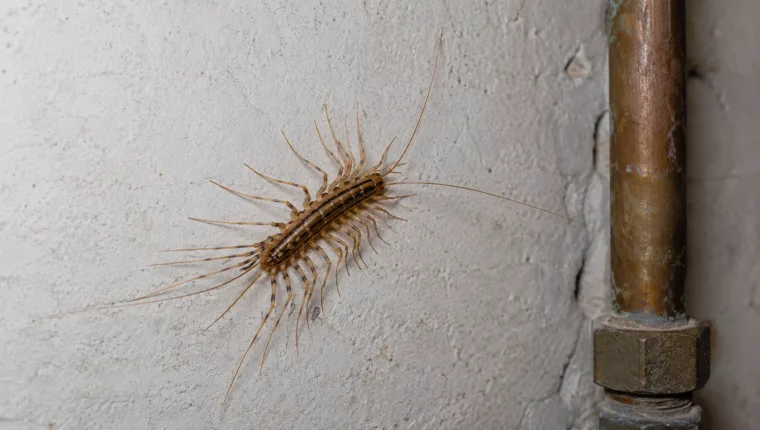
The house centipede is a flattened, many-legged arthropod that commonly lives in basements, bathrooms, crawl spaces, utility rooms, garages, and other sheltered areas. It is not an insect. Unlike insects, which have six legs, centipedes have one pair of legs on most body segments.
House centipedes are active hunters. They feed on small arthropods such as flies, silverfish, cockroach nymphs, spiders, moths, and other prey they can capture. That predatory role is why a small number of house centipedes may be beneficial indoors, even though their appearance can be alarming.
The main decision is not simply whether to kill the centipede you see. It is whether the sighting is isolated or part of a pattern caused by moisture, prey, or entry points that need correction.
How to Identify a House Centipede
House centipedes have a narrow, flattened body, very long legs, and long antennae. Their legs become progressively longer toward the rear, creating a feathery outline when viewed from above. They move quickly and may pause suddenly before changing direction.
Color can vary with lighting and life stage, but adults are commonly yellowish gray to brownish, often with darker longitudinal markings. Because the legs extend well beyond the body, the animal can look much larger than its actual body length.
House centipede vs. silverfish
Silverfish are wingless insects with a tapered, carrot-shaped body, six legs, and three tail-like filaments. They move with a fishlike side-to-side motion and feed on starchy materials, paper, adhesives, and debris. House centipedes have many more legs, a flatter body, and a much wider leg span.
House centipede vs. millipede
Millipedes generally have a rounded or cylindrical body, short legs, and slow movement. Many curl into a coil when disturbed. They usually enter buildings during wet weather or seasonal migrations and feed on decaying organic matter. House centipedes are flatter, faster, and predatory.
House centipede vs. other centipedes
Other centipedes may have shorter, sturdier legs and a heavier body. Species vary by region, so photographs should not be used to make a high-stakes identification when a bite, unusual size, or medically concerning reaction is involved. Collect a clear photo from a safe distance or ask a qualified pest professional or local extension resource for identification.
Why Are House Centipedes in My House?
House centipedes need shelter, suitable humidity, and prey. Indoor sightings often increase when one or more of these conditions are present:
- Persistent moisture from leaks, condensation, poor ventilation, or damp foundations
- High humidity in basements, bathrooms, laundry rooms, or crawl spaces
- Cracks around foundations, utility penetrations, windows, doors, or floor drains
- Clutter, stored cardboard, and undisturbed areas that provide cover
- Populations of silverfish, flies, spiders, cockroaches, or other prey
- Seasonal movement from outdoors during heat, drought, heavy rain, or cold weather
A single house centipede can wander from outdoors or another part of the building. Repeated sightings in the same room are more useful than one isolated encounter because they can reveal a moisture zone or prey source.
Where House Centipedes Hide
During the day, house centipedes often remain in dark, protected spaces. At night, they may emerge to hunt. Common hiding and activity areas include:
- Basement wall-floor joints and foundation cracks
- Behind stored boxes, shelving, appliances, and water heaters
- Under sinks and near plumbing penetrations
- Bathrooms with persistent condensation
- Crawl spaces and unfinished utility areas
- Garages, mudrooms, and door thresholds
- Closets or storage rooms with silverfish or spider activity
Seeing a centipede in a dry bedroom does not necessarily mean it breeds there. It may have followed prey or traveled from a nearby damp area.
Are House Centipedes Dangerous?
House centipedes are generally secretive and avoid people. They are not known for damaging wood, clothing, food, or household structures. Their presence is mainly a nuisance and an indicator that indoor conditions support them or their prey.
Centipedes have venom used to subdue prey, and a bite is possible if one is trapped against skin or handled. Bites from house centipedes are uncommon. Do not handle a centipede with bare hands. If a bite causes severe pain, spreading swelling, breathing difficulty, dizziness, or another serious reaction, seek urgent medical help. Do not use an online image to diagnose a bite or identify the species with certainty.
For routine removal, use a container, vacuum, or other no-contact method. Keep children and pets away from the area while the animal is being removed.
Do House Centipedes Mean You Have Another Pest Problem?
Sometimes. House centipedes can survive where prey is available, so repeated sightings may coincide with silverfish, spiders, flies, cockroaches, or other small arthropods. However, one centipede does not prove a hidden infestation.
Look for independent evidence before treating another pest. Useful evidence includes sticky-monitor captures, droppings, shed skins, webbing, damaged food packaging, or repeated sightings in a defined area. Avoid broad pesticide use based only on the presence of a predator.
How to Get Rid of House Centipedes
1. Document where and when you see them
Record the room, date, time, weather, and nearby moisture. A simple log can reveal whether activity clusters around a basement drain, utility penetration, bathroom, or seasonal weather change.
2. Reduce moisture
Repair leaks, improve ventilation, manage condensation, and use a dehumidifier where appropriate. Keep gutters and downspouts functioning so water moves away from the foundation. Moisture correction can reduce both centipedes and many prey species.
3. Reduce prey and shelter
Vacuum webs, insects, shed skins, and debris. Move cardboard off basement floors, reduce clutter, and store items in sealed containers. Clean behind appliances and shelving where small insects may remain undisturbed.
4. Seal entry points
Inspect door sweeps, window screens, foundation cracks, utility penetrations, and gaps around pipes. Seal appropriate openings with materials suitable for the surface. Do not seal a gap that also serves as required drainage or ventilation.
5. Use monitoring traps
Place sticky monitors along wall edges in dry, inaccessible locations where children and pets cannot reach them. Monitors help confirm activity and reveal prey species. They are not a complete control method by themselves.
6. Remove individual centipedes without touching them
Capture the animal under a container and release it outdoors where appropriate, or vacuum it and empty the vacuum according to the appliance instructions. Avoid handling it directly.
7. Consider targeted treatment only after inspection
If sanitation, moisture correction, exclusion, and monitoring do not reduce repeated activity, a qualified pest professional can identify harborages and determine whether a labeled treatment is appropriate. Any pesticide must be used exactly according to its label. Do not apply dusts or sprays into electrical equipment, air systems, drains, food areas, bedding, or child- and pet-accessible locations unless the product label specifically permits that use.
What Does Not Solve a House Centipede Problem?
- Killing only the visible centipede: This removes one animal but does not address moisture, prey, or access.
- Broad indoor spraying: Unnecessary pesticide use can increase exposure without correcting the underlying conditions.
- Relying only on ultrasonic devices or scents: These approaches do not replace inspection, moisture reduction, exclusion, and prey control.
- Ignoring leaks and humidity: Damp conditions can continue supporting centipedes and other pests.
- Assuming every many-legged arthropod is the same: Millipedes, centipedes, and silverfish have different biology and control priorities.
When to Call a Pest Control Professional
Professional inspection is reasonable when sightings are frequent, centipedes appear in multiple rooms, activity persists after moisture and exclusion work, or monitors reveal a second pest population. Assistance is also appropriate when access requires entering unsafe crawl spaces, working near electrical systems, opening walls, or using ladders.
A good inspection should look beyond the visible centipede. Ask the technician to identify likely moisture sources, entry points, prey evidence, monitoring locations, and the purpose of any proposed pesticide. Request the product name, active ingredient, target area, reentry instructions, and follow-up plan before treatment.
How to Prevent House Centipedes
- Keep indoor humidity controlled, especially in basements and crawl spaces.
- Repair plumbing leaks and improve bathroom and laundry ventilation.
- Maintain door sweeps, screens, weather stripping, and utility seals.
- Store cardboard, paper, and textiles off damp floors.
- Vacuum edges, storage areas, webs, and insect debris regularly.
- Use monitors to detect changes in centipede and prey activity.
- Inspect exterior drainage, mulch depth, leaf litter, and foundation moisture.
Prevention is working when sightings and monitor captures decline over several weeks and moisture readings or visible condensation improve. Weather can temporarily change activity, so evaluate trends rather than one night.
Frequently Asked Questions
Why do house centipedes run toward people?
They usually are not chasing people. Their rapid, irregular movement can make it appear that way as they search for cover or react to light and vibration.
Should I leave a house centipede alone?
One isolated centipede can be left alone or removed without contact. Repeated sightings justify checking humidity, leaks, entry points, and prey activity.
Do house centipedes damage a home?
They do not eat wood, fabric, or stored food and are not considered structural pests. Their presence may indicate damp conditions or other arthropods.
Can house centipedes climb walls and ceilings?
Yes. Their long legs and speed allow them to move across walls and other surfaces, especially while hunting or seeking shelter.
Will a dehumidifier get rid of house centipedes?
A dehumidifier can make a damp area less favorable, but it works best with leak repair, ventilation, clutter reduction, exclusion, and prey control.
Are house centipedes a sign of cockroaches?
Not necessarily. They eat several kinds of small arthropods. Use monitors and look for independent evidence before concluding that cockroaches are present.
What is the difference between a house centipede and a millipede?
House centipedes are flat, fast predators with long legs. Millipedes are slower, usually cylindrical, have short legs, and feed mainly on decaying plant material.
When should I worry about a centipede bite?
Seek medical help for severe pain, spreading swelling, breathing difficulty, dizziness, or another serious reaction. Do not rely on online content to diagnose a bite.
