
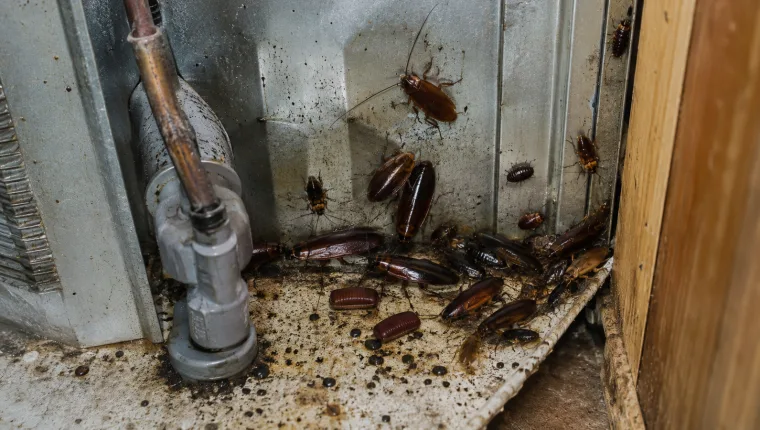
Cockroaches do not build true nests. Unlike ants, bees, or termites, they do not construct an organized colony structure with chambers, workers, and a central queen. What people call a “cockroach nest” is usually a harborage: a protected crack, void, appliance space, cabinet gap, drain area, or other hiding place where several cockroaches gather because food, water, warmth, and shelter are nearby.
Finding one cockroach does not automatically reveal the harborage. Repeated sightings, nymphs, egg cases, fecal spotting, cast skins, and consistent captures on sticky monitors are stronger clues. The most important decision is whether the evidence points to an isolated visitor or an established indoor population that requires structured control.
- What people mean by a cockroach nest
- Where cockroach harborages are commonly found
- Signs that a harborage may be nearby
- How to distinguish active evidence from old evidence
- Common lookalikes and misidentifications
- How to inspect safely without spreading cockroaches
- How to estimate the severity of the problem
- What to do after finding a suspected cockroach harborage
- When to call a professional
- Room inspection checklist
- Frequently asked questions
- Do cockroaches have a queen or central nest?
- Does finding an egg case mean there is an infestation?
- Where is the first place to look for a cockroach harborage?
- Will cleaning remove the cockroach harborage?
- Should I spray directly into every crack?
- How long should sticky monitors stay in place?
- Can cockroaches live inside appliances?
- Can one apartment be treated without the neighboring units?
What people mean by a cockroach nest
A cockroach harborage is a place where cockroaches rest, hide, reproduce, and remain protected during much of the day. Several insects may occupy the same narrow space, but they are not maintaining a nest in the social-insect sense.
Cockroaches often gather because the location offers:
- A tight crevice that keeps their bodies in contact with surfaces
- Warmth from motors, compressors, pipes, or appliances
- Moisture from leaks, condensation, drains, or humid rooms
- Food residue, grease, crumbs, cardboard, or stored products
- Darkness and limited disturbance
- Fecal deposits and chemical cues associated with aggregation
This distinction matters because removing visible insects without correcting the harborage conditions often produces only temporary improvement. Effective control usually requires inspection, monitoring, sanitation, moisture correction, exclusion, and a treatment method matched to the species and infestation level.
Where cockroach harborages are commonly found
The most likely locations depend on the species.
Small indoor species, especially German cockroaches, tend to remain close to kitchens, bathrooms, food preparation areas, and warm appliances. Larger species may enter from outdoors, sewer systems, utility spaces, basements, crawl spaces, roof areas, or drains.
Kitchen harborages
Kitchens provide food, water, warmth, and many narrow gaps. Inspect visually accessible areas such as:
- Under and behind the refrigerator, especially near the compressor area
- Under the sink and around plumbing penetrations
- Cabinet hinges, drawer tracks, and gaps between cabinets and walls
- Behind removable toe-kicks
- Around dishwashers, microwaves, ovens, and other appliances
- Near trash containers, recycling, pet-food stations, and stored cardboard
- Along backsplash seams, counter gaps, and wall penetrations
Do not dismantle energized appliances or reach into electrical components. A flashlight and sticky monitors can reveal activity without unsafe access.
Bathroom and laundry harborages
Bathrooms and laundry rooms can support cockroaches when there are plumbing leaks, condensation, floor drains, pipe chases, or warm equipment. Common inspection points include:
- Under sinks and vanities
- Around toilet and sink plumbing penetrations
- Behind accessible washing machines and dryers
- Near floor drains and utility sinks
- Inside gaps behind loose trim, baseboards, or wall panels
- Near water heaters and humid utility spaces
Basements, crawl spaces, garages, and utility areas
American, Oriental, smoky brown, and other larger cockroaches may be associated with damp lower levels, utility rooms, drains, exterior doors, sewer connections, leaf litter, or structural gaps. Look for moisture, organic debris, damaged weather stripping, unsealed pipe openings, and repeated activity near entry points.
Multi-unit buildings
In apartments, condominiums, dormitories, and commercial buildings, cockroaches can move through shared walls, pipe chases, utility penetrations, hallways, and adjacent units. Treating only one room or one apartment may not solve the source when activity is distributed across the building.
Residents should document sightings and report recurring activity to the property manager. Coordinated inspection and treatment is often more effective than isolated applications.
Signs that a harborage may be nearby
No single sign provides a perfect estimate of infestation size.
The best assessment combines multiple forms of evidence.
Live cockroaches
Repeated sightings in the same area suggest nearby shelter or a regular travel route.
Seeing small nymphs is especially important because young cockroaches usually remain closer to the harborage than mobile adults.
A daytime sighting can occur for several reasons, including disturbance, crowding, food or water pressure, or a severe infestation. It is a warning sign, but it should not be used alone to calculate infestation size.
Fecal spotting
Small indoor cockroaches can leave dark specks or smears near cracks, hinges, corners, appliance edges, and travel routes. Larger cockroach droppings may be more cylindrical. Droppings can resemble material from other pests, so location and accompanying evidence matter.
Fresh recurring spotting in a cleaned monitoring area is more informative than old residue of unknown age.
Egg cases
A cockroach egg case is called an ootheca. Its size, shape, color, and placement vary by species. Some species carry the egg case for much of its development, while others deposit or attach it in a protected location.
Finding several egg cases, especially with nymphs and fresh fecal spotting, can indicate active reproduction nearby. A single empty case may be old and does not by itself prove current activity.
Cast skins
Cockroach nymphs shed their outer covering as they grow. Multiple cast skins in a protected crack or cabinet area suggest repeated development in that location.
Odor
Heavy cockroach activity can produce a persistent musty or oily odor. Odor alone is not reliable enough for identification, but it can support other evidence in a known infestation.
Sticky-monitor captures
Sticky monitors help show where cockroaches are traveling and where activity is concentrated.
Place them flush against walls or edges, not in the center of open floors. Useful locations include under sinks, beside refrigerators, behind toilets, near trash areas, and along suspected travel routes.
Write the date and location on each monitor. Check them consistently. A cluster of captures near one appliance or plumbing area is more useful than a single trap placed randomly.
How to distinguish active evidence from old evidence
| Evidence | What it may mean | How to interpret it |
|---|---|---|
| Live adults and nymphs | Current activity | Strong evidence, especially when repeated in the same zone |
| Fresh monitor captures | Current travel route or nearby harborage | Compare location and weekly counts |
| Multiple oothecae and nymphs | Reproduction nearby | Strong indication of an established population |
| Fresh fecal spotting after cleaning | Ongoing activity | More useful than residue of unknown age |
| Old dry cast skins only | Historical or uncertain activity | Inspect and monitor before drawing conclusions |
| One dead cockroach | Visitor, prior treatment, or nearby population | Insufficient alone to locate a harborage |
Common lookalikes and misidentifications
People sometimes mistake beetles, crickets, silverfish, earwigs, or other insects for cockroaches. Egg cases can also be confused with seeds, capsules, or debris. Photograph the specimen from above and from the side with a size reference. Avoid crushing it if identification is needed.
Species identification matters because German cockroaches usually indicate indoor reproduction, while some larger outdoor species may enter occasionally. Review the broader cockroach identification guide and the guide to flying cockroaches when the insect is large, winged, or associated with exterior entry.
How to inspect safely without spreading cockroaches
- Start with observation. Record where, when, and how often cockroaches are seen.
- Use a flashlight. Inspect accessible edges, gaps, hinges, plumbing areas, and appliance exteriors.
- Place labeled sticky monitors. Position them against walls near suspected routes.
- Check food and water sources. Look for crumbs, grease, pet food, trash residue, leaks, and condensation.
- Photograph evidence. Capture insects, egg cases, fecal spotting, and the surrounding location.
- Avoid scattering activity. Do not spray random cracks or use total-release foggers. These actions can expose occupants, interfere with bait programs, and fail to reach deep harborages.
- Do not open unsafe spaces. Avoid energized appliances, electrical panels, sealed wall voids, and inaccessible plumbing cavities.
How to estimate the severity of the problem
Severity should be estimated from patterns, not one dramatic observation. Consider:
- How many rooms show evidence
- Whether adults and nymphs are present
- Whether egg cases are being found repeatedly
- Whether sticky-monitor counts are increasing
- Whether daytime sightings are frequent
- Whether neighboring units or shared spaces are affected
- Whether activity continues after sanitation and moisture problems are corrected
A concentrated cluster in one cabinet zone may represent a localized harborage. Captures across kitchens, bathrooms, bedrooms, hallways, and adjacent units suggest broader distribution. For a more complete evidence framework, use the guide to cockroach infestation signs.
What to do after finding a suspected cockroach harborage
Remove food competition
Clean grease and crumbs, store food in sealed containers, empty trash regularly, and avoid leaving pet food out overnight. Sanitation alone may not eliminate an established infestation, but it makes monitoring and bait-based control more effective.
Correct moisture
Repair accessible leaks, dry standing water, improve ventilation where appropriate, and address condensation. Cockroaches often remain where water is consistently available.
Reduce shelter
Remove unnecessary cardboard and clutter. Seal suitable cracks and utility gaps after confirming that sealing will not trap unresolved activity inside inaccessible spaces. Use materials appropriate for the opening and building condition.
Use monitoring to guide treatment
Continue tracking locations and counts. Monitoring helps determine whether activity is declining, moving, or spreading.
Use pesticides only according to the label
The U.S. Environmental Protection Agency emphasizes integrated pest management and careful pesticide use. Read the entire label, use only products approved for the site and pest, keep products away from children and pets, and never mix products unless the label explicitly directs it.
Broad indoor spraying and foggers are generally poor substitutes for inspection and targeted control. They may not reach deep harborages and can create unnecessary exposure. Professional plans may include monitoring, sanitation guidance, targeted baits, insect growth regulators, dusts in appropriate voids, exclusion, and follow-up.
When to call a professional
Professional inspection is appropriate when:
- Nymphs and egg cases are found repeatedly
- Activity appears in several rooms
- Daytime sightings are frequent
- The suspected harborage is inside appliances, walls, ceilings, or utility spaces
- The property is a multi-unit building
- Residents have asthma, pesticide sensitivities, young children, or pets that complicate product use
- Monitoring counts do not decline after sanitation and targeted control
- The species is uncertain
Ask the provider how the inspection will identify species, map harborages, monitor progress, coordinate adjacent units, and limit unnecessary pesticide exposure. Review likely service costs in the cockroach exterminator cost guide.
Room inspection checklist
- Record the date, room, and time of every sighting
- Photograph specimens with a size reference
- Check under sinks and around plumbing penetrations
- Inspect accessible cabinet hinges, drawer tracks, and toe-kicks
- Look behind accessible appliances without opening energized components
- Check trash, recycling, pet-food, and stored-cardboard areas
- Look for fecal spotting, egg cases, and cast skins
- Place labeled sticky monitors against edges
- Check for leaks, condensation, and standing water
- Review monitor captures weekly
- Report recurring activity in multi-unit housing
- Escalate widespread or persistent activity to a qualified professional
Frequently asked questions
Do cockroaches have a queen or central nest?
No. Household cockroaches do not have a central queen-led nest like ants or termites. They gather in harborages where conditions are favorable.
Does finding an egg case mean there is an infestation?
One egg case is a warning sign but not a complete diagnosis. Multiple egg cases, nymphs, fresh fecal spotting, and repeated monitor captures provide stronger evidence of nearby reproduction.
Where is the first place to look for a cockroach harborage?
Start where food, water, warmth, and narrow hiding spaces overlap: under sinks, near refrigerators, around dishwashers, inside accessible cabinet gaps, and near plumbing penetrations.
Will cleaning remove the cockroach harborage?
Cleaning removes food competition and improves control, but sanitation alone may not eliminate cockroaches hidden in cracks, appliances, wall voids, or neighboring units.
Should I spray directly into every crack?
No. Random spraying can create exposure, interfere with bait, and fail to reach the true harborage. Use only label-approved products and placements, or hire a qualified professional for targeted treatment.
How long should sticky monitors stay in place?
Monitoring should continue long enough to establish a pattern and confirm improvement. Label each monitor, inspect it regularly, and compare captures by location and date rather than relying on one trap.
Can cockroaches live inside appliances?
Yes, especially near warm motors, compressors, controls, and food residue. Do not dismantle energized appliances. Monitor accessible exterior edges and seek professional help when activity appears internal.
Can one apartment be treated without the neighboring units?
Sometimes, but recurring activity may continue when cockroaches move through shared walls, plumbing, or utility penetrations. Coordinated inspection is often necessary in multi-unit buildings.
