
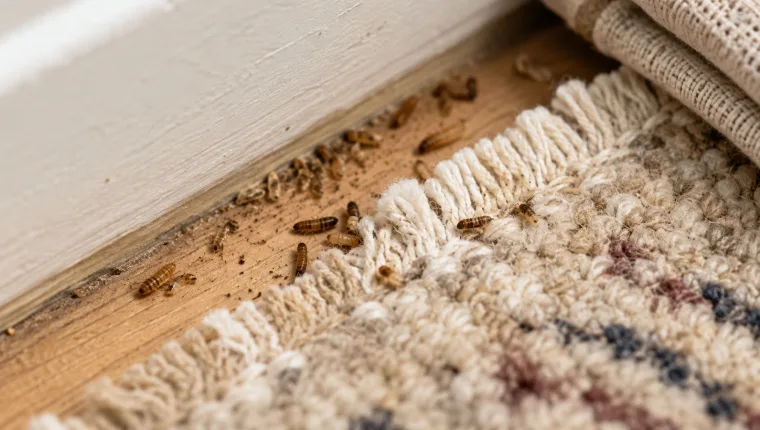
- Quick answer: what do carpet beetle larvae look like?
- Carpet beetle larvae identification
- Carpet beetle larvae vs. common lookalikes
- What damage do carpet beetle larvae cause?
- Where carpet beetle larvae hide and breed
- How to inspect for a carpet beetle infestation
- How to remove carpet beetle larvae
- Carpet beetle treatment options
- Common reasons carpet beetle control fails
- How to prevent carpet beetle larvae from returning
- Can carpet beetle larvae cause a rash?
- When to call a professional
- Frequently asked questions
Quick answer: what do carpet beetle larvae look like?
Carpet beetle larvae are usually elongated or carrot-shaped, covered with visible hairs or bristles, and tan, brown, reddish brown, or banded depending on the species. They move slowly compared with fleas and do not have the flat, oval body shape of bed bugs. Some species have a distinctive tuft of longer hairs at the rear.
The larvae are the damaging life stage. Adult carpet beetles usually feed outdoors on pollen and nectar, although adults may appear near windows after emerging indoors. Larvae remain hidden in dark, undisturbed areas where suitable food accumulates.
Main decision factor: do not choose a treatment based only on a larva found on a wall. First locate the material or debris supporting development.
Carpet beetle larvae identification
Size, shape, color, and movement
Most carpet beetle larvae are only a few millimeters long, although size varies by species and developmental stage. Their bodies are visibly segmented and typically wider toward one end. Under good lighting, the hairs are usually the most useful clue.
- Body: elongated, tapered, segmented, and visibly hairy.
- Color: cream to brown, often with darker bands or patches.
- Movement: slow crawling rather than jumping.
- Location: closets, carpet edges, baseboards, vents, upholstered furniture, stored textiles, cabinets, attics, wall voids, and windowsills.
Why carpet beetle larvae appear on walls
Larvae sometimes leave a feeding site and wander across floors, walls, or ceilings while searching for another food source or a protected place to molt. A larva on a wall may therefore be some distance from the actual source. Check the wall perimeter, nearby vents, closets, stored fabrics, furniture, and window areas rather than assuming the wall itself is infested.
Adult carpet beetles
Adults are small, rounded or oval beetles. Depending on the species, they may be dark or patterned with pale, brown, yellow, or white scales. Adults near windows can indicate that larvae developed somewhere inside and the beetles are trying to reach light.
Carpet beetle larvae vs. common lookalikes
Correct identification matters because the source and control plan differ substantially among carpet beetles, clothes moths, fleas, bed bugs, and other household pests.
| Possible pest | Key clues | Typical location | Main difference |
|---|---|---|---|
| Carpet beetle larva | Hairy, tapered, slow moving | Closets, carpet edges, lint, stored textiles | Larval hairs and shed skins are common clues |
| Clothes moth larva | Pale caterpillar, sometimes in a silken case or webbing | Wool, fur, feathers, stored fabrics | Silk, webbing, or portable case may be present |
| Bed bug nymph | Flat, oval, six-legged, not hairy | Beds, upholstered furniture, cracks near resting areas | Body is smooth and flattened rather than bristly |
| Flea larva | Wormlike, pale, legless-looking, avoids light | Pet resting areas, carpet, floor cracks | More slender and wormlike, without the dense bristles of carpet beetle larvae |
| Fuzzy caterpillar | Usually larger and associated with plants or outdoor entry | Near doors, windows, houseplants | Often much larger and not linked to stored natural fibers |
Photograph the specimen beside a ruler or millimeter scale and, when practical, place it in a sealed clear container for professional identification. Do not use a generated illustration as definitive evidence of anatomy.
What damage do carpet beetle larvae cause?
Larvae feed on materials containing animal proteins and on organic debris that accumulates in quiet areas. Damage can be mistaken for clothes moth activity.
Materials most at risk
- Wool clothing, rugs, felt, and blankets
- Fur, feathers, down, leather, and animal-hair items
- Taxidermy, insect collections, and natural-history materials
- Upholstery containing natural fibers or accumulated pet hair
- Stored dry animal products, pet food, or other suitable organic material in some situations
- Lint, hair, dead insects, and debris inside vents, baseboard gaps, attics, and cabinets
Synthetic fabric alone is usually less attractive, but blends can be damaged when they contain wool or are soiled with perspiration, food, oils, hair, or other organic residues.
Signs of active feeding
- Irregular holes or surface grazing on natural-fiber items
- Hairy larvae in folds, seams, carpet edges, or storage areas
- Empty, bristly shed skins
- Fine debris or damaged fibers beneath stored items
- Repeated adult beetles at windows
Old shed skins and old fabric damage do not prove that activity is current. Monitoring and repeated inspection help distinguish a historical problem from an active source.
Where carpet beetle larvae hide and breed
The most productive inspection areas are dark, quiet, rarely cleaned spaces where food material accumulates.
Closets and stored textiles
Inspect wool coats, hats, blankets, rugs, felt, feather-filled items, fabric bins, garment seams, shelving corners, and the floor beneath stored belongings. Check items that have remained undisturbed for months.
Carpet edges and upholstered furniture
Lift or inspect carpet edges where practical, especially beneath radiators and furniture. Examine upholstery seams, the underside of cushions, furniture dust covers, and areas where pet hair collects.
Vents, baseboards, attics, and wall voids
Larvae can develop on dead insects, lint, feathers, or nesting material hidden in building voids. Check accessible vent covers, window tracks, baseboard gaps, attic storage, and areas near bird, rodent, or insect activity. Do not open walls, enter unsafe attics, or disturb wildlife nests without appropriate professional support.
Pantries and pet areas
Some carpet beetle species may use stored animal-based foods, pet food, or organic debris. Inspect damaged packaging, spilled food, pet bedding, and the space beneath appliances or feeding stations.
How to inspect for a carpet beetle infestation
- Confirm the specimen. Photograph or collect one safely. Look for a hairy, tapered larva or a bristly shed skin.
- Map every sighting. Record the room, wall, window, closet, or furniture location and date.
- Inspect natural-fiber items. Start with wool, fur, feathers, felt, leather, down, and stored textiles.
- Check hidden debris. Inspect lint, pet hair, dead insects, vent edges, baseboards, and furniture undersides.
- Look for a building source. Note bird nests, rodent nesting material, dead insects, or inaccessible voids that may require a professional.
- Separate active from old evidence. Clean the area and monitor for new larvae, skins, or damage.
How to remove carpet beetle larvae
Successful control depends on removing the food source, cleaning harborages, protecting vulnerable items, and monitoring. Killing visible larvae without locating the source often produces only temporary improvement.
1. Isolate and inspect affected items
Move suspect textiles into sealed bags or containers before carrying them through the home. Inspect seams, folds, labels, cuffs, rug edges, and storage boxes. Avoid mixing inspected items with untreated belongings.
2. Clean according to the item’s care instructions
Launder, dry-clean, heat-treat, freeze, or otherwise clean items only when the material and manufacturer instructions permit it. Delicate, historic, high-value, or taxidermy items may require a textile conservator or specialist. Do not apply household pesticides directly to clothing, bedding, museum objects, or other personal items unless the product label explicitly allows that use.
3. Vacuum thoroughly
Vacuum carpet edges, baseboards, closet floors, cracks, upholstered furniture seams, registers, and accessible lint accumulations. Use attachments to reach corners. Empty the vacuum outdoors into a sealed bag or follow the vacuum manufacturer’s disposal instructions. Vacuuming removes larvae, skins, eggs, hair, lint, and dead insects, but it must be paired with source removal.
4. Remove lint, hair, and dead insects
Clean under furniture and appliances, along window tracks, around vents, and in pet resting areas. Address recurring dead-insect accumulations near windows or light fixtures. Replace heavily contaminated disposable storage materials when practical.
5. Protect clean items
Store clean, fully dry natural-fiber items in sealed containers or garment storage that prevents pest access. Clean items before long-term storage because food stains, body oils, and hair can make fabrics more attractive.
6. Correct the hidden source
If larvae continue appearing after detailed cleaning, investigate inaccessible voids, old animal nests, chimney or attic debris, contaminated insulation, or a dead-animal source. Wildlife exclusion, nest removal, or structural work may be regulated or unsafe and may require qualified professionals.
Carpet beetle treatment options
Cleaning and source removal
This is the foundation of control and usually the most important step. It removes both insects and the materials that support them.
Monitoring traps
Species-appropriate sticky or pheromone monitors may help detect adults and track activity, but traps do not remove hidden larval food sources. Place and inspect them according to product directions. An empty trap does not prove that the home is clear.
Targeted pesticide treatment
When a labeled pesticide is appropriate, treatment should be limited to locations and surfaces allowed by the label, such as certain cracks, crevices, carpet edges, or voids. Keep children and pets away as directed, protect food and personal items, and follow ventilation and reentry instructions. More pesticide is not better, and broad indoor spraying may increase exposure without solving the hidden source.
Professional treatment
Professional help is most useful when the source is inaccessible, activity persists after cleaning, valuable materials are involved, several rooms are affected, or pesticide use would be difficult to manage safely. A good service should identify the pest, locate likely larval food sources, explain preparation, use targeted methods, and provide a monitoring or follow-up plan.
Common reasons carpet beetle control fails
- Treating visible larvae but leaving wool, feathers, lint, pet hair, or dead insects in place
- Cleaning the center of a room but missing carpet edges, furniture undersides, vents, or storage corners
- Ignoring bird, rodent, or insect debris in attics and wall voids
- Returning untreated textiles to a cleaned closet
- Assuming adult beetles at a window are the only problem
- Using traps as a substitute for source removal
- Applying pesticides off label or to clothing, bedding, food areas, or air-handling systems
- Stopping monitoring immediately after the first cleaning
How to prevent carpet beetle larvae from returning
- Clean wool, fur, feathers, and other vulnerable materials before storage.
- Use sealed containers for long-term textile and keepsake storage.
- Vacuum carpet edges, closets, upholstery, and pet-hair accumulation routinely.
- Clean dead insects from windows, light fixtures, vents, and accessible void edges.
- Repair screens and seal appropriate gaps that allow adult beetles to enter.
- Inspect secondhand rugs, upholstered furniture, taxidermy, and natural-fiber goods before bringing them indoors.
- Address bird or rodent nesting around the structure using lawful, species-appropriate methods.
- Monitor rooms where previous activity occurred.
Can carpet beetle larvae cause a rash?
Larval hairs may irritate some people, but a skin reaction alone cannot confirm carpet beetles. Many medical conditions and other exposures can cause similar symptoms. Avoid handling larvae or shed skins with bare hands if irritation is a concern, clean affected materials carefully, and seek medical guidance for severe, persistent, infected, or unexplained symptoms.
When to call a professional
Consider a pest-management professional when:
- Larvae continue appearing after repeated source-focused cleaning.
- Activity involves multiple rooms, HVAC-adjacent areas, attics, wall voids, or inaccessible spaces.
- Valuable rugs, collections, historic textiles, taxidermy, or large upholstered items are affected.
- A bird or rodent nest, carcass, or contaminated insulation may be involved.
- You cannot identify the specimen confidently.
- Children, pets, asthma, chemical sensitivities, or food-storage conditions make treatment planning more complex.
Frequently asked questions
Why am I finding carpet beetle larvae on the wall?
Larvae often wander away from a feeding source while searching for another protected area or a place to molt. Inspect nearby closets, vents, carpet edges, furniture, windows, and stored natural-fiber items.
Do carpet beetle larvae bite?
They are not blood-feeding insects. Their hairs may irritate some people, but skin symptoms alone are not reliable evidence of carpet beetles.
Are carpet beetle larvae the same as bed bugs?
No. Carpet beetle larvae are elongated and hairy. Bed bug nymphs are flat, oval, six-legged, and not covered in dense bristles.
Will vacuuming get rid of carpet beetles?
Vacuuming is important because it removes insects, skins, hair, lint, and dead insects. It works best when combined with finding and removing the main food source and protecting clean items.
Should I throw away all my clothes?
Usually not. Inspect and clean affected items according to their care instructions, isolate untreated belongings, and discard only items that are too damaged or cannot be cleaned economically.
How long does carpet beetle removal take?
The timeline depends on how quickly the source is found, the number of affected areas, and whether hidden debris or nests are involved. Continue monitoring after cleaning because larvae and adults may appear from areas that were initially missed.
What is the best carpet beetle killer?
There is no single product that replaces identification and source removal. Cleaning, removing larval food, protecting textiles, and targeted label-compliant treatment are more dependable than relying on a contact spray alone.
