
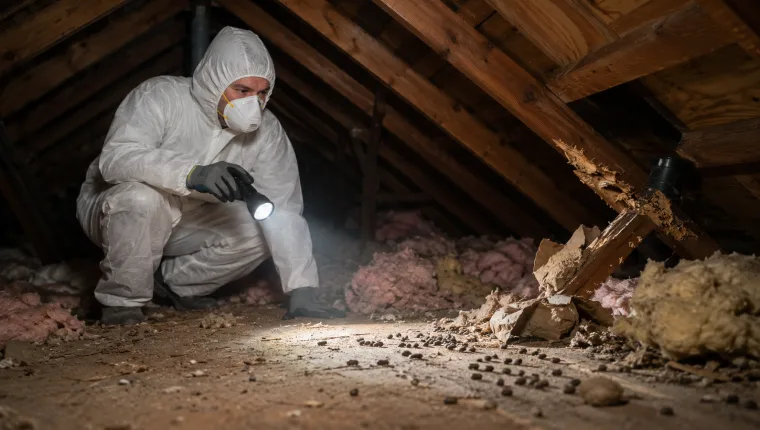
Rats are probably using an attic when repeated nighttime movement is supported by rat-sized droppings, fresh gnawing, rub marks, damaged insulation, nesting material, captures, camera footage, or a visible roofline entry route. Noise alone is not enough. Mice, squirrels, bats, birds, raccoons, plumbing, ducts, and normal roof movement can sound similar.
The main decision factor is whether the evidence shows current rat activity and whether the attic can be inspected and serviced safely. A successful plan usually combines:
- Identification of the animal and its travel routes
- Removal with correctly sized, protected traps
- Correction of food, water, and shelter conditions
- Exterior exclusion after active rats are accounted for
- Safe cleanup or professional remediation of contaminated material
- Monitoring for renewed activity
Use our rodent control guide for the complete integrated process. For pricing, compare the rat control cost guide with the broader pest control cost guide.
- Why Rats Enter Attics
- Signs of Rats in Attic Spaces
- Roof Rats vs. Norway Rats in an Attic
- How Roof Rats Enter an Attic
- How to Inspect an Attic Safely
- How Rats Are Removed from an Attic
- Should You Use Poison in an Attic?
- Cleaning Rat Droppings and Nests in an Attic
- When Attic Insulation May Need Removal
- Dead Rat Odor in the Attic
- Attic Exclusion: How to Keep Rats Out
- Do Not Seal Rats Inside
- How Much Does Rat Attic Removal Cost?
- What a Professional Attic Rat Service Should Include
- Common Mistakes with Rats in the Attic
- When to Call a Professional
- Attic Exterior Inspection Checklist
- Frequently Asked Questions
- How do I know whether rats are in my attic?
- What do rats in an attic sound like?
- Can rats damage attic wiring?
- Should I vacuum rat droppings in the attic?
- What is the best way to remove attic rats?
- Should I use poison in the attic?
- Can I seal the attic opening immediately?
- When should I hire a professional?
Why Rats Enter Attics
Attics offer warmth, darkness, nesting material, protected travel routes, and access to wall voids. Roof rats are especially associated with elevated spaces because they are agile climbers and often live in trees, shrubs, vines, dense vegetation, false ceilings, cabinets, and attics.
Common attic attractants and access conditions include:
- Branches or vines touching the roof
- Open soffits, damaged fascia, or loose roof edges
- Unscreened or damaged attic vents
- Gaps around plumbing, cable, electrical, or HVAC penetrations
- Attached garages, porches, additions, or lower roofs that create climbing routes
- Bird seed, pet food, animal feed, fruit trees, garbage, or compost nearby
- Water from roof leaks, condensation, plumbing, or stored containers
- Cardboard, fabric, insulation, paper, and stored items suitable for nesting
Signs of Rats in Attic Spaces
| Evidence | What it suggests | Reliability | Next step |
|---|---|---|---|
| Rat captured or clearly recorded | Current rat activity and a usable travel route | Very high | Continue trapping, inspect exterior access, and monitor adjacent voids |
| New droppings after safe cleanup | Ongoing use of the attic | High | Map the area and inspect nearby beams, vents, insulation, and wall drops |
| Fresh gnawing or damaged wiring | Recent rat activity and possible safety hazard | High | Restrict access and obtain pest and electrical evaluation |
| Rub marks on rafters, beams, pipes, or openings | Repeated travel through a narrow route | Moderate to high | Inspect both ends of the route and the exterior roofline |
| Nesting material or compressed insulation | Shelter use by a rodent or other animal | Moderate | Look for droppings, hair, tracks, food, and camera confirmation |
| Nighttime scratching or running | An animal or building system in the attic or roof | Moderate alone | Record timing and location; compare physical evidence |
| Old droppings with no recurrence | Historical or uncertain access | Low for current activity | Clean safely, inspect entry points, and monitor |
Droppings
Rat droppings are larger than mouse droppings, but size and shape vary by species, age, diet, damage, and moisture. Roof-rat droppings are often described as spindle-shaped or pointed, while Norway-rat droppings are often blunter. These are useful tendencies, not a stand-alone diagnosis.
Attic droppings commonly collect:
- Along beams, rafters, ledges, and wall plates
- Near attic access doors
- Around stored materials
- Beside vents and penetrations
- Near nesting areas
- Where wall voids open into the attic
Do not sweep, blow, or vacuum dry droppings. Photograph them first, then follow the CDC wet-cleanup procedure when contamination is limited and safely accessible.
Sounds
Roof rats are mostly active at night. Attic sounds may include running, gnawing, scratching, rustling, or movement along rafters and wall plates. Heavier daytime movement, rolling objects, vocalizations, or roof damage may indicate squirrels, raccoons, or another animal instead.
Record:
- Exact time and duration
- Whether the sound is above, beside, or inside a wall
- Whether it follows weather, heating, cooling, or water use
- Whether it moves between the roof and a wall void
- Whether droppings, tracks, or gnawing occur nearby
If activity seems to continue downward through a wall cavity
, see our rats in the walls guide.
Gnawing and Property Damage
Rats may gnaw electrical cable insulation, flexible ducts, pipes, gas lines, wood, stored boxes, plastic, and roof materials. They also shred insulation and soft materials for nests.
Damaged wiring, hot electrical components, flickering circuits, burning odor, gas odor, or visible arcing requires immediate qualified evaluation. Pest treatment does not replace electrical, gas, HVAC, roofing, or structural repair.
Nests and Insulation Damage
Rat nests may contain shredded paper, fabric, plant material, insulation, cardboard, plastic, or other fibrous material. Insulation can be flattened into runways, tunneled through, contaminated with urine and droppings, or gathered into a nest.
A disturbed insulation pattern is not specific to rats. Mice, squirrels, bats, birds, and air movement can alter insulation. Confirm the animal before selecting removal or cleanup.
Roof Rats vs. Norway Rats in an Attic
| Feature | Roof rat | Norway rat |
|---|---|---|
| Typical building level | Attics, upper floors, walls, false ceilings, cabinets | Basements, ground floors, crawl spaces, but sometimes ceilings or attics |
| Outdoor habitat | Trees, shrubs, vines, dense vegetation, fences, overhead lines | Burrows, foundations, sewers, debris, woodpiles, ground cover |
| Body pattern | Slender, pointed muzzle, relatively large ears, tail longer than head and body | Stockier, blunt muzzle, smaller ears, tail shorter than head and body |
| Movement | Excellent climber; frequently travels above ground | Strong burrower and swimmer; commonly travels at ground level |
| Attic entry focus | Roofline, eaves, soffits, vents, branches, vines, utilities | Lower entry routes, wall chases, pipes, additions, and occasional upper access |
The UC Statewide IPM Program notes that roof rats favor elevated nesting areas and may travel on fences, branches, pipes, ledges, and overhead lines. Species matters because trap placement and exterior inspection must match the animal’s route.
How Roof Rats Enter an Attic
| Entry route | Clue | Inspection priority |
|---|---|---|
| Soffit, fascia, or eave gap | Gnawing, staining, loose material, or a dark opening | Check roof edges and the corresponding interior rafter bay |
| Attic or gable vent | Damaged screen, loose louvers, droppings, or hair | Inspect screen attachment and nearby runways |
| Roof intersection or flashing gap | Open transition near additions, porches, chimneys, or dormers | Use a roofer or qualified professional for safe exterior access |
| Branch, vine, fence, or overhead line | Elevated travel path to the roof | Observe at dusk and inspect the destination area |
| Utility or HVAC penetration | Gap around pipes, cables, conduit, or refrigerant lines | Inspect inside and outside without damaging the service |
| Garage or lower-roof connection | Droppings or rub marks where one roof level meets another | Inspect attached structures as part of the same system |
| Wall void from a lower entry point | Sounds moving vertically, droppings near top plates, or pipe-chase access | Trace the route to foundation, crawl space, basement, or utility opening |
The CDC exclusion checklist specifically includes rafters, gables, eaves, soffits, attic vents, utility lines, foundations, and wall-floor junctions.
How to Inspect an Attic Safely
Do not enter an attic that lacks a stable access platform, safe lighting, adequate headroom, known walking surfaces, or acceptable temperature. Ceiling drywall and loose insulation do not support body weight. Attics can also contain exposed nails, sharp metal, damaged wiring, animal waste, heat stress, asbestos-containing material, and hidden openings.
A limited inspection can often begin without crawling through the attic:
- Listen and observe from the access opening
- Use a bright light from a stable platform
- Photograph visible beams, insulation, vents, and penetrations
- Check exterior roofline conditions from the ground
- Use a professionally installed camera where appropriate
- Review electrical, HVAC, roofing, and renovation history
Do not climb onto a roof, overhead utility, unsupported ceiling, or unstable ladder to search for a rat opening. Use a qualified pest professional, roofer, electrician, or contractor when the inspection exceeds safe access.
How Rats Are Removed from an Attic
The safest removal plan intercepts rats on reachable travel routes, keeps traps away from people and pets, and coordinates capture with exterior exclusion.
- Confirm the animal. Use droppings, captures, camera footage, tracks, rub marks, and entry-route evidence.
- Reduce food and water. Secure garbage, pet food, bird seed, fruit, animal feed, compost, and leaks.
- Place rat-sized snap traps on confirmed routes. Roof-rat traps may need protected aboveground placement on stable ledges or beams by a professional.
- Pre-bait cautious rats. Rats often avoid new objects, so an unset baited trap may improve acceptance before activation.
- Check traps daily. Remove carcasses promptly using safe procedures.
- Seal entry routes in a coordinated sequence. Do not trap active rats inside the attic or wall system.
- Continue monitoring. CDC considers one week with no captures and no new signs encouraging evidence that activity has stopped.
The CDC trapping guidance recommends traditional snap traps and advises against glue traps and live traps. Traps must be the correct size and kept inaccessible to children, pets, birds, and other non-target animals.
Should You Use Poison in an Attic?
Rodenticide can create a serious practical problem in an attic: a poisoned rat may die under insulation, inside a wall, in a ceiling void, or near ductwork where the carcass is difficult to find and remove.
Additional risks include:
- Exposure to children, pets, and wildlife
- Secondary poisoning of predators and scavengers
- Carcass odor and insect development
- Failure to correct the structural entry point
- Use of a product or placement not permitted by the label
There is no dependable bait that makes rats leave a building to die outdoors. A licensed program may use rodenticide in specific protected situations, but the proposal should explain product registration, placement, monitoring, carcass searches, non-target protection, and the response if odor develops.
Cleaning Rat Droppings and Nests in an Attic
Do not sweep, blow, or vacuum dry rat droppings, urine, or nesting material. CDC explains that dry cleaning can put contaminated particles into the air.
For a small, safely accessible area, the general CDC process is:
- Ventilate the space when this can be done safely.
- Wear rubber or plastic gloves.
- Wet urine, droppings, nests, and nearby hard surfaces with an EPA-registered disinfectant.
- Allow the disinfectant to remain for the label contact time.
- Wipe material up with paper towels.
- Place waste in a covered trash container.
- Disinfect nearby hard surfaces.
- Wash gloved hands, remove gloves, and wash bare hands.
Do not mix cleaning chemicals. Do not use a leaf blower, shop vacuum, compressed air, or dry broom in a contaminated attic.
When Attic Insulation May Need Removal
Insulation does not automatically need complete replacement because one dropping was found. The decision depends on contamination extent, material type, moisture, nesting, accessibility, odor, HVAC involvement, and whether insulation performance has been damaged.
| Condition | Likely response |
|---|---|
| A few isolated droppings on a hard surface | Document, wet-clean safely, inspect for recurrence, and monitor |
| Limited contamination on exposed removable insulation | Bag and remove affected material using appropriate precautions; replace after control and exclusion |
| Widespread droppings, urine, nests, or flattened insulation | Professional contamination assessment and likely selective or broader removal |
| Strong persistent odor or wet contaminated insulation | Locate source, assess moisture, remove affected material, and correct the cause |
| Rodents or contamination inside HVAC ducts | Professional rodent removal and qualified duct-system evaluation |
| Unknown insulation, asbestos concern, or heavy dust | Stop work and obtain material and occupational-safety guidance |
CDC states that exposed insulation contaminated with urine and droppings can be placed into plastic bags for removal. Heavy infestations require additional protective measures. Cleanup should occur after active rats are removed and entry routes are controlled; otherwise new contamination can recur.
Dead Rat Odor in the Attic
A dead rat may create a strong putrid, sweet, or sulfur-like odor that intensifies with heat. Flies or scavenger beetles may appear near the carcass or around attic access, windows, ceiling fixtures, and wall openings.
Other attic odor sources include:
- A dead mouse, squirrel, bird, bat, or other animal
- Wet insulation, roof leakage, or mold
- Sewer or plumbing vent problems
- Electrical overheating
- Stored food, garbage, or nesting debris
When the source is safely accessible, follow CDC guidance for disinfecting and double-bagging a carcass. Do not crawl across unsupported ceiling areas or reach blindly near wiring to retrieve it. Persistent odor with no safe access may require a pest professional and contractor.
Attic Exclusion: How to Keep Rats Out
Exclusion means repairing the building so rats cannot reenter. It is usually the most durable part of the control plan, but it must follow a complete roofline and utility inspection.
Common repairs include:
- Repairing soffits, fascia, eaves, roof edges, and loose siding
- Installing durable rodent-resistant screening on attic and gable vents
- Sealing gaps around electrical, cable, plumbing, gas, and HVAC penetrations
- Repairing garage-door corners and attached-roof transitions
- Correcting chimney, flashing, dormer, and roof-intersection defects
- Removing or thinning vines and dense vegetation against the structure
- Trimming branches that provide direct roof access
- Coordinating overhead-line problems with the utility or a qualified professional
Foam alone is not a durable rat barrier in exposed, chewable locations. Repairs should use metal, masonry, hardware cloth, flashing, or another material appropriate for the gap, roof assembly, ventilation, drainage, fire code, and utility.
Do Not Seal Rats Inside
Closing every hole immediately can trap rats in the attic, wall voids, or occupied rooms. Trapped animals may gnaw new exits, damage wiring, die in inaccessible spaces, or move deeper into the structure.
A coordinated exclusion plan usually:
- Maps all likely entry points.
- Closes secondary gaps that are not actively used.
- Traps and monitors active interior routes.
- Confirms activity has stopped.
- Completes permanent repair of the final access point.
- Rechecks the roofline and attic after repair.
One-way devices are not appropriate for every rat situation and can fail when multiple entrances, dependent young, damaged structures, or shared buildings are involved. Use them only as part of a professionally planned exclusion strategy.
How Much Does Rat Attic Removal Cost?
Cost depends on more than the number of rats. Professional proposals may include:
- Interior and exterior inspection
- Roofline or attic access equipment
- Trapping and repeated service visits
- Entry-point repair
- Roofing, soffit, vent, or utility work
- Carcass removal
- Dropping and nest cleanup
- Insulation removal and replacement
- Odor or insect remediation
- Monitoring and warranty
A low quote that only places bait may not include exclusion, cleanup, repairs, or follow-up. Use the rat control cost guide to compare service scope. When the evidence points to mice, use the mouse exterminator cost guide instead.
What a Professional Attic Rat Service Should Include
| Component | Questions to ask |
|---|---|
| Identification | What evidence confirms rats, and is roof rat or Norway rat more likely? |
| Inspection | Which attic, roof, wall, garage, foundation, and utility areas were inspected? |
| Removal | What traps or methods are used, where are they placed, and how often are they checked? |
| Exclusion | Which openings are repaired, with what materials, and who handles roofing or utility work? |
| Cleanup | Is contamination limited or heavy, and what insulation or duct work is included? |
| Repairs | Are electrical, HVAC, roofing, and structural repairs included or referred out? |
| Follow-up | How is success measured, and what happens if signs return? |
| Warranty | Which entry points and recurrence conditions are covered or excluded? |
Common Mistakes with Rats in the Attic
- Assuming every attic noise is a roof rat
- Walking on ceiling drywall or entering an unsafe attic
- Using mouse traps for rats
- Placing traps where pets, children, birds, or wildlife can reach them
- Using poison without a carcass and non-target plan
- Sealing the final active opening before rats are removed
- Cleaning droppings with a vacuum or broom
- Replacing insulation before completing exclusion
- Repairing one hole without inspecting the full roofline
- Ignoring branches, vines, attached garages, and overhead travel routes
- Failing to inspect wiring, ducts, and gas lines for damage
When to Call a Professional
Professional inspection is appropriate when:
- The attic cannot be accessed safely
- Activity continues after a week of correctly placed trapping
- Several roofline openings or attached structures are involved
- Droppings, urine, nests, or insulation contamination are extensive
- Rodents have entered HVAC ducts
- Strong carcass odor persists
- Electrical, gas, roof, plumbing, or structural damage is suspected
- The property is multi-unit, commercial, food-service, healthcare, or childcare
- Children, pets, birds, or wildlife complicate trap or bait safety
Attic Exterior Inspection Checklist
| Inspection area | What to record |
|---|---|
| Roofline | Eaves, soffits, fascia, flashing, dormers, roof intersections, and loose materials |
| Vents and openings | Attic vents, gables, screens, chimneys, plumbing vents, and exhaust outlets |
| Utilities | Cable, electrical, gas, HVAC, and plumbing penetrations |
| Climbing routes | Branches, vines, fences, trellises, downspouts, pipes, and overhead lines |
| Attached structures | Garage, porch, patio roof, addition, shed, and lower-roof connections |
| Attic evidence | Droppings, tracks, rub marks, gnawing, nests, insulation, sounds, and captures |
| Safety damage | Wiring, ducts, gas lines, wood, roofing, and moisture |
| Control work | Trap map, captures, exclusion repairs, cleanup, and monitoring dates |
Frequently Asked Questions
How do I know whether rats are in my attic?
Repeated nighttime movement supported by rat-sized droppings, fresh gnawing, rub marks, nesting, captures, camera footage, or a roofline entry route provides strong evidence.
What do rats in an attic sound like?
They may create running, gnawing, scratching, rustling, or thumping sounds, usually at night. Other wildlife and building systems can sound similar.
Can rats damage attic wiring?
Yes. Rats may gnaw electrical insulation and other building systems, creating fire, shock, gas, water, HVAC, or equipment risks.
Should I vacuum rat droppings in the attic?
No. CDC advises against sweeping or vacuuming dry droppings, urine, and nesting material. Wet contaminated material with disinfectant first.
What is the best way to remove attic rats?
Confirm the animal, use rat-sized protected snap traps on active routes, remove food and water, coordinate exclusion, clean safely, and monitor.
Should I use poison in the attic?
Poison can leave inaccessible carcasses and create odor, insect, pet, wildlife, and label-compliance problems. A professional plan should address those risks.
Can I seal the attic opening immediately?
Not if rats may still be inside. Removal and exclusion should be coordinated so animals are not trapped in the attic or wall system.
When should I hire a professional?
Hire help when access is unsafe, trapping fails, contamination is extensive, ducts are involved, odor persists, or electrical, gas, roof, or structural damage is suspected.
