
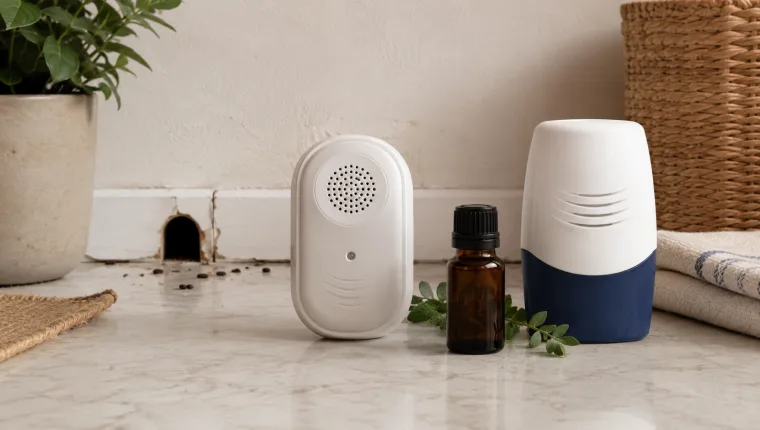
Mouse repellents do not reliably eliminate an established infestation. Ultrasonic devices, peppermint oil, scented sprays, predator odors, bright lights, and similar products may change mouse behavior temporarily in a limited area, but they do not remove mice already nesting in a building, close entry points, clean contamination, or prove that activity has stopped.
The best response to active mice is an integrated plan:
- Confirm current mouse activity.
- Remove accessible food, water, and nesting material.
- Use correctly placed mouse-sized traps.
- Find and seal entry points in coordination with removal.
- Clean droppings and nests using wet-cleanup precautions.
- Monitor until there are no captures and no new signs.
A repellent may have a narrow supporting role when a product is specifically labeled for mice and the exact site where it will be used. It should not replace the core process described in our step-by-step mouse control guide.
Begin with the mouse infestation signs guide if you have not confirmed whether the evidence is current. For the broader prevention and removal framework, see rodent control.
- Mouse Repellents at a Glance
- Why Repellents Rarely Solve an Active Mouse Infestation
- Do Ultrasonic Mouse Repellents Work?
- What About Electromagnetic Pest Repellers?
- Does Peppermint Oil Repel Mice?
- Are "Natural" Mouse Repellents Safer?
- Can Mothballs Keep Mice Away?
- Do Ammonia, Bleach, or Vinegar Repel Mice?
- Do Predator Scents, Cat Litter, or Pet Hair Work?
- Can Bright Lights or Continuous Noise Drive Mice Out?
- When a Labeled Mouse Repellent May Have a Limited Role
- How to Evaluate a Mouse Repellent Before Buying
- Registered Pesticide vs. Minimum-Risk Product
- What Works Better Than Repellents?
- Mouse Repellents in Specific Locations
- How Much Do Mouse Repellents Cost?
- When to Call a Professional
- Common Mouse-Repellent Mistakes
- Mouse Repellent Product Evaluation Checklist
- Frequently Asked Questions
- What is the most effective mouse repellent?
- Do ultrasonic mouse repellents work through walls?
- Can ultrasonic devices make mice leave permanently?
- Does peppermint oil get rid of mice?
- How often must peppermint oil be reapplied?
- Are essential oils safe around pets?
- Can mothballs repel mice?
- Does ammonia keep mice away?
- Do dryer sheets repel mice?
- Will a cat solve a mouse infestation?
- Can repellents protect a parked vehicle?
- How do I know whether a mouse repellent worked?
- What should I use instead of a mouse repellent?
- When should I call an exterminator?
Mouse Repellents at a Glance
| Method | Possible short-term effect | Main limitation | Role in a control plan |
|---|---|---|---|
| Ultrasonic plug-in device | May disturb mice in a directly exposed area | Sound is directional, blocked by objects, and mice may adapt | Do not use as the primary control method |
| Electromagnetic or wiring-based device | Marketing claims vary | Whole-building control claims require reliable scientific support | Do not assume it replaces traps or exclusion |
| Peppermint oil or essential-oil spray | Strong odor may create temporary local avoidance | Odor fades, coverage is inconsistent, and mice can use another route | Optional supporting measure only when product directions allow |
| Commercial scented repellent | May discourage use of a small treated area | Performance is product-, site-, and reapplication-dependent | Read the full label and verify the target pest and use site |
| Mothballs | Strong pesticide vapor in an airtight labeled use | Not a general mouse repellent; open use can expose people and pets | Do not use for mice unless a current label explicitly permits it |
| Ammonia, bleach, or harsh household chemicals | Strong odor | Fumes and mixing hazards; no reliable infestation control | Do not use as a mouse-repellent strategy |
| Predator urine, used cat litter, or animal scent | Possible temporary behavioral response | Odor, sanitation, and exposure concerns; mice may habituate | Not a substitute for removal and exclusion |
| Dryer sheets, soap, spices, or household fragrances | Temporary odor around one object | No dependable structural coverage or monitoring value | Do not rely on them to protect a home |
| Traps plus exclusion | Removes current mice and blocks future entry | Requires correct placement, repairs, and monitoring | Core evidence-based control strategy |
Why Repellents Rarely Solve an Active Mouse Infestation
A building provides mice with several resources at the same time: shelter, warmth, travel routes, nesting material, food, and water. A smell or sound in one corner does not remove those resources.
Repellents commonly fail as stand-alone control because:
- Mice can move behind walls, cabinets, appliances, insulation, and stored materials where the repellent does not reach.
- Odors fade and may require frequent reapplication.
- Ultrasonic sound does not travel effectively through walls or around large objects.
- Mice can use a different route within the same building.
- A hungry or established animal may tolerate an unpleasant stimulus.
- Repellents provide no carcass, capture, or specimen to confirm removal.
- They do not reveal whether new droppings, gnawing, or nesting continue.
- They do not repair a quarter-inch entry gap.
The UC Statewide IPM Program describes ultrasonic devices as having very limited use because the sound is directional and does not penetrate behind objects. The Federal Trade Commission has also challenged or warned against unsupported claims that electronic devices eliminate rodents or replace conventional control.
Do Ultrasonic Mouse Repellents Work?
Ultrasonic devices emit sound above the usual range of human hearing. Products may claim to irritate, confuse, or drive mice from a room.
The practical problems are coverage and adaptation:
- Ultrasound generally travels in a straight line.
- Furniture, cabinets, boxes, walls, and insulation create sound shadows.
- A device in an open room may not affect a nest behind an appliance or inside a wall.
- The sound does not seal the opening that allowed mice to enter.
- Any initial reaction may diminish as animals become accustomed to the stimulus.
The Federal Trade Commission has warned manufacturers and retailers that efficacy claims for ultrasonic pest-control devices need competent and reliable scientific evidence. Previous FTC cases challenged claims that the devices eliminated rodent infestations or replaced conventional control.
An ultrasonic device should not be used to decide that a room is mouse-free. Confirmation requires captures, direct observations, safe cleanup followed by no new droppings, no new damage, and continued monitoring.
What About Electromagnetic Pest Repellers?
Some plug-in products claim to alter electrical wiring fields or send pulses through household circuits. Whole-building claims can sound more convincing than a single-room ultrasonic claim, but the purchasing standard should be the same: ask for independent evidence supporting the exact product, pest, building type, and claimed coverage.
Do not treat testimonials, ratings, wiring diagrams, or a vague “laboratory tested” statement as proof. Useful evidence identifies the mouse species, test setting, measurement method, duration, return of activity, and whether traps or exclusion were used at the same time.
Does Peppermint Oil Repel Mice?
Peppermint oil has a strong odor, and a freshly treated spot may be less attractive to a mouse for a limited period. That does not demonstrate whole-home control.
Its limitations include:
- Volatile odor decreases over time.
- Absorbent materials and ventilation change how long the smell remains.
- A mouse may travel a few inches away and use another path.
- Oil does not remove a nest or close an opening.
- Repeated application can stain or damage some surfaces.
- Concentrated oils can irritate skin, eyes, and airways and may create pet-exposure concerns.
Some peppermint-oil pesticide products may qualify for EPA’s minimum-risk exemption. That status is not the same as EPA registration and product-specific proof of effectiveness. EPA states that it generally does not review products claiming the minimum-risk exemption or provide a label review for them.
Choose a formulated product with complete directions rather than improvising a concentrated homemade mixture. Follow the label for placement, ventilation, surfaces, reapplication, storage, children, and pets.
Are “Natural” Mouse Repellents Safer?
Natural origin does not automatically mean harmless, pet-safe, or effective. Before use, check every ingredient, the target pest, allowed sites, food-contact restrictions, ventilation, surface compatibility, reapplication directions, and child or animal warnings.
Do not apply essential oils directly to pets, pet bedding, food, dishes, toys, or ventilation equipment unless the product label permits it. Seek veterinary guidance after a suspected pet exposure.
Can Mothballs Keep Mice Away?
Mothballs should not be scattered in rooms, attics, crawl spaces, wall voids, vehicles, gardens, or around a home to repel mice. Mothballs are pesticide products intended to release vapor inside specific labeled settings, commonly airtight containers for clothes-moth control.
The National Pesticide Information Center states that mothballs should not be used to repel animals unless the label describes that use. Open placement can expose people and animals to pesticide vapor. If the odor is noticeable, the vapor is being inhaled.
Using more mothballs, placing them inside a wall, or mixing them with other chemicals does not create a safe mouse treatment.
Do Ammonia, Bleach, or Vinegar Repel Mice?
Strong household odors may be unpleasant, but they are not a reliable mouse-control program. Ammonia and bleach can irritate eyes and airways. Mixing household cleaners can release dangerous gases.
Use cleaning products only for their labeled cleaning or disinfecting purpose. For rodent waste, follow the CDC wet-cleanup procedure. Do not create concentrated odor stations or leave open containers of chemicals where children, pets, or occupants can reach them.
Do Predator Scents, Cat Litter, or Pet Hair Work?
Mice may react to predator-related odors, but a response does not guarantee departure from a building. Established mice may continue using a protected nest when food, warmth, and cover are available.
Used litter and animal waste also create sanitation, odor, and exposure problems. Pet hair does not provide a measurable removal result. A resident cat may capture individual mice, but it does not inspect the exterior, seal entry points, or safely clean contamination.
Can Bright Lights or Continuous Noise Drive Mice Out?
Light or noise may disturb one hiding place, but mice can shift deeper into a wall or become active at another time. Use cameras or traps to document activity instead of running lights, radios, or equipment continuously.
When a Labeled Mouse Repellent May Have a Limited Role
A specifically labeled product may help discourage activity around a small, defined location when:
- No active indoor nest is established
- The main entry point has already been corrected
- Food and nesting material are removed
- The use site appears on the label
- The product can be reapplied as directed
- Results are checked with traps or monitoring
Examples might include protecting a compatible stored item, a limited outdoor location, or a vehicle component after inspection and cleanup. The product still should not be described as proof that all mice are gone.
How to Evaluate a Mouse Repellent Before Buying
| Question | What a useful answer looks like | Warning sign |
|---|---|---|
| Is the target pest named? | House mice or mice are specifically listed | Only vague words such as pests or vermin |
| Is the use site listed? | Indoor room, vehicle, exterior, storage, or plant site is clearly defined | Claims of universal use anywhere |
| What regulatory category applies? | EPA registration number or a clear minimum-risk exemption statement | EPA logo used as a general endorsement |
| How was effectiveness measured? | Product-specific testing with defined outcome and duration | Testimonials, vague laboratory claims, or before-and-after anecdotes |
| How large is the treated area? | Realistic dimensions and placement limits | Whole-home coverage through walls without supporting data |
| How often is reapplication required? | Specific interval and conditions such as cleaning or weather | No explanation of odor loss or device limitations |
| What are the safety restrictions? | Clear directions for children, pets, food, surfaces, and ventilation | Claims such as completely safe, non-toxic, or harmless without qualification |
| What happens if mice remain? | Instructions to inspect, trap, exclude, or contact a professional | Guaranteed elimination without monitoring |
Registered Pesticide vs. Minimum-Risk Product
An EPA-registered pesticide has an EPA Registration Number on the label. Registration means EPA has reviewed the product for its labeled safety and performance requirements.
A product qualifying under the federal minimum-risk pesticide exemption does not need federal FIFRA registration when all exemption conditions are met. EPA generally does not confirm individual exempt products or review their labels. States may impose additional requirements.
Neither category permits ignoring the label. A pesticide product must be used only for its listed pest, site, method, amount, and precautions.
What Works Better Than Repellents?
1. Confirm Current Activity
Look for new droppings after safe cleanup, captures, camera footage, fresh food damage, gnawing, tracks, or nesting. One old pellet does not prove a current infestation.
2. Remove Food and Water
- Store food and pet food in tight containers.
- Clean crumbs, grease, and spills.
- Put pet bowls away overnight.
- Repair leaks and condensation.
- Use garbage containers with tight lids.
3. Use Mouse-Sized Snap Traps
The CDC recommends traditional snap traps for household rodent control. Place them along active wall routes and keep them inaccessible to children and pets. CDC advises against glue traps and live traps.
4. Seal Entry Points
CDC notes that mice can fit through a hole approximately 1/4 inch or 6 millimeters wide. Inspect doors, cabinets, pipes, utility lines, vents, foundations, attics, basements, crawl spaces, garages, and wall-floor junctions.
Coordinate exclusion with trapping so mice are not sealed inside inaccessible voids.
5. Clean Safely
Do not sweep or vacuum dry mouse droppings, urine, or nesting material. Wet contaminated material with disinfectant, follow the product contact time, wipe it up, and wash hands according to CDC guidance.
6. Monitor and Verify
Continue until there are no captures and no new signs. CDC considers one week with no captures and no new evidence encouraging, although longer monitoring is appropriate where entry pressure remains high.
Mouse Repellents in Specific Locations
- Walls: room devices and scents rarely reach every cavity. Trap along accessible routes and inspect utility openings.
- Attics and garages: stored objects and insulation create untreated zones; inspect vents, eaves, doors, food, and nesting material.
- Vehicles: inspect wiring, filters, air intakes, and food first. Use only products labeled for the exact vehicle location and material.
- Apartments: coordinate inspection, trapping, sanitation, and exclusion across shared walls and common areas.
How Much Do Mouse Repellents Cost?
Compare more than the shelf price. Include the number of devices or treatment points, reapplication, monitoring, food loss, damage during delay, entry repairs, and professional control. For service pricing, see the mouse exterminator cost guide.
When to Call a Professional
Professional mouse control is appropriate when:
- Activity continues after a week of correctly placed trapping
- Mice are inside walls, ceilings, ducts, attics, or crawl spaces
- Entry points cannot be identified or safely reached
- Several rooms or units are affected
- Contamination is heavy
- Food-service, healthcare, childcare, or commercial areas are involved
- Children and pets complicate safe device placement
- Wiring, plumbing, vehicles, or structural materials are damaged
Ask the provider to separate inspection, trapping, exclusion, sanitation, cleanup, follow-up, and warranty.
Common Mouse-Repellent Mistakes
- Using repellents without confirming active mice
- Expecting one plug-in device to work through walls and furniture
- Using peppermint oil instead of closing entry points
- Scattering mothballs in occupied areas
- Mixing bleach, ammonia, or other chemicals
- Applying concentrated essential oils around pets or food
- Believing a quiet room proves mice are gone
- Failing to monitor for new droppings and damage
- Delaying traps while mice continue nesting
- Ignoring connected apartments or shared utility routes
Mouse Repellent Product Evaluation Checklist
| Field | What to record |
|---|---|
| Product and manufacturer | Exact name, company, and contact information |
| Target pest | Whether mice or house mice are specifically listed |
| Use site | Indoor, outdoor, vehicle, storage, garden, or other labeled location |
| Regulatory status | EPA Registration Number or minimum-risk exemption information |
| Active ingredients or mechanism | Ultrasound, essential oil, scent, taste repellent, or another mechanism |
| Claimed coverage | Area, room, object, distance, and obstructions |
| Evidence supplied | Product-specific testing, duration, outcome, and independent review |
| Safety restrictions | Children, pets, food, surfaces, ventilation, and storage |
| Maintenance | Reapplication, cartridge, battery, electricity, and replacement schedule |
| Monitoring plan | Traps, cameras, droppings, damage, and review date |
| Control work completed | Food correction, trapping, exclusion, cleanup, and repairs |
| Result | New signs, no change, temporary shift, or verified control |
Frequently Asked Questions
What is the most effective mouse repellent?
No repellent reliably replaces inspection, mouse-sized traps, food correction, entry-point sealing, safe cleanup, and monitoring.
Do ultrasonic mouse repellents work through walls?
No. Ultrasound is directional and is blocked or weakened by walls, furniture, cabinets, and other objects.
Can ultrasonic devices make mice leave permanently?
They may cause a temporary reaction in a directly exposed area, but permanent removal is not reliably established and mice may adapt or use another route.
Does peppermint oil get rid of mice?
Peppermint odor may create temporary local avoidance. It does not remove established mice, nests, food sources, or entry points.
How often must peppermint oil be reapplied?
Frequency depends on the formulated product, surface, ventilation, and label. Homemade applications have no standardized duration.
Are essential oils safe around pets?
Safety depends on the oil, concentration, species, exposure route, and product directions. Do not assume a natural product is pet-safe.
Can mothballs repel mice?
Mothballs should not be used for mice unless the current pesticide label explicitly permits that use. Open placement can expose people and animals to pesticide vapor.
Does ammonia keep mice away?
A strong odor may cause short-term avoidance, but ammonia does not provide reliable structural control and can create harmful fumes.
Do dryer sheets repel mice?
There is no dependable evidence that dryer sheets protect a building from an established mouse infestation.
Will a cat solve a mouse infestation?
A cat may catch individual mice but does not seal entry points, document activity, clean contamination, or guarantee elimination.
Can repellents protect a parked vehicle?
A labeled product may have a supporting role, but inspection, food removal, wiring evaluation, entry prevention, and monitoring remain necessary.
How do I know whether a mouse repellent worked?
Use traps and monitoring. Look for no captures, no new droppings after safe cleanup, no fresh gnawing, and no repeated sightings over time.
What should I use instead of a mouse repellent?
Use mouse-sized snap traps along active routes, remove food and water, seal openings, clean safely, and continue monitoring.
When should I call an exterminator?
Call when mice remain after correctly placed trapping, occupy inaccessible voids, affect several units, cause heavy contamination, or damage wiring and building systems.
