
Last reviewed: July 2026
Effective spider pest control combines web removal, exclusion, clutter reduction, moisture correction, monitoring, and control of the insects spiders use as food. A pesticide application may temporarily reduce visible spiders, but long-term results are unlikely when doors, vents, foundation gaps, exterior lighting, flying insects, storage areas, and undisturbed webs remain unchanged.
Most spiders found around homes are predators of insects and do not require property-wide treatment. Control is more justified when:
- Spiders repeatedly enter occupied rooms
- Numerous active webs appear around doors, windows, porches, or lights
- Egg sacs are found indoors
- A concerning species may be present
- Spiders occur in children’s play areas, stored clothing, shoes, beds, or frequently handled materials
- An underlying insect infestation is supporting spider activity
The main decision factor is whether the problem involves occasional wandering spiders, a continuing indoor population, heavy exterior web-building, or a potentially medically important species. Identification should be based on a specimen and reliable regional evidence rather than a blurry photograph, bite mark, or internet comparison alone.
For signs that suggest continuing activity, see our spider infestation signs guide. For general professional pricing, visit our pest-control cost guide.
- How Spider Pest Control Works
- How to Identify a Spider
- Harmless vs. Concerning Spider Situations
- Signs of a Spider Infestation
- Why Spiders Enter Homes
- Where Spiders Hide Indoors
- Step-by-Step Indoor Spider Control
- Outdoor Spider Control
- Spider-Control Methods Compared
- Do Spider Sprays Work?
- Spider-Repellent Products and Home Remedies
- Spider Pest-Control Safety
- Suspected Venomous Spiders
- Spider Bites and Medical Caution
- Why Spider Control Fails
- How Long Does Spider Control Take?
- When to Call a Spider Exterminator
- Spider Activity Log
- Frequently Asked Questions
- What is the best way to control spiders?
- Does one spider mean an infestation?
- Why do spiders keep coming into my house?
- Do spiders indicate another pest problem?
- Should outdoor spiders be killed?
- Does removing webs get rid of spiders?
- Do spider sprays work?
- Do peppermint oil and other scents repel spiders?
- Do ultrasonic spider repellents work?
- Do sticky traps work for spiders?
- Why are spiders around my porch lights?
- How do I keep spiders out of my garage?
- Can spiders live inside walls?
- Can spiders come through drains?
- How can I identify a venomous spider?
- Can a doctor identify a spider from a bite?
- When should I call a spider exterminator?
- How much does professional spider control cost?
How Spider Pest Control Works
Spider control works best as an Integrated Pest Management program. Instead of automatically spraying every visible surface, the process identifies why spiders are present and corrects the conditions supporting them.
A practical program includes:
- Confirming that the animal is a spider
- Determining whether it builds webs or actively hunts
- Mapping sightings, webs, egg sacs, and prey insects
- Removing active and abandoned webs
- Vacuuming or capturing indoor spiders
- Sealing entry points
- Reducing insects attracted by lights, food, moisture, or plants
- Reducing clutter and sheltered hiding places
- Using targeted pesticide treatment only where justified
- Monitoring for new activity
The U.S. Environmental Protection Agency explains that Integrated Pest Management emphasizes prevention, monitoring, action thresholds, and pesticide use only when needed.
A few outdoor garden spiders may remain below any reasonable action threshold because they help reduce other insects. Repeated indoor sightings, hidden egg sacs, widow-spider habitat, or webs interfering with doors and occupied areas may justify stronger action.
How to Identify a Spider
Spiders are arachnids rather than insects. Adult spiders generally have:
- Eight legs
- Two main body regions
- No wings
- No antennae
- Silk-producing structures called spinnerets
Insects have six legs, three main body regions, and commonly possess antennae. Ticks, mites, harvestmen, pseudoscorpions, and other arachnids may also be mistaken for spiders.
Spider identification can depend on:
- Body shape
- Leg proportions
- Eye arrangement
- Markings
- Web structure
- Hunting behavior
- Habitat
- Geographic range
Color alone is unreliable. Lighting, age, sex, recent feeding, molting, and natural variation can change how a spider appears.
Web-Building Spiders
Web-building spiders usually remain on or near a web that captures prey. Common web types include:
- Orb-shaped webs
- Messy cobwebs
- Funnel webs
- Sheet webs
- Small webs in windows and corners
Web location and structure can help identify the spider family, but an abandoned web does not prove that the spider remains present.
Hunting Spiders
Hunting spiders do not rely on a capture web. They move across floors, walls, vegetation, garages, and storage areas searching for prey.
Examples include:
- Wolf spiders
- Jumping spiders
- Ground spiders
- Sac spiders
- Fishing spiders
A hunting spider found indoors may have entered accidentally through a door, garage, firewood, plant, box, or structural opening.
Harmless vs. Concerning Spider Situations
| Situation | Likely response | Important consideration |
|---|---|---|
| One spider near an open door | Capture, vacuum, or remove it and inspect the door seal | The spider may be an accidental invader |
| Outdoor orb web away from occupied areas | Tolerate it or remove the web if necessary | The spider may be reducing flying insects |
| Repeated webs around lights and entrances | Remove webs, reduce attractive lighting, control insects, and seal gaps | The underlying attractant may be the insect population |
| Multiple indoor spiders and egg sacs | Inspect storage, crawl spaces, basements, and prey insects | Some species can reproduce indoors |
| Possible widow or recluse spider | Avoid handling and obtain reliable identification | Geographic range and specimen features matter |
| Suspected spider bite without a specimen | Seek medical advice based on symptoms | A skin reaction cannot identify the responsible animal |
The University of California Statewide Integrated Pest Management Program notes that spiders are generally beneficial predators and that spiders commonly observed in the open during the day are unlikely to cause serious injury.
That does not mean every spider should be handled. Use gloves and tools when moving stored materials, firewood, outdoor furniture, or clutter in areas where hidden spiders may occur.
Signs of a Spider Infestation
The word “infestation” is often used loosely. Finding one spider does not show that spiders are breeding throughout the property.
Evidence of continuing activity may include:
- New webs appearing shortly after removal
- Several spiders of different sizes
- Egg sacs
- Repeated sticky-trap captures
- Spiders in several rooms
- Numerous prey insects in webs
- Activity around the same cracks or storage areas
- Recurring seasonal entry from outside
Active and Abandoned Webs
An active web may appear maintained and contain recently captured insects. An old web may collect dust and remain after the spider has left.
Remove both active and abandoned webs, record the locations, and inspect the area again. New construction helps identify active zones.
Egg Sacs
Spider egg sacs vary in shape, texture, color, and placement. They may be:
- Attached to webs
- Hidden beneath furniture
- Inside storage areas
- Carried by the female
- Attached to plants or outdoor structures
Remove egg sacs with a vacuum or tool rather than crushing them with bare hands. Empty or dispose of vacuum contents appropriately after collection.
Sticky-Trap Captures
Sticky monitoring traps placed along walls can help identify:
- Rooms with repeated activity
- Travel routes
- Whether spiders are entering from a garage or basement
- Whether prey insects are also present
- Whether activity declines after corrections
Keep traps away from children and pets. Sticky traps are monitoring tools and rarely solve the underlying problem by themselves.
Why Spiders Enter Homes
Spiders may enter while searching for:
- Insect prey
- Shelter
- Mates
- Stable temperature
- Protected molting or egg-laying sites
- Overwintering locations
Common entry routes include:
- Gaps beneath doors
- Damaged screens
- Garage doors
- Foundation cracks
- Utility penetrations
- Crawl-space vents
- Roof and soffit gaps
- Open windows
- Boxes, plants, firewood, and stored items
Exterior lights can attract moths, flies, beetles, and other insects. Spiders then build webs near the concentrated food supply.
Where Spiders Hide Indoors
Basements and Crawl Spaces
These areas may provide humidity, darkness, clutter, insects, and undisturbed corners.
Inspect:
- Foundation walls
- Floor joists
- Utility lines
- Window wells
- Stored boxes
- Sump areas
- Crawl-space vents
Garages
Garages combine exterior access, stored materials, insects, and infrequently disturbed spaces.
Check:
- Door corners
- Weather seals
- Storage shelves
- Firewood
- Gardening equipment
- Gloves and shoes
- Items stored against walls
Attics
Attics may contain flying insects, stored materials, roof gaps, vents, and undisturbed webs. Attic entry can involve fall, electrical, heat, insulation, and respiratory hazards.
Bedrooms and Living Areas
Spiders may hide:
- Behind furniture
- Beneath beds
- Inside closets
- Behind curtains
- Near windows
- Inside shoes or stored clothing
Frequent bedroom sightings may be related to window gaps, prey insects, clutter, or movement from an adjoining garage, attic, basement, or exterior wall.
Step-by-Step Indoor Spider Control
Step 1: Remove Individual Spiders
Small numbers of spiders can be:
- Captured beneath a container and removed
- Vacuumed
- Collected by a pest professional
Do not handle an unidentified spider with bare hands.
Step 2: Remove Webs and Egg Sacs
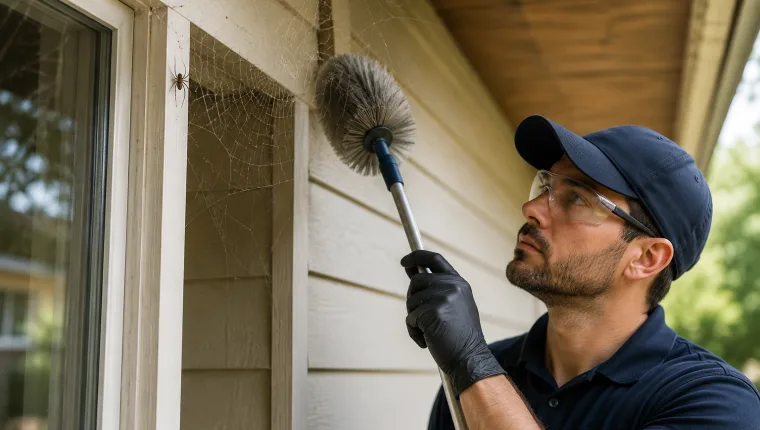
Use:
- A vacuum
- A long-handled web-removal brush
- A broom
- A disposable cloth
Focus on corners, windows, ceilings, storage areas, basements, garages, and utility rooms. The University of California Statewide Integrated Pest Management Program recommends vacuuming spiders and their webs and reducing clutter that can provide hiding places.
Step 3: Reduce Prey Insects
Check spider webs and sticky traps for the insects being captured.
Possible underlying pests include:
- Flies
- Moths
- Gnats
- Ants
- Cockroaches
- Beetles
- Crickets
- Silverfish
Correct the food, moisture, lighting, drain, sanitation, or structural conditions supporting those insects.
Step 4: Reduce Clutter
- Remove unnecessary cardboard.
- Use sealable storage containers.
- Keep items off the floor when practical.
- Move storage away from walls.
- Shake out gloves, footwear, and outdoor equipment.
- Vacuum beneath furniture and shelving.
Step 5: Seal Entry Points
- Install door sweeps.
- Repair screens.
- Seal utility penetrations.
- Repair foundation cracks.
- Seal gaps around windows and doors.
- Repair garage-door seals.
- Screen vents where appropriate.
The University of California Statewide Integrated Pest Management Program notes that sealing cracks and gaps around windows and doors helps prevent spiders from entering homes.
Step 6: Monitor
Place sticky traps along walls in garages, basements, utility rooms, closets, and other active areas. Number the traps and record captures by date.
Outdoor Spider Control
Complete elimination of outdoor spiders is neither practical nor environmentally desirable. Outdoor control should focus on occupied areas and routes that allow spiders to enter the building.
Remove Webs From Structures
Remove webs around:
- Doors
- Windows
- Porches
- Eaves
- Exterior lights
- Deck railings
- Play equipment
- Outdoor furniture
A strong stream of water may remove webs from suitable exterior surfaces. Avoid damaging electrical fixtures, windows, nests, finishes, and fragile materials.
Reduce Exterior Lighting Attraction
Possible changes include:
- Turning off unnecessary lights
- Using motion sensors
- Relocating lights away from doors
- Directing freestanding lights toward the building
- Closing curtains or blinds near bright windows
- Selecting less insect-attractive lighting where practical
Lighting changes reduce insects rather than directly repelling spiders.
Manage Vegetation and Debris
- Trim vegetation touching the structure.
- Remove leaf litter near entrances.
- Move firewood away from the house.
- Remove piles of bricks and debris.
- Keep grass and weeds managed near the foundation.
- Inspect beneath decks and outdoor furniture.
Correct Moisture
Moisture supports many insects that become spider prey.
Repair:
- Leaking faucets
- Clogged gutters
- Drainage problems
- Condensation
- Irrigation directed at walls
- Damp crawl spaces
Spider-Control Methods Compared
| Method | Where it fits | Main limitation |
|---|---|---|
| Vacuuming | Indoor spiders, webs, egg sacs, and prey insects | Does not prevent new entry |
| Web removal | Porches, windows, garages, ceilings, and exterior walls | Webs may return if prey and shelter remain |
| Sticky monitoring traps | Mapping indoor activity and travel routes | Limited control and potential child or pet access |
| Exclusion | Doors, windows, foundations, vents, and utility gaps | Does not remove spiders already inside |
| Prey-insect control | Properties with flies, moths, cockroaches, ants, or other insects | Requires correct identification of the underlying pest |
| Targeted pesticide treatment | Confirmed harborages, cracks, voids, and labeled exterior sites | Temporary when webs, prey, entry points, and clutter remain |
| Routine broad spraying | Rarely justified as a stand-alone spider solution | May increase exposure without solving the source |
Do Spider Sprays Work?
A spray may kill a spider when the product directly contacts it. Residual products may affect spiders crossing a treated surface when that use is permitted by the label.
Results are often limited because spiders:
- Spend little time on treated open surfaces
- Remain inside webs, cracks, boxes, or voids
- Can enter after treatment
- Are supported by continuing prey insects
- May avoid poorly placed deposits
The University of Minnesota Extension recommends an integrated approach using nonchemical methods and insecticides only when appropriate.
Spider-Repellent Products and Home Remedies
Products and home remedies commonly promoted for spiders include:
- Peppermint oil
- Cedar
- Vinegar
- Chestnuts
- Citrus
- Ultrasonic devices
- Electronic repellents
Odor-based products may produce temporary avoidance under some conditions but do not replace web removal, prey control, exclusion, and monitoring.
Essential oils can irritate people or harm pets when misused. Concentrated oils should not be broadly sprayed around cats, birds, aquariums, children, food surfaces, or enclosed occupied rooms without appropriate product and veterinary guidance.
Spider Pest-Control Safety
Every pesticide must be used according to its EPA-registered label.
Before treatment, tell the provider about:
- Children
- Pregnant occupants
- Pets
- Aquariums and terrariums
- People with asthma or chemical sensitivities
- Food-preparation areas
- Gardens and flowering plants
- Ponds and drainage areas
Ask for:
- Product names
- EPA registration numbers
- Application locations
- Preparation instructions
- Re-entry instructions
- Pet precautions
- Cleaning instructions
Do not:
- Use outdoor products indoors
- Apply more than the label permits
- Treat bedding or clothing unless specifically allowed
- Spray inside electrical equipment
- Apply dust in visible piles
- Place sticky traps where children or pets can contact them
- Handle unidentified spiders with bare hands
Suspected Venomous Spiders
Widow and recluse spiders are frequently misidentified. Geographic range is an important part of identification.
A concerning spider should be:
- Captured without direct handling when it can be done safely
- Placed in a sealed container
- Photographed from several angles
- Identified by an extension service, qualified entomologist, medical professional, or experienced pest provider
Do not rely on markings alone. Many harmless spiders have dark bodies, brown coloring, abdominal patterns, or shapes that resemble commonly feared species.
Spider Bites and Medical Caution
A skin lesion, swelling, pain, redness, itching, or two small marks cannot prove that a spider caused the reaction.
Many suspected spider bites are never linked to a captured spider. Other possible causes include:
- Other arthropods
- Skin infections
- Allergic reactions
- Contact dermatitis
- Minor injuries
- Other medical conditions
Seek prompt medical care for severe pain, muscle cramping, breathing difficulty, weakness, spreading redness, fever, tissue damage, signs of infection, or another concerning reaction.
Do not attempt to identify a spider species from a photograph of skin.
Why Spider Control Fails
- Only visible spiders were sprayed.
- Webs and egg sacs remained.
- Flying insects continued gathering around lights.
- Door and window gaps remained open.
- Clutter provided protected harborages.
- Moisture supported prey insects.
- Exterior vegetation touched the building.
- Firewood or boxes carried spiders indoors.
- The pesticide did not reach the active harborage.
- Monitoring stopped before seasonal entry ended.
- The animal was not actually a spider.
Repeated treatment failure should trigger another inspection of prey insects, entry routes, moisture, storage, and species identification.
How Long Does Spider Control Take?
One accidental spider can be removed immediately. A property with heavy exterior webs or continuing indoor activity may require several weeks of corrections and monitoring.
| Situation | Possible timeline | Main variable |
|---|---|---|
| One wandering spider | Immediate removal | Whether the entry point remains open |
| Recurring webs near exterior lights | Several days to weeks | Lighting, prey insects, web removal, and seasonal pressure |
| Indoor spiders in storage areas | Several weeks | Clutter, egg sacs, prey, exclusion, and cleaning |
| Heavy exterior activity | Ongoing seasonal management | Landscape, water, lights, nearby habitat, and insect pressure |
| Potentially concerning species | Inspection and targeted control | Identification, hiding areas, and building conditions |
When to Call a Spider Exterminator
Professional spider control may be appropriate when:
- A concerning species may be present
- Spiders occur in occupied bedrooms or children’s areas
- Numerous egg sacs are present
- Webs return repeatedly after removal
- Spiders occupy inaccessible attics, crawl spaces, or voids
- An underlying insect infestation requires treatment
- The property is a warehouse, school, daycare, healthcare site, or commercial facility
- DIY pesticide use would create safety concerns
- Identification remains uncertain
What Professional Service Should Include
- Spider and prey-insect identification
- Interior and exterior inspection
- Web and egg-sac assessment
- Entry-point findings
- Lighting and moisture recommendations
- Clutter and storage recommendations
- Targeted treatment plan
- Follow-up and monitoring
Questions to Ask the Company
- Which spider or spider group did you identify?
- What evidence suggests an infestation?
- Which prey insects are present?
- Where are spiders entering?
- Will webs and egg sacs be removed?
- Which nonchemical corrections are recommended?
- What products and EPA registration numbers will be used?
- Which locations will be treated?
- How will success be measured?
- Are follow-up visits included?
- What can cause spiders to return?
Spider Activity Log
| Date | Room or exterior area | Spider, web, or egg sac | Prey insects present | Action taken | New activity |
|---|---|---|---|---|---|
Frequently Asked Questions
What is the best way to control spiders?
Remove spiders, webs, and egg sacs; reduce prey insects; seal entry points; reduce clutter and moisture; change attractive exterior lighting; and use targeted pesticide treatment only when justified.
Does one spider mean an infestation?
No. One spider may have entered accidentally. Repeated sightings, egg sacs, several life stages, and webs returning after removal provide stronger evidence of continuing activity.
Why do spiders keep coming into my house?
Common reasons include prey insects, door gaps, damaged screens, exterior lighting, moisture, clutter, firewood, boxes, and seasonal movement.
Do spiders indicate another pest problem?
Sometimes. Numerous spiders or webs containing insects may indicate flies, moths, gnats, ants, cockroaches, beetles, or other prey around the property.
Should outdoor spiders be killed?
Not automatically. Most outdoor spiders are beneficial predators. Focus control on occupied areas, concerning species, heavy webbing, and entry routes.
Does removing webs get rid of spiders?
Web removal reduces active and abandoned sites and may remove egg sacs. Spiders can return when prey insects, shelter, and entry routes remain.
Do spider sprays work?
Some products kill spiders by direct contact or after they cross treated surfaces. Results are usually temporary unless exclusion, web removal, prey control, and cleaning are also completed.
Do peppermint oil and other scents repel spiders?
Odor products may cause temporary avoidance but do not provide reliable structural control. Concentrated essential oils may also create pet and occupant risks.
Do ultrasonic spider repellents work?
Ultrasonic devices should not replace inspection, exclusion, web removal, prey reduction, and monitoring.
Do sticky traps work for spiders?
Sticky traps can capture wandering spiders and help locate activity. They rarely solve the cause of the problem by themselves.
Why are spiders around my porch lights?
Lights attract flying insects, providing concentrated prey. Reduce unnecessary lighting, relocate fixtures, and remove webs regularly.
How do I keep spiders out of my garage?
Repair garage-door seals, reduce cardboard and clutter, store items off the floor, remove webs, control insects, and inspect firewood and equipment.
Can spiders live inside walls?
Some spiders use wall voids, utility openings, cracks, and spaces around windows. They may leave those areas to hunt or build webs.
Can spiders come through drains?
A spider may become trapped in a sink or bathtub after entering from elsewhere, but damaged plumbing gaps, utility openings, and dry drains can also provide routes for arthropods.
How can I identify a venomous spider?
Use a captured specimen, geographic range, body features, and qualified identification. Do not rely on color, one marking, or a skin reaction alone.
Can a doctor identify a spider from a bite?
A skin reaction alone usually cannot identify the responsible species. Medical treatment should be based on the symptoms and clinical evaluation.
When should I call a spider exterminator?
Call a professional for suspected concerning species, numerous egg sacs, recurring indoor activity, inaccessible harborages, prey infestations, commercial properties, or failed DIY control.
How much does professional spider control cost?
Pricing depends on property size, indoor and outdoor treatment, web removal, infestation level, prey insects, accessibility, service frequency, and location. See our pest-control cost guide.
Spider identification should be based on a specimen and reliable regional information. A skin lesion cannot confirm a spider bite or identify a species. Seek medical care for severe or worsening symptoms, and use pesticides only according to their EPA-registered labels.


