
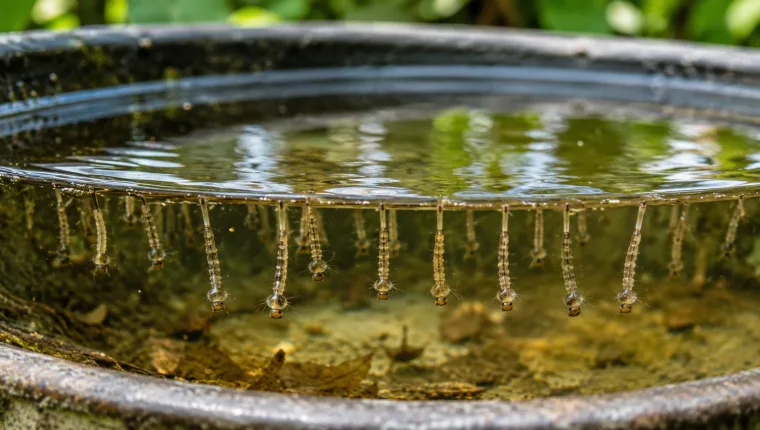
Mosquito larvae are the immature, water-dwelling stage of mosquitoes. They usually look like tiny, flexible organisms that wriggle or jerk through standing water and repeatedly return to the surface. Finding them means mosquitoes are completing part of their life cycle in that water source. The most effective first response is usually to remove, empty, scrub, cover, or properly maintain the water—not to reach immediately for a spray.
- What mosquito larvae look like
- Why finding mosquito larvae matters
- Where mosquito larvae are commonly found
- How quickly mosquito larvae develop
- How to remove mosquito breeding water safely
- When a larvicide may be appropriate
- Water sources that require extra caution
- Why adult mosquito sprays do not solve breeding water
- How to monitor whether control is working
- Common mistakes that allow larvae to return
- When to call a professional or local mosquito-control program
- Weekly standing-water checklist
- Frequently asked questions
- Does standing water always contain mosquito larvae?
- Can mosquito larvae live in very small amounts of water?
- Will dumping the water kill mosquito larvae?
- Can I pour bleach into water with mosquito larvae?
- Are mosquito dunks safe?
- How often should I check my yard for mosquito breeding sites?
- Do mosquito larvae mean my family is at immediate risk of disease?
- Why do mosquitoes remain after I remove standing water?
What mosquito larvae look like
Mosquito larvae are often called “wigglers” because of their distinctive movement. Their exact appearance varies by species and developmental stage, but several clues are useful:
- They live in water rather than crawling on a dry surface.
- They have an elongated, segmented body and a clearly defined head.
- They move with quick, wriggling or whipping motions when disturbed.
- Many species hang at an angle from the surface while breathing through a small tube near the end of the abdomen.
- They repeatedly dive and return to the surface.
Some mosquito genera rest differently. For example, certain larvae lie nearly parallel to the water surface rather than hanging downward. Because posture alone is not enough for species-level identification, homeowners should focus on confirming that the organism is consistent with a mosquito larva and then eliminate the breeding source.
Larvae versus pupae
Mosquito pupae are the next stage after larvae. They are shorter, more comma-shaped, and often look top-heavy because the front portion of the body is enlarged. Pupae are sometimes called “tumblers” because they rapidly flip or tumble downward when the water is disturbed. They do not feed, but they remain active and eventually emerge as adult mosquitoes.
Larvae versus other small aquatic organisms
Not every tiny organism in water is a mosquito. Midge larvae, drain-fly larvae, small crustaceans, insect nymphs, worms, and other aquatic life may occur in containers or natural water. Mosquito larvae are most likely when the organisms repeatedly use the surface, wriggle when disturbed, and occur in stagnant or slow-moving water that has been present for several days.
A clear close-up photograph or a specimen collected without direct skin contact can help a local mosquito-control district, cooperative extension office, or pest-management professional confirm the identification. Do not add pesticide simply because something is moving in the water.
Why finding mosquito larvae matters
Larvae prove that the water source is suitable for mosquito development at that moment. Adult female mosquitoes lay eggs in or near water, depending on the species. Eggs hatch into larvae, larvae develop through several growth stages, larvae become pupae, and adults emerge from the pupal case at the water surface.
Interrupting the life cycle before adults emerge is usually more efficient than trying to control flying mosquitoes throughout a property. A single overlooked bucket, clogged gutter, tire, tarp fold, or plant saucer can produce repeated generations during warm weather.
The presence of larvae does not identify the mosquito species or prove that the mosquitoes carry disease. Disease risk varies by region, season, mosquito species, and local public-health conditions. For current local risk information, use your public-health department or mosquito-control district rather than trying to infer risk from appearance alone.
Where mosquito larvae are commonly found
Mosquitoes can develop in surprisingly small amounts of water. Some species prefer temporary containers; others use floodwater, marshes, tree holes, stormwater systems, or more permanent water. Around homes, inspect every place that can hold water long enough for development.
| Breeding source | Why it becomes a problem | Preferred corrective action |
|---|---|---|
| Buckets, cups, cans, toys, and small containers | They collect rain or irrigation water and may remain undisturbed. | Empty, scrub, turn upside down, store under cover, or discard. |
| Plant saucers and decorative pots | Frequent watering keeps them wet. | Empty and scrub regularly; avoid persistent standing water. |
| Birdbaths | Shallow water warms quickly and may accumulate organic matter. | Replace water and scrub the basin on a regular schedule. |
| Pet-water containers | Outdoor bowls may remain filled for days. | Refresh and clean frequently while maintaining safe access to drinking water. |
| Rain barrels and cisterns | Stored water may remain available for weeks. | Use tight-fitting lids, intact screens, and properly sealed openings. |
| Clogged gutters | Leaves and debris create pockets of stagnant water. | Clean gutters from a safe position or hire a qualified service when height creates a fall risk. |
| Tires | They retain rainwater and provide a protected, dark container. | Dispose of correctly, store under cover, or prevent water accumulation. |
| Tarps, pool covers, and outdoor furniture covers | Folds and depressions create hidden pockets. | Drain, tighten, reposition, or store so water cannot collect. |
| Wheelbarrows, boats, and equipment | Open surfaces collect rain. | Turn over, drain, cover, or store properly. |
| Ornamental ponds and fountains | Poor circulation or neglected edges can support development. | Maintain circulation and filtration; use only management methods appropriate for that water feature. |
| Poorly maintained swimming pools | Low circulation and inadequate maintenance can create breeding habitat. | Restore proper pool maintenance; consult a pool professional when necessary. |
| Low spots and drainage problems | Water remains after rain or irrigation. | Correct grading, drainage, leaks, or irrigation practices when feasible. |
How quickly mosquito larvae develop
Development speed depends on mosquito species, temperature, food, crowding, and water conditions. In warm conditions, some mosquitoes can progress from egg to adult in roughly a week, while cooler temperatures or different species may extend the process. This is why a weekly property check is a practical minimum during mosquito season and why checking after rain is especially important.
Do not assume that a container is safe because it was empty several days ago. New rain, irrigation, condensation, or a slow leak can refill it. Likewise, dumping water without scrubbing may leave eggs attached to the container wall above the previous waterline. Some container-breeding mosquito eggs can tolerate drying and hatch when water returns.
How to remove mosquito breeding water safely
The safest and most durable approach follows a simple hierarchy: remove unnecessary containers, empty and scrub manageable water sources, prevent refill, maintain necessary water features, and reserve labeled larvicides for water that cannot reasonably be drained or covered.
1. Empty the water
Pour water onto a dry area where it will soak in and will not simply collect in another depression. Avoid dumping it into another container, storm drain, or area where standing water will persist.
2. Scrub the inside surface
Use a brush and ordinary cleaning appropriate for the container to remove the film and debris along the waterline. Scrubbing is important because eggs may remain attached to the surface after the water is gone.
3. Dry, invert, cover, or store the item
Turning a bucket upside down is more reliable than repeatedly remembering to empty it. Store toys, equipment, and containers under cover whenever possible. Tighten tarps so they shed water instead of forming pockets.
4. Repair the cause of recurring water
Fix dripping outdoor faucets, irrigation overspray, clogged drains, damaged gutters, and landscape depressions. Correcting the source reduces mosquitoes and may also prevent moisture-related building or pest problems.
5. Recheck after rain and irrigation
Use the downloadable weekly standing-water checklist and repeat the inspection after storms, landscape work, or changes in irrigation.
When a larvicide may be appropriate
A larvicide targets immature mosquitoes in water. It may be appropriate when a water source cannot be emptied, eliminated, covered, circulated, or otherwise managed. Examples can include certain catch basins, ornamental features, rainwater systems, or persistent water areas—provided the product label permits that specific site.
One commonly used microbial larvicide is Bacillus thuringiensis israelensis, often abbreviated Bti. Products containing Bti come in different formulations and are registered for specific sites. Other mosquito larvicides use different active ingredients and have different restrictions.
The product label is the controlling instruction. Confirm all of the following before use:
- The product is registered for mosquito larvae.
- The exact type of water site appears on the label.
- The application amount and retreatment interval match the label.
- The use is allowed under state and local rules.
- The water is not being treated in a way the label prohibits.
- Children and pets cannot access or disturb the product contrary to label directions.
Never improvise by adding bleach, gasoline, oil, detergent, salt, essential oils, or household pesticide mixtures to standing water. These methods can create exposure risks, harm non-target organisms, contaminate water, violate pesticide law, or simply fail to provide reliable control.
Water sources that require extra caution
Drinking water and pet water
Do not add a larvicide or any other chemical to human or animal drinking water unless the product label explicitly allows that exact use. For bowls and small containers, frequent emptying, cleaning, and refilling is usually the appropriate approach.
Swimming pools and spas
Maintain pools and spas according to applicable sanitation and circulation requirements. Do not substitute a mosquito larvicide for proper pool maintenance unless a product is specifically labeled for that circumstance.
Natural ponds, wetlands, streams, and public drains
These systems may be regulated, may support fish and beneficial organisms, and may fall under a local mosquito-control or stormwater authority. Do not apply products to them without appropriate authorization and label permission.
Rain barrels and irrigation storage
Use intact screening and tight covers first. If a larvicide is being considered, verify that the label permits the stored-water use and any intended downstream irrigation use.
Why adult mosquito sprays do not solve breeding water
An adulticide targets flying adult mosquitoes. It does not remove eggs, larvae, or pupae from containers unless the product is also specifically labeled for that purpose and applied to an allowed site. If breeding water remains, new adults can continue emerging after a spray.
A complete mosquito control plan combines source reduction, water management, barriers such as screens, personal protection, and—when justified—targeted larval or adult control. Repeated broad spraying without correcting breeding sites can waste effort and may increase exposure to people, pets, pollinators, and other non-target organisms.
How to monitor whether control is working
Monitoring should focus on both water sources and adult activity. Keep a dated record of:
- Containers or wet areas inspected.
- Larvae or pupae observed.
- Water removed or corrected.
- Containers scrubbed, covered, inverted, or discarded.
- Rainfall or irrigation since the previous check.
- Any labeled larvicide used, including product name and date.
- Areas where adult mosquito activity remains high.
Finding fewer larvae after source reduction is a positive sign, but it does not prove the property is the only source of adult mosquitoes. Adults can fly from neighboring yards, unmanaged drainage systems, wetlands, construction sites, or other nearby habitats. Persistent activity may require a broader neighborhood or professional assessment.
Common mistakes that allow larvae to return
- Checking only obvious containers: small tarp folds, toys, gutters, and plant saucers are frequently missed.
- Dumping without scrubbing: eggs may remain attached above the waterline.
- Ignoring irrigation: recurring overspray or leaks can refill a site even without rain.
- Treating adults while leaving water: the next generation continues developing.
- Using homemade water treatments: improvised mixtures are unreliable and may be unsafe or illegal.
- Assuming moving water is always protected: quiet edges, clogged sections, and poorly circulated features may still support larvae.
- Failing to recheck: mosquito control is a repeated maintenance process during warm, wet periods.
When to call a professional or local mosquito-control program
Professional or public mosquito-control assistance is appropriate when:
- Larvae are coming from a storm drain, catch basin, retention area, wetland, or public property.
- Standing water cannot be safely accessed or corrected.
- Drainage or structural problems require specialized repair.
- Adult mosquito activity remains severe despite thorough source reduction.
- A large property, multi-unit community, school, commercial site, or event space needs a documented management plan.
- Local public-health authorities report elevated mosquito-borne disease activity.
- You are unsure whether a product is legal or appropriate for the water source.
A qualified provider should inspect the site, identify breeding conditions, explain which life stage each service targets, disclose products and labels, discuss non-target precautions, and set realistic expectations. No responsible service should promise that a single application will permanently eliminate all mosquitoes from an open property.
Weekly standing-water checklist
Download the Weekly Standing-Water Checklist to inspect the property consistently after rain and irrigation. The checklist covers buckets, plant saucers, toys, gutters, tarps, tires, rain barrels, birdbaths, pool covers, pet-water containers, drains, low spots, and ornamental water features.
Frequently asked questions
Does standing water always contain mosquito larvae?
No. Standing water becomes a potential breeding site, but larvae will be present only if suitable mosquitoes laid eggs and conditions allowed them to hatch and develop. The absence of visible larvae during one inspection does not mean the water should be left in place.
Can mosquito larvae live in very small amounts of water?
Yes. Some container-breeding mosquitoes can develop in small water volumes held by cups, caps, plant saucers, toys, or folds in plastic. The container only needs to retain water long enough for development.
Will dumping the water kill mosquito larvae?
Removing the water eliminates the current aquatic stages if they are discharged onto a dry area, but eggs may remain on the container wall. Scrub the surface and prevent the container from refilling.
Can I pour bleach into water with mosquito larvae?
Do not use bleach or another household chemical as an improvised mosquito treatment. Empty and scrub manageable containers. For water that cannot be removed, use only a pesticide specifically labeled for mosquito larvae and that exact site.
Are mosquito dunks safe?
Safety depends on using a registered product exactly according to its label and only in permitted sites. Read the full label, follow site restrictions and application directions, and keep products stored away from children and pets.
How often should I check my yard for mosquito breeding sites?
Check at least weekly during mosquito season and again after rain, irrigation changes, storms, or outdoor projects. Warm weather can allow development to proceed quickly.
Do mosquito larvae mean my family is at immediate risk of disease?
Larvae show that mosquitoes are breeding, but they do not identify the species or prove infection. Follow local public-health guidance for current disease risk and use recommended bite-prevention measures.
Why do mosquitoes remain after I remove standing water?
Adults may already be present, may emerge from overlooked sites, or may fly in from nearby properties and natural habitats. Continue weekly inspections, maintain screens and personal protection, and seek a broader assessment if activity remains high.
